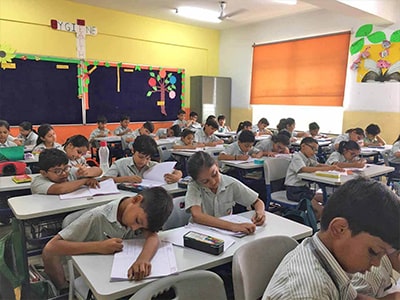
Learn how children’s thinking skills grow and why cognitive development is important for school and life.
Have you ever wondered why some children quickly solve puzzles, ask endless questions, or figure out solutions on their own? These are signs of cognitive development, the way a child’s brain learns to think, understand, and solve problems. Every child’s mind grows every day, and the right experiences at school and at home can make learning exciting and meaningful.
In this blog, we will explore the cognitive development meaning, how children develop thinking skills, and why schools play a key role in helping kids grow smarter, more curious, and confident learners. Understanding this can help parents guide their children in ways that make learning easier, more fun, and more long-lasting.
What Does Cognitive Development Mean?
Cognitive development is how children learn to think, understand, and solve problems as they grow. It’s not just about memorising facts or doing homework. It’s about how they process information, make decisions, and understand the world around them.
From recognising patterns in numbers to figuring out why a story has a happy ending, children are constantly using their brains to learn new things. This is why understanding the meaning of cognitive development is important; it helps parents, teachers, and students see how thinking skills develop over time.
Every child develops at their own pace, and experiences at school, home, and even while playing contribute to stronger thinking abilities. Activities such as asking questions, exploring, experimenting, and solving simple problems help children develop their brains. This makes them more curious, confident, and better at understanding new ideas.
Stages of Cognitive Development
Children’s thinking and learning abilities grow in stages as their brains develop. Psychologist Jean Piaget described four main stages of cognitive development, showing how children understand the world at different ages. Here’s a simple guide to these stages:
- Sensorimotor Stage (0–2 years)
At this age, babies and toddlers learn mainly by using their senses and moving around. They explore by touching, looking, listening, and moving. They start to realise that objects are still there even when they can’t see them, and they begin to understand that their actions, like shaking a rattle, can create effects, like making noise.
- Preoperational Stage (2–7 years)
At this stage, children begin to think symbolically. They can use words, pictures, and objects to represent ideas. Imaginative play, role-playing, drawing, and storytelling become important ways to learn. Kids also start to see things from others’ perspectives, though they may still struggle with complex logic.
- Concrete Operational Stage (7–11 years)
Children start to think more logically about real-life situations. They can solve problems, understand rules, and compare ideas. Their curiosity increases, and they enjoy experimenting, asking questions, and discussing their thoughts. As their planning and reasoning skills improve, school learning becomes more meaningful.
- Formal Operational Stage (11 years and above)
At this stage, children develop abstract thinking and can reason about hypothetical situations. They can plan ahead, think critically, and consider different possibilities. This stage helps them make decisions, solve problems, and reflect on their own thinking, laying the foundation for independent learning.
Understanding these stages helps parents and teachers give the right support and activities for children at every age, making learning easier and more fun.
Importance of Cognitive Development in Child Growth
Cognitive development plays a key role in a child’s overall growth. Understanding the importance of cognitive development helps parents and educators support children in thinking clearly, solving problems, and understanding new ideas, making learning more enjoyable and effective. When parents and schools support it, children can explore, experiment, and build essential skills that last a lifetime.
Here’s why cognitive development is so important:
- Enhances Learning Ability
Children with strong thinking skills can grasp new concepts faster and apply what they learn in different situations. This makes learning easier and more meaningful, whether in the classroom or during everyday activities.
- Improves Memory and Understanding
Developing cognitive skills helps children remember information better and connect ideas logically. This strengthens their understanding of the lessons and allows them to apply their knowledge in practical ways.
- Strengthens Problem-Solving and Decision-Making
Thinking skills in children begin to develop when they start analysing situations and making decisions. They learn to solve problems step by step, which builds independence and confidence in their abilities.
- Boosts Confidence, Curiosity, and Independent Thinking
Children who develop strong cognitive skills become curious, ask questions, and enjoy exploring new possibilities. This encourages self-reliance and fosters a positive attitude toward learning.
- Supports Academic and Social Growth
Well-developed cognitive skills in students support clear communication, effective collaboration with peers, and active participation in group tasks. This prepares them for both academic success and real-life interactions.
Focusing on child brain development ensures that children are ready to face challenges, think critically, and enjoy learning at every stage. Schools that nurture these skills provide a strong foundation for lifelong growth.
How Schools Support Cognitive Development
Schools provide the right environment and activities to help children develop their thinking and problem-solving skills. With help from teachers, students learn the thinking skills to understand lessons, remember information, and make decisions confidently.
Here are some key ways schools help children’s cognitive growth:
- Engaging Lessons
Teachers use storytelling, questions, and interactive discussions to make learning interesting. When children actively think about ideas, they understand them better and remember them longer.
- Reflection and Self-Assessment
Schools encourage students to reflect on their learning through journals, discussions, or small projects. Thinking about what worked and what didn’t helps children understand their progress and improve their skills.
- Cross-Subject Connections
Teachers show how ideas from different subjects relate to each other. For example, a science experiment may include math calculations or writing observations. This helps children see the bigger picture and improves critical thinking.
Nurturing Young Minds for a Brighter Future
Cognitive development shapes how children think, learn, and solve problems. As children’s thinking skills develop, they become more confident and able to understand new concepts. This growth not only helps them in school but also prepares them for life beyond the classroom.
Schools play a key role in supporting this journey. Modern schools in Ahmedabad, such as Global Indian International School, provide an environment where children can explore ideas, engage in engaging activities, and develop essential cognitive skills. Their schools help children learn and grow through hands-on activities, reflection, and connections across subjects, laying a strong foundation for their future.
With the right guidance at home and at school, children can strengthen their problem-solving, memory, reasoning, and creativity. Supporting cognitive development helps students become independent, lifelong learners who face challenges with confidence and curiosity.
 Ahmedabad Campus










![Global Montessori Programme [GMP]](https://globalindianschool.org/ahmedabad/wp-content/uploads/2023/09/l1.png)