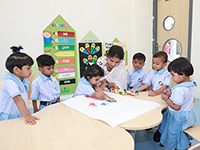
Have you ever watched a child learn to ride a bike? A firm hand will provide support at first. Slowly, it will be removed as the child gets confidence.
That’s exactly how scaffolding in teaching works. It is a method of teaching that introduces concepts to students through step-by-step guidance. As students receive such systematic direction, they become more engaged. Read on to learn all you need to know about scaffolding in education and why it’s a better option for classrooms, especially at institutions among the top schools in Nagpur.
What Is Scaffolding, and Why Does It Matter?
Scaffolding in teaching is a systematic process of guiding students toward understanding complex concepts through step-by-step guidance. This method, developed by psychologist Jerome Bruner, relies on Vygotsky’s Zone of Proximal Development (ZPD) – the space between what an individual can do alone and what they can do with support.
Recent research confirms its power:
- A 2024 study found that adaptive scaffolding (support that adjusts based on student interaction) improved learning speed and reduced cognitive load in game-based environments. (BMC Medical Education)
- Another study (Frontiers in Psychology, 2023) on self-regulated learning scaffolding showed positive effects on academic performance when learners are taught to plan, monitor, and reflect. (Frontiers in Psychology)
How Is Scaffolding Implemented in Classrooms?
Some of the types of scaffolding strategies include:
- Modelling and Demonstration: Teachers model the process before students attempt it.
- Visual Aids: Use of charts, diagrams to help students visualise concepts.
- Questioning: Guided/open-ended questions to make learners think for themselves. Many of the best play schools in Nagpur use such methods to engage young children.
- Chunking Information: Breaking complex topics into smaller, manageable units.
- Peer Learning: Pairing students so they help one another.
Who Benefits Most from Scaffolding?
- Students who struggle with certain topics initially.
- Mixed-ability classes where learners are at different levels.
- Children in early grades and preschools, including when selecting nursery admission, benefit hugely from structured support and gradual release of responsibility.
When Should Scaffolding Be Used and Phased Out?
- Use from early learning stages (preschool, early primary) for new or difficult concepts.
- Gradually reduce support as students gain confidence and competence.
- Particularly helpful during transitions—e.g. from pre-school to school grade levels.
Where Does Scaffolding Work Best?
- In classrooms with diverse learners.
- In schools with strong pedagogy among CBSE schools in Nagpur Maharashtra, where curricula demand understanding, not rote.
- In settings that allow for individual feedback, peer interaction, visual supports.
Why Is Scaffolding Especially Valuable?
- It reduces cognitive overload by presenting information in manageable portions.
- It helps boost student confidence and motivation, as learners see success with support.
- Research (such as that in 2024 and 2023) shows that scaffolding improves learning outcomes, especially for more difficult or unfamiliar tasks.
How Do Teachers Practically Implement Scaffolding?
- Evaluate previous knowledge of students.
- Set clear, measurable learning objectives.
- Build on what students already know, linking to familiar concepts.
- Provide step-by-step instructions, with visual aids.
- Encourage interaction, questioning, peer learning.
- Monitor progress and adjust support levels.
- Give constructive feedback, asking reflective questions.
Final Thoughts
Scaffolding is indeed an essential tool for student success. When implemented properly, it builds confidence, enhances comprehension, and nurtures independence.
If you are exploring school admissions or searching among the top schools in Nagpur for a teaching approach that supports every learner, consider institutions like GIIS Nagpur that incorporate scaffolding and personalised instructional support.
FAQs: Scaffolding in Education & Learning Support at GIIS Nagpur
Who introduced the concept of scaffolding in education?
Jerome Bruner popularised it, building on Vygotsky’s theory of the Zone of Proximal Development (ZPD).
What are examples of scaffolding strategies?
Modelling, visual aids, chunking, questioning, peer learning, guided support.
When should scaffolding be used, and when should support be withdrawn?
It should be used especially when introducing new, difficult concepts and reduced gradually as students master them.
Where is scaffolding most effective?
In early grades, preschools, mixed-ability classrooms, and CBSE schools in Nagpur Maharashtra that follow competency‐based learning or interactive teaching methods.
Why is scaffolding better than direct instruction alone?
Because it supports understanding, motivates learners, reduces failure risk, and builds independence over time.
How does scaffolding tie into nursery admission and early education?
From the time of nursery admission, children benefit from scaffolding (play-based learning, modelling, guided interactions), which lays a foundation for confidence and lifelong learning.
 Nagpur Campus