Kids learn best when they’re having fun. Montessori schools capture this idea effectively. They convert day-to-day activity into compelling exercises in logical thinking and problem-solving. As per stats, such a play-based learning approach can result in a 23% higher knowledge retention rate after six weeks than conventional teaching methods.
But how exactly does this technique form young minds to think logically? Let’s check it out.
What is Montessori play-based learning?
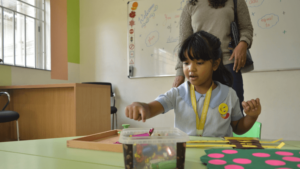
Montessori play-based learning is all about allowing children to learn through activities. Rather than staying in one place with lengthy lectures, children are able to move around, touch, discover, and experiment on their own. Each activity will teach them a skill.
What makes Montessori’s approach so special is that children select what they wish to do. Kids are presented with thoughtfully crafted materials according to their interests. So, children will just love every minute of learning.
7 Main Montessori Activities That Build Logical Thinking

1. Practical Life Activities
Students will be encouraged to engage in daily activities such as pouring water, tying shoelaces, spooning beans, buttoning shirts, etc. At first glance, they appear to be ordinary chores. But here’s what’s going on in a child’s brain:
- Step-by-step actions improve their order and memory power.
- Hand-eye coordination and fine motor skills become sharper. Both of them are associated with improved cognitive development.
2. Sensorial Materials
Montessori sensorial material is meant to define and refine the five senses. Children will compare and sort them out, which improves their logical thinking skills. Soon, they will start recognizing patterns. All these lay the foundation for understanding abstract concepts later.
3. Mathematics with Montessori Materials
The Montessori curriculum follows a hands-on approach to teaching mathematics. Children work with number rods, spindle boxes, golden beads, bead chains, and so on. They will be able to view and touch numbers through such material.
It’s education through play, but with deeply embedded math principles. Kids will develop numerical logic and basic problem-solving skills.
4. Puzzle Maps
Montessori puzzle maps are really helpful in building visual memory and logical classification. Kids will learn to match puzzle pieces as per shape and size. They may also group regions by colour. That helps them understand the geographical relationship of how countries link up, how rivers flow, and so on.
5. Sorting and Categorizing Games
Children are taught to sort buttons by color and size. It improves their reasoning skills. Gradually, kids will have the ability to spot even small differences and similarities. Such play-based learning techniques have a significant influence on early brain development.

6. Science and Nature Discovery
Montessori does not teach science as a distinct subject. It is integrated into daily play and learning activities. Children are presented with actual materials such as leaves, stones, magnifying glasses, water trays, soil, etc. They are asked to observe and experiment with them.
Such natural learning creates curiosity in young minds. That’s why our GIIS Noida curriculum focuses on science-oriented activities. Our main aim is to create lifelong learners who can think and explore confidently.
7. Story Sequencing
Kids will also work with story sequencing cards—sets of images that tell a brief story when placed in the correct order. That strengthens the brain’s capacity to think in sequence and solve problems in everyday life.
Also Read: Developing Care for the Environment: Practices for Sustainability in Schools
How Play-Based Learning Improves Logical Reasoning?
On the surface, a kid sorting colored beads or constructing a block tower may seem like plain old play. But in fact, they’re developing important neural pathways in their brain. It provides their brain with the freedom to wonder, “What if I do this?” or “How can I get this to fit?”
That type of education through play is at the core of the Montessori curriculum. Kids learn from hands-on materials that are structured to develop logic naturally. These activities aren’t arbitrary; they’re thoughtfully selected to engage both creative and logical sides of the brain.
That’s why a lot of Montessori schools in Noida focus on a balance between freedom and structure. It allows them to think for themselves, make choices, and learn patterns without even knowing they’re doing it.
Benefits of Logical Thinking Through Montessori
- Enables children to problem-solve independently.
- Improves memory and concentration through sequential steps of activities.
- Kids develop improved pattern recognition and difference-spotting skills.
- Increases confidence as they finish tasks and work things out for themselves.
- Play-based learning helps them think up new solutions to everyday problems.
- Promotes tranquil thinking, even if things don’t work out as expected.
Conclusion
The early years are perhaps the most crucial period for children. Building a positive learning environment is required for their proper academic and social development. When children are allowed to experiment through play and learning techniques, they automatically pick up essential life skills.
At GIIS Noida, we live by this philosophy to the fullest. Our thoughtfully planned learning and play areas allow children to learn about logic organically. After all, why choose between fun and knowledge when they can have both?
FAQs:
How does Montessori help kids think smart and solve problems?
At GIIS Noida, Montessori encourages independent thinking through hands-on activities. Kids learn to identify patterns, make decisions, and solve real-world problems confidently.
What is fun play learning in Montessori style?
It means exploring stories, puzzles, and science activities that feel like games. At our International Montessori Kindergarten, fun and learning go hand in hand.
What age is best for Montessori learning?
The Global Montessori program at GIIS Noida is ideal for ages 2 to 6, when kids are naturally curious, energetic, and ready to explore.
How is Montessori learning different from regular preschool?
Our Montessori curriculum allows freedom of choice and hands-on discovery, unlike traditional setups that rely on fixed routines and passive instruction.
How does Montessori build brain power in young children?
At GIIS Noida, early playschool admission gives children access to sensorial tools and logical games that boost memory, sequencing, and cognitive development.
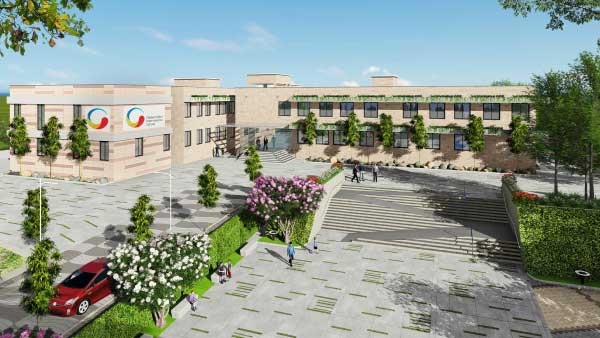
 Noida Campus