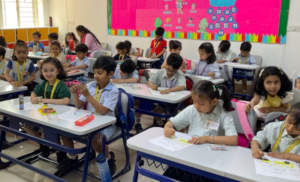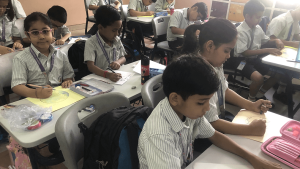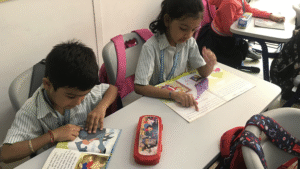
Nursery, LKG and UKG describe three common stages before Grade 1, though schools may use different names for them. Nursery, LKG, and UKG each mark an important stage in a child’s early education, building on the skills developed in the previous stage. Nursery supports a child in adjusting to school routines, basic concepts through play, and social interaction. LKG focuses on communication, early literacy, and numeracy, while UKG strengthens the skills and prepares a child for Grade 1. The LKG and UKG ages may differ between schools based on their age cut-off dates and admission criteria. At GIIS Noida, the corresponding early-years levels are called Nursery, K1 and K2.
Defining Nursery, LKG, and UKG
Generally, these are the three early-years stages in a child’s life before Grade 1. Though the exact curriculum varies between schools, learning gradually becomes more structured as a child progresses through every stage.
Nursery: The Child Gets Comfortable with School
Often, nursery is the first formal school experience of a child. The focus is to help a child comfortably adjust to the classroom while building motor, communication, and social skills.
A child may learn through the following:
- Songs, stories, and rhymes
- Basic numbers, colours, and shapes
- Creative activities and drawing
- Taking turns and sharing
- Classroom routines and basic hygiene
- Following simple instructions
The nursery vs LKG difference is chiefly the level of structure. Nursery places particular emphasis on settling in, play and exploration.
LKG: Building a Child’s Foundations
Lower Kindergarten (LKG) builds on these experiences through play, conversation, stories and hands-on activities.
A child may begin to:
- Complete simple tasks and follow instructions
- Recognise sounds and letters
- Build vocabulary
- Practice pre-writing skills
- Identify sequences and patterns
- Count and recognise numbers
Therefore, LKG builds the foundation for more developed skills taught in UKG.
UKG: Preparing Your Child for Grade 1
Upper Kindergarten, or UKG, usually strengthens the skills a child has built in Nursery and LKG.
Learning may include the following:
- Independent classroom tasks
- Reading simple words
- Basic mathematical concepts
- Listening and comprehension
- Problem-solving
- Writing short words and letters
- Communication and vocabulary
The goal is to encourage a child to develop enough confidence to join Grade 1 rather than forcing him into advanced learning too early.
Nursery versus LKG versus UKG: A Quick Comparison
| Stage | Key Focus | Learning |
|---|---|---|
| Nursery | Adjustment and exploration | Social skills, language, basic concepts |
| LKG | Foundation building | Pre-writing, numbers, sounds, letters |
| UKG | Building confidence for Grade 1 | Independence, numeracy, writing, early reading |
Each stage builds on earlier experiences, with time for children to revisit skills as they grow.
What Are the Usual Ages for Nursery, LKG and UKG?
As a general guide, Nursery often serves children around 3–4, LKG around 4–5 and UKG around 5–6 years old. These are broad age bands, not universal admission rules. Schools may use different class names and apply an age cut-off on a particular date.
GIIS Noida calls its early-years levels Nursery, K1 and K2. Its published pages currently give different age thresholds, so parents should share their child’s date of birth with admissions and confirm the eligible class and cut-off for the intended academic year before applying.
Early Years Stages in India
Normally, the early years stages in India go through a progression from play-based exploration to foundational academic learning.
Nursery children are taught how to interact with others and become a part of classroom activities. In LKG, they learn more about the alphabet, numbers, and sounds. In UKG, they develop such skills through writing, problem-solving activities, and early reading.
Development of social-emotional skills is important in all three phases.
What Should Parents Look for in an Early-Years Programme?
Look beyond the class name. Ask how children learn through play, stories, movement and hands-on activities. Notice whether teachers encourage conversation, curiosity, friendships and growing independence. Also ask how they support children who are new to school and keep families informed.
The right stage depends on the school’s age criteria and your child’s experience. It should not be decided by whether a child can already read or write.
How Children’s Skills Develop Across the Stages
The skills a child develops become more structured as they transition from Nursery to LKG and UKG. Every stage builds on the earlier stage while supporting age-appropriate emotional, academic, and social growth.
- Nursery: Focus on curiosity, motor skills, and social interaction through group learning, creative activities, stories, and play.
- LKG: Develop communication, counting, and alphabet recognition, while learning to complete tasks and follow instructions.
- UKG: Strengthen problem-solving, reading, and basic arithmetic, with greater focus on school readiness and independence.
Explore the Early Years at GIIS Noida
GIIS Noida offers the Global Montessori Plus (GMP) programme across Nursery, K1 and K2. It brings Montessori principles together with activities supporting language, numeracy, creativity, values and emotional development. The school also describes 9GEMS as part of its wider approach to learning. GIIS
During a campus tour, ask to see the spaces your child would use and discuss the daily routine, communication with parents, safety procedures and the move into Grade 1. Confirm the current age criteria with the admissions team.
FAQs
What is the actual difference between nursery, lower kindergarten, and upper kindergarten?
Nursery supports a child in adjusting to school routines, basic concepts through play, and social interaction. LKG focuses on communication, early literacy, and numeracy, while UKG strengthens the skills and prepares a child for Grade 1.
What is the standard LKG and UKG age?
Generally, 3.5-4.5 years is the usual age for LKG, and 4.5-5.5 years is for UKG. The exact age criteria differ by school.
Is nursery compulsory for a child before enrolling in LKG?
Nursery is not necessarily compulsory for a child before enrolling in LKG. A few schools allow direct admission to lower kindergarten if the child meets their specific admission requirements and age.
What does a child usually learn in UKG?
In UKG, a child usually develops early reading, problem-solving skills, writing, comprehension, communication, and numeracy.
How should parents and guardians select the right stage for their child?
They should consider factors such as the child’s age, developmental readiness, the school’s admission criteria, curriculum, and previous preschool experience.
 Noida Campus