 Start your child’s journey to success.
Early childhood education lays the foundation for a child’s future academic success and personal development. When it comes to choosing a preschool, parents often find themselves confused between different educational institutions.
Two prominent approaches are Montessori vs. Traditional Preschool. Each has its unique methods and beliefs about how children learn and grow.
In this article, we will explore the fundamental aspects of Montessori and traditional preschool education, highlighting key differences and the respective benefits they offer.
Understanding Montessori Education
Maria Montessori was an Italian physician and educator who founded the Montessori method in the early 20th century. The philosophy she founded revolves around the belief that children are naturally curious and capable of self-directed learning.
In a Montessori classroom, the environment is carefully designed to foster independence and exploration. Teachers are often referred to as guides at the best kindergarten school in Noida, along with Montessori. Their priority involves facilitating rather than leading the learning process.
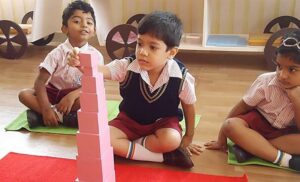
The Montessori classroom is characterized by mixed-age groups that allow children to learn from one another. Learning materials are hands-on and designed to engage children in a sensory and interactive manner. The emphasis is on individual progress, with children encouraged to choose activities that align with their interests and developmental readiness.
Traditional Preschool Education
On the other hand, when the talk is about traditional preschool education, it is understood that it follows a more conventional and structured approach. It often involves instruction led by teachers.
In this approach, the educators guide students through a predetermined curriculum. The classrooms are typically organized by age, and the focus is on group activities and uniform progress.
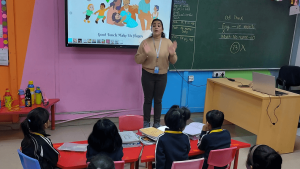
In a traditional preschool, the teacher plays a central role in directing the learning experience. The curriculum is often standardized and covers a range of subjects and skills deemed appropriate for a specific age group.
The main objective is to prepare children for formal schooling by instilling a set of foundational knowledge and skills.

Key Differences Between Montessori and Traditional Preschools
Understanding the key differences between these two approaches is crucial for parents seeking the best fit for their child’s developmental needs.
1. Age Groups: Montessori’s Community vs. Traditional Progression
In Montessori classrooms, one of the defining features is the presence of mixed-age groups. This intentional blending of age ranges inculcates a sense of community where younger children learn from older peers, and older ones reinforce their knowledge by helping younger counterparts.
On the flip side, traditional preschools typically organize children strictly by age. It adheres to a structured progression. While this approach simplifies administrative aspects, it may limit the natural mentorship and cooperative learning opportunities that mixed-age settings in Montessori environments offer.
2. Classroom Setup: Inviting Exploration vs. Conventional Spaces
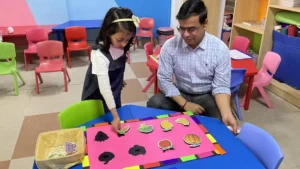
Montessori classrooms are meticulously designed to be open, inviting, and conducive to exploration. The environment is carefully curated, with various learning materials strategically placed to encourage children’s engagement. These materials are often hands-on, promoting sensory and experiential learning.
Conversely, traditional preschool classrooms often follow a more conventional setup. Desks or tables may be arranged in rows, with each child having their own designated space.
3. Teachers’ Role: Guides vs. Directors
In the Montessori approach, teachers are viewed as guides rather than directors. They observe and support children’s individual learning journeys. Their job is also to assist when needed, which allows students to take the lead.
In contrast, traditional preschool teachers typically play a more directive role, leading the class through planned activities. The teacher acts as the primary source of knowledge and instruction to guide the entire class collectively.
4. Approach to Learning: Self-Directed vs. Uniform Progression
Montessori Nursery places a strong emphasis on self-directed learning. It assists in recognizing that children thrive when given the autonomy to choose activities based on their interests and developmental readiness.
Conversely, traditional preschools often follow a more uniform approach, with teachers guiding the entire class through a structured curriculum. This approach ensures that all children are exposed to the same set of skills and knowledge within a specified timeframe.
5. Play and Discipline:
Montessori views play as an essential component of learning and considers it a child’s work. Discipline in Montessori is often intrinsic, with children learning through natural consequences. Traditional preschools may have a more explicit approach to discipline that often involves external rewards and consequences.
Benefits of Montessori Education
Montessori education stands out for its highly developed benefits that extend beyond traditional academic achievements. One of its paramount strengths lies in fostering independence and critical thinking skills.
Montessori preschools provide children with the flexibility to select their own activities and learn at their own speed. The flexibility helps them foster a feeling of individuality and self-reliance from an early age.
It is also remarkable how Montessori education affects kids’ social and emotional development. The mixed-age classrooms encourage peer learning that fosters a collaborative spirit and empathy. The emphasis on individual progress over competition contributes to a positive self-image and a love for learning.
Montessori’s effectiveness is evident and can be supported by research findings and numerous anecdotes. Studies suggest that Montessori-educated children often exhibit solid problem-solving abilities and adaptability.
The holistic approach to education informed during school admission form filling integrates academics with practical life skills. This approach positions Montessori as a powerful foundation for a child’s lifelong success, both academically and emotionally.
Benefits of Traditional Preschool Education
Traditional preschool education offers distinct advantages. It is prominently marked by structured routines and learning guided by teachers. The consistent schedule and clear expectations provide children with a sense of security. This aids in the development of organizational and time-management skills.
Furthermore, traditional preschools excel at fostering socialization and preparing children for the collaborative nature of formal schooling. Regular group activities and interactions with peers contribute to the development of essential social skills, including teamwork and communication.
In certain situations, traditional preschools may be more suitable, especially for children who thrive in a predictable environment. For those who benefit from clear instructional guidance, the teacher-led approach ensures foundational knowledge and skill acquisition.
In essence, traditional preschools play a vital role in preparing children for structured educational systems. They will encounter it later, which will help balance social development with foundational academic skills.
Conclusion
At the time of decision, there are a lot of things that determine whether a family chooses traditional preschool education or Global Montessori school. For starters, it can be the values of the family and the child’s requirements. Being a parent, you also need to consider the intended educational goals that will ultimately form their educational path.
Whether opting for a Montessori school like Global Montessori Plus or a traditional preschool, the key is understanding the unique aspects of each approach to make an informed decision tailored to a child’s needs. While typical preschools offer a more disciplined approach, Montessori promotes independence and customized learning.
Connect with GIIS, a well-known international school, to prepare children for the demands of academic life. Knowing the distinct advantages of every Montessori philosophy enables parents to make well-informed choices. Contact our website to learn how we complement your child’s developmental requirements and learning style.
Frequently Asked Questions
1. What is the difference between traditional and Montessori preschools?
The primary differences lie in the classroom setup and teaching approach. Even the role of teachers may have a vast difference. Montessori emphasizes self-directed learning in mixed-age groups, while traditional preschools follow a structured curriculum with age-specific classrooms.
2. What are the benefits and key concepts of Montessori education?
Montessori education promotes independence and critical thinking. The approach tends to instill social-emotional development. Key concepts include mixed-age classrooms with hands-on learning materials. The vital concept also involves a teacher-guided but child-directed approach.
3. What are the 3 most important principles of Montessori education?
Montessori education is all about self-directed learning and a free approach. This approach helps children choose the direction that will help them enhance their intellectual levels.
The three key principles start with mixed-age classrooms. Its second belief is self-directed learning, which kids develop on their own with guidance. The last point is a carefully prepared environment that encourages exploration and independence.
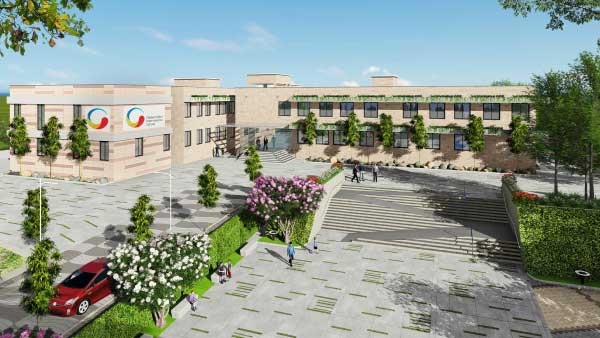
 Noida Campus