 Start your child’s journey to success.
 A good vocabulary is no less than a treasure for kids. During the early years of learning, young learners between 3 to 8 years should be encouraged to learn opposite words to develop connections and share their thoughts more clearly.
Many best CBSE schools in Varthur, Bangalore ensure the collective contribution of parents and teachers to encourage students to understand opposite learn words.
Understanding opposite words is an essential part to explore and understand the English language. Opposite words also makes the language more fun, interesting and expressive.
Research shows that by age 5, children have an expressive vocabulary of around 2,100–2,200 words and a receptive vocabulary of 20,000–24,000 words (Wikipedia – Vocabulary Development). This highlights why introducing antonyms early supports language growth.
What are Opposite Words?
Opposite words often known as antonyms are words having contrasting meanings. For example, the word hot is the opposite of the word cold.
Learning opposite words develops their vocabulary with a deeper understanding of the language. Besides enhancing their language skills, it also helps the students to have effective communication skills. This also gives the freedom to the students to express their thoughts while connecting with others.
The use of colourful charts and images can make the learning experience engaging for the children. Use charts with images that depict the meaning of the words to visually reinforce the concepts.
Benefits of Learning Opposites
The opposite word of learn in English ensures various benefits like:
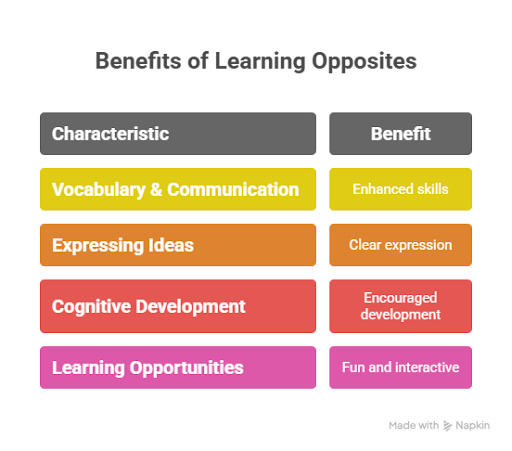
Enhances Vocabulary and Communication Skills:
Learning and understanding the opposite words helps students enhance their vocabulary and communication skills. It helps them to communicate with others and present their opinions using the right words. It helps them to share their thoughts and opinions in personal and social contexts.
📊 A 2022 study by the American Speech-Language-Hearing Association found that children who practice antonyms regularly demonstrate 37% better word-retrieval and communication clarity compared to peers who don’t (ASHA.org).
Helps Children Express Ideas Clearly:
Opposite words are also helpful for children to express their thoughts, ideas, and feelings clearly without any hesitation. As they understand the meaning of the words, they can easily and accurately describe their emotions. This prevents any confusion and hesitation in children as they express themselves.
Encourages Cognitive Development:
By understanding the opposite words, children ensure cognitive development using word associations. This helps them to engage in critical thinking to connect ideas, perceptions, and concepts. This enhances their ability to analyse, understand and categorise information for academic and personal success.
According to a 2023 child development report, learning antonyms improves categorization and problem-solving skills, boosting cognitive flexibility by 28% in children aged 4–7 (OSSPEAC).
Fun and Interactive Learning Opportunities:
Using games and exercises to support opposite words learn brings engaging learning opportunities. It engages the students to understand, learn, and implement the opposite words correctly. These enjoyable and interactive exercises reinforce the understanding and use of opposite words. By using the fun elements, children can be encouraged to dynamically explore the language.
Top 100 Opposite Words for Kids
Basic Opposites
- Hot – Cold
- Up – Down
- Big – Small
- Fast – Slow
- Light – Dark
- Open – Close
- Hard – Soft
- Near – Far
- High – Low
- Old – New
Opposites Related to Emotions
- Happy – Sad
- Angry – Calm
- Excited – Bored
- Brave – Scared
- Laughing – Crying
- Friendly – Unfriendly
- Proud – Ashamed
- Easy – Difficult
- Cheerful – Gloomy
- Confident – Nervous
Advanced Opposites
- Public – Private
- Polite – Rude
- Success – Failure
- Love – Hate
- Rich – Poor
- Safe – Dangerous
- Honest – Dishonest
- Useful – Useless
- Mature – Immature
- Strong – Weak
Opposite in Verbs
- Push – Pull
- Give – Take
- Come – Go
- Enter – Exit
- Buy – Sell
- Build – Destroy
- Start – Finish
- Win – Lose
- Love – Hate
- Break – Fix
Nature and Environment
- Wet – Dry
- Warm – Cool
- Sunny – Cloudy
- Light – Heavy
- Clean – Dirty
- Fresh – Stale
- Smooth – Rough
- Soft – Hard
- Bright – Dull
- Clear – Foggy
Everyday Life
- Day – Night
- Before – After
- Always – Never
- Front – Back
- Early – Late
- Inside – Outside
- Right – Wrong
- Strong – Weak
- Happy – Sad
- Start – Stop
Food and Drink
- Sweet – Sour
- Bitter – Sweet
- Hot – Cold
- Full – Empty
- Fresh – Rotten
- Cooked – Raw
- Thick – Thin
- Soft – Hard
- Smooth – Chunky
- Delicious – Disgusting
Miscellaneous
- Male – Female
- Yes – No
- True – False
- Success – Failure
- Present – Absent
- Together – Apart
- Adult – Child
- Import – Export
- Agree – Disagree
- Follow – Lead
Fun and Games
- Win – Lose
- Start – Finish
- Play – Rest
- Join – Leave
- Show – Hide
- Build – Break
- Love – Hate
- Dance – Sit
- Share – Keep
- Help – Hinder
Final Set
- Fast – Slow
- Simple – Complex
- Tight – Loose
- Healthy – Unhealthy
- Calm – Excited
- Quiet – Loud
- Normal – Weird
- Clear – Cloudy
- Bright – Dim
- Tired – Energetic

Interactive Opposite Word Games and Activities
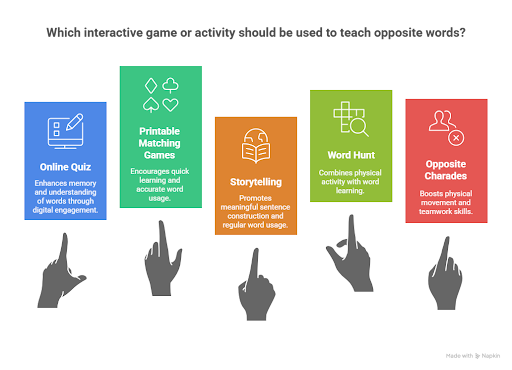
To make opposite learn words engaging, word games and activities are the best way. It not only engages the children but also helps them to enhance their vocabulary and understanding. Moreover, these games boost physical movements along with memory retention.
Here are some of the interesting games and activities ideas that can be tried to teach children opposite words:
Online Quiz:
This can be a simple yet engaging way to help your child learn opposite words. Try online quizzes to test student’s knowledge of opposite words. This will also help in improving their memory, knowledge and understanding of different words.
Printable Matching Games:
Use different games to encourage children to match the opposite words with their meaning based on their understanding. This will help them to quickly learn different words with their accurate use in day to day use.
Storytelling:
Storytelling can be one interesting way to encourage children to learn and understand opposite words. Teachers and parents should encourage children to make meaningful sentences using opposite words. Motivate them to use opposite words in regular conversation to keep them familiar with the words.
Word Hunt:
Word hunt can also be a fun game to motivate students to understand a word and then find its opposite word in a hunt. Besides helping to learn opposite words, this game is also beneficial for their physical mobility and flexibility. If your children are into sports, this game will surely be a treat for them.
Opposite Charades:
This simple game ensures to boost physical movements and memory retention in the children. In this game, one participant acts out the words while the others guess the opposite. This also develops teamwork skills in the children for their future success.
Tips for Parents and Teachers
- Encourage the use of opposite words in daily conversations to help kids understand their meaning and use.
- Use stories and daily experiences including opposite words to engage kids.
- Ensure regular revisions of opposite words to make kids familiar with them.
- Try interactive games, apps and resources to support opposite words learn in kids.
- Incorporate poems, songs and rhymes that include opposite words for better understanding.
- Use flashcards, picture books and other visual aids to reinforce understanding and retention of opposite words by creating visual associations.
- Motivate kids to use opposite words in creative sentences to enhance their understanding and communication skills.
- Encourage kids to role play different opposite words like being happy and sad, angry and calm, etc.
Conclusion
The early introduction of students with opposite learning words ensures their holistic development. It helps the students become comfortable and familiar with the opposite words and their use in day-to-day life. To learn opposite words not only enhances the verbal skills of the students, but also benefits them in their higher studies by building a strong educational foundation.
GIIS is one of the best IGCSE schools in Bangalore that helps students to understand the opposite words using fun and engaging resources. Learning the opposite words supports the overall communication skills of the children to help them become global future leaders.
Studies show that children with strong vocabulary skills by age 7 are four times more likely to have above-average literacy performance by age 11 (Institute of Education, University College London).
FAQs
What is the purpose of teaching opposite words to children?
Opposite words strengthen vocabulary and improve language understanding.
How are opposite words categorized in the blog?
Categories include Basic, Emotions, Verbs, Nature, Food, and Daily Life opposites.
Can you give some examples?
Hot–Cold, Happy–Sad, Push–Pull, Clean–Dirty, Sweet–Sour.
What methods are suggested for teaching opposites?
It is suggested to use games and interactive activities such as flashcards and storytelling.
Where can I find the full list of 100 opposite words?
This list is given at the end of the blog – you simply have to access the full list by scrolling through the blog.
 Whitefield Campus
 Bannerghatta Campus