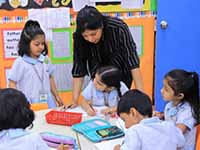
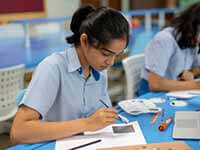
At international schools in Singapore, future-ready skills are built into everyday lessons rather than added later. Children learn to think critically because classes ask them to investigate, not just recall. They learn to lead because they’re given real responsibility, whether in a club, an event or a community project.
Emotional intelligence develops the same way. It grows when a school pays attention to how students feel and acts on what it finds.
Global Indian International School (GIIS) in Singapore shows how this works in practice. Its approach combines IB, Cambridge and CBSE curricula with a holistic framework called 9GEMS.
A Brief Look into Future-ready Skills:
| Skill | How schools teach it | The GIIS Singapore Benefit |
| Critical thinking | Inquiry-led units, open-ended questions | IB PYP, Cambridge Lower Secondary |
| Problem solving | Lab work, project-based tasks | 40+ skill-based labs |
| Leadership | Student roles, clubs, service | 9GEMS 框架 |
| Emotional intelligence | Reflection, teacher mentoring and practising empathy. | 幸福指数 |
| Adaptability | Multiple curricula, global exposure | IB, IGCSE, CBSE pathways |
What Are Future-Ready Skills?
Future-ready skills are the abilities a student needs beyond subject knowledge. They include analytical thinking, collaboration, communication, self-awareness and the habit of learning new things independently.
These skills help students apply classroom knowledge, solve problems and prepare for further study and work
How Do Most International Schools Teach These Skills?
The mechanism is fairly consistent across many reputable schools:
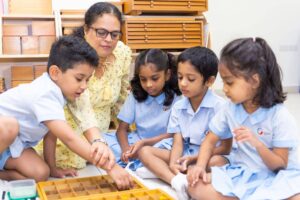
- Inquiry builds on subject knowledge: Students investigate a question before receiving the answer.
- Learning becomes more challenging as students progress: Cambridge Lower Secondary Programme leads into IGCSE at Grades 9 and 10. Students can progress to the IB Diploma Programme in Grades 11 and 12.
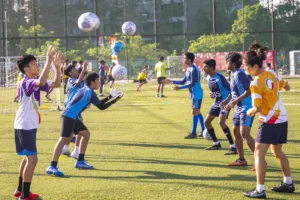
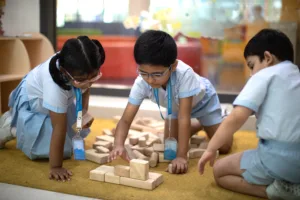
- Practice happens in real settings: Labs, clubs, performances and community projects give students something to apply their thinking to.
- Progress is measured beyond marks: Schools track participation, well-being and personal growth alongside grades.
What Does This Look Like at GIIS Singapore?
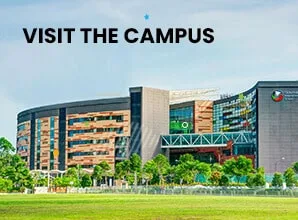
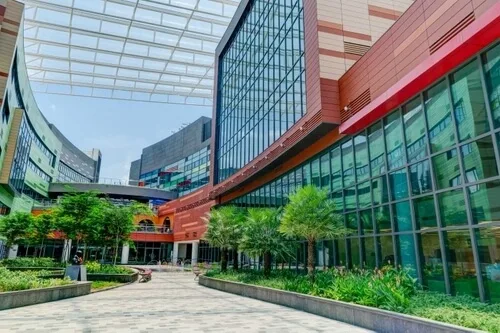
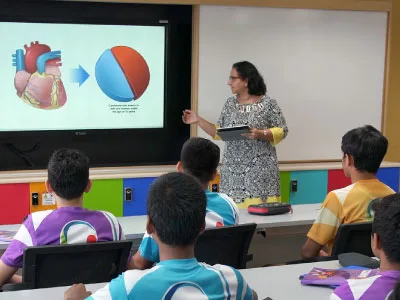
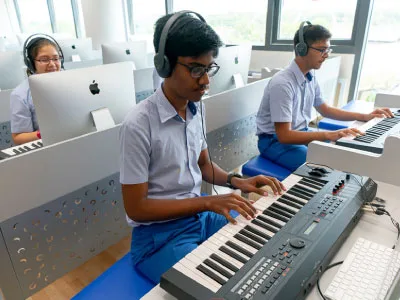
The GIIS SMART Campus sits on 10 acres in Punggol. It has 92 SMART classrooms and more than 40 skill-based labs. Each student takes at least one after-school activity and co-curricular clubs run inside the school day.
According to GIIS, the 2025 IBDP school average was 37.4 points, and three students scored a maximum of 45. The school reports that over 400 graduates have secured places at QS top-20 universities in the last five years, with counselling starting in Grade 9. Founded in 2002, GIIS is part of the Global Schools Group, which has 64 campuses across 11 countries.
Final Thoughts: What Should Parents Check Before Choosing an International School in Singapore?
Ask these questions on a campus tour:
- How is critical thinking assessed?
- Do students lead anything, such as clubs, events or service projects?
- Is there a way to ascertain a student’s well-being?
- Is the school registered and quality-certified? Look for private education registration and EduTrust certification, a government quality assurance scheme run by SkillsFuture Singapore.
Book a campus tour at GIIS in Singapore to explore the learning environment and speak with an admissions counsellor.

GIIS 团队
Team GIIS is a group of enthusiastic writers who bring the vibrant world of GIIS in Singapore to life through engaging blog posts. Dedicated to highlighting the school’s teaching methodology, innovative learning environment, and diverse curriculum options like IB, Cambridge and CBSE, they aim to connect with parents, educators and students, sharing insights and stories that inspire and inform the school community.