Key Takeaways
- Experiential learning means learning by doing, reflecting and applying, not just memorising.
- UAE schools are prioritising hands-on learning, backed by strong national education participation rates.
- It builds understanding, problem-solving, confidence, collaboration and communication in your child.
- It shows up across labs, field trips, projects, presentations and internships, not just one activity.
- It also gives your child early clarity on their interests and strengths.
- CBSE schools in Abu Dhabi, including GIIS Abu Dhabi, build this into daily school life.
Introduction
Sit your child down with a textbook, and they might memorise a concept just long enough for a test. Take them into a lab, a garden or a real project, and something different happens. They understand it, and they remember it. This is the simple power behind experiential learning.
In this blog, we look at what experiential learning really means, why schools across the UAE are leaning into it, and how it shapes your child’s growth at a CBSE school in Abu Dhabi.
What Is Experiential Learning?
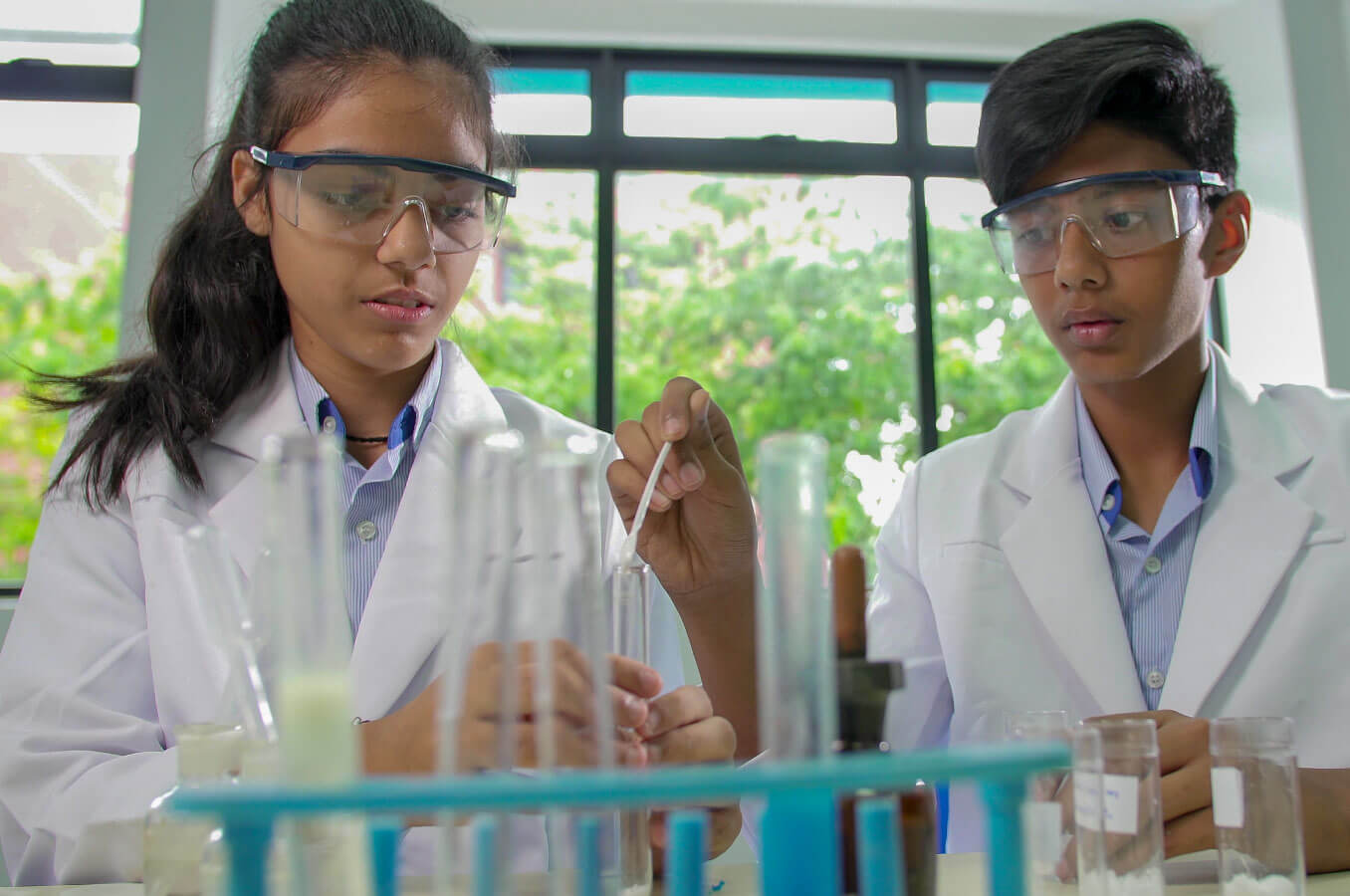
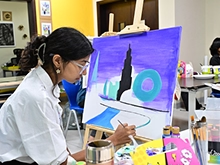
Experiential learning is learning by doing. Instead of only listening to a lesson, your child works through it. They run the experiment, build the model, join the debate or take part in the field trip.
The idea follows a simple loop. Your child does something, reflects on what happened, draws a lesson from it, and then applies that lesson the next time. Over time, this loop builds understanding that lasts far longer than rote memory ever does.
Think of the difference between reading about photosynthesis and growing a plant from seed. Both teach the same concept, but only one lets your child watch it happen, ask questions along the way and remember the answer without needing to revise it the night before an exam.
Why Are UAE Schools Embracing Experiential Learning?
This shift is not happening by chance. Schools across the UAE are actively moving away from purely textbook teaching.
A UNESCO report on UAE education notes that the participation rate in general education has reached 99 per cent in recent years, reflecting steady national investment in stronger learning outcomes. Alongside this, UAE education coverage has highlighted how schools nationwide are prioritising hands-on, experiential activities, from lab work and field trips to internships and guest speaker sessions, to help students lead their own learning.
Even at the policy level, the UAE Ministry of Education has trained thousands of educators ahead of the new academic year with a strong focus on experiential, peer-to-peer training methods, reinforcing that this approach now sits at the centre of how the country wants children to learn.
For you as a parent, this means your child is growing up in a system that actively values curiosity and application, not just recall. Schools are investing in teacher training, infrastructure, and partnerships so this way of learning becomes part of the daily routine, rather than a once-a-term event.
How Does Experiential Learning Benefit Your Child?
The advantages go well beyond a single lesson. Here is what it builds over time:
- Deeper understanding. Concepts learned through practice tend to stick, rather than fading after an exam.
- Stronger problem-solving. Real projects rarely go as planned, and your child learns to adapt and find solutions.
- Greater confidence. Completing a hands-on task builds a sense of achievement that a worksheet cannot match.
- Better collaboration. Group projects and field activities teach your child to work well with others.
- Early career clarity. Exposure to real scenarios helps your child discover what genuinely interests them, long before they have to choose a stream or career.
- Sharper communication. Presenting projects, pitching ideas or explaining findings builds confidence in speaking up, a skill that carries well beyond school.
Where Does Experiential Learning Happen at School?
It is not confined to one classroom or one subject. Here is what it can look like across a typical school week:
| Activity | What Your Child Gains |
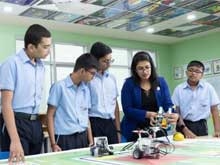
| Science labs and experiments | Hands-on understanding of theory |
| Field trips and site visits | Real-world context for classroom topics |
| Innovation and research projects | Independent thinking and research skills |
| Group presentations and debates | Confidence and clear communication |
| Internships and mentorship | Early exposure to careers and workplaces |
Traditional Learning Versus Experiential Learning
| Traditional Learning | Experiential Learning |
| Focused on textbooks and notes | Focused on activities and real tasks |
| Knowledge is often memorised | Knowledge is applied and tested |
| Assessment through written exams | Assessment through projects and outcomes |
| Limited scope for exploration | Encourages curiosity and choice |
How Do CBSE Schools in Abu Dhabi Bring This to Life?
The best CBSE schools in Abu Dhabi weave it into everyday school life through labs, innovation challenges, community projects and mentorship.
GIIS Abu Dhabi is a good example of this in practice. As one of the top Indian schools in Abu Dhabi, it runs its own holistic education framework alongside the CBSE curriculum, covering entrepreneurship, innovation and leadership through hands-on programmes rather than theory alone.
Students take part in innovation and research competitions, inter-campus challenges and a dedicated centre for innovation and entrepreneurship. Leadership talks, community projects and enrichment programmes add further real-world exposure outside the regular timetable.
These experiences work alongside tools like career mapping and psychometric assessment, giving your child both the practical exposure and the self-awareness to make informed choices later on. Together, they help your child move from simply knowing a subject to genuinely understanding where their strengths lie.
If this is the kind of learning environment you want for your child, admission open in Abu Dhabi schools at GIIS Abu Dhabi right now, and our admissions team would be glad to guide you through it.
Conclusion
Learning by doing is not a passing trend. It is how children build real understanding, confidence and clarity about who they are. For your child, that means an education that goes beyond marks and prepares them for what comes next, in the classroom and well outside it.
Want to see how GIIS Abu Dhabi brings experiential learning into everyday classrooms? Reach out to our admissions team today. We would be happy to show you around and answer your questions.
Frequently Asked Questions
1. What age is right to start experiential learning?
There is no fixed age. Simple hands-on activities can begin from the early years, with complexity increasing as your child grows.
2. Does experiential learning replace regular CBSE lessons?
No. It works alongside the CBSE curriculum, helping your child apply what they learn in the classroom to real situations.
3. Can experiential learning improve exam results?
Yes, indirectly. Since concepts are understood more deeply, your child often finds it easier to recall and apply them in exams.
4. How can I tell if a school offers genuine experiential learning?
Look for regular labs, field trips, projects, competitions and mentorship, not just occasional one-off events.
5. Is experiential learning suitable for every child?
Yes. It can be adapted to different learning styles and paces, so every child engages with it in a way that works for them.