Children learn in ways that are far from passive. Especially in the early years, learning is not just about remembering letters and numbers. It’s about building confidence, curiosity, and self-awareness. That’s where play comes in, not as a side activity, but as the heart of early learning. Many international primary schools in Singapore understand this and have shaped their early childhood programmes around meaningful, play-driven approaches that give children a strong head start.
What is play-based learning?
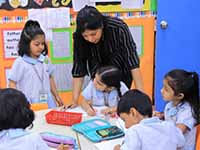
Play-based learning looks simple on the surface. You might see children stacking blocks, dressing up as firefighters, or chatting over pretend tea. However, these experiences are giving young learners a chance to explore, solve problems, work with others, and make sense of their world, all on their terms.
This approach works because children are naturally curious. When given the right environment and gentle guidance, they pick up new ideas while they play. For example, building a tower that keeps falling teaches them about balance and gravity, in addition to an early introduction on how to balance objects. A role-play session as a shopkeeper brings in math, language, and negotiation skills all at once. At Global Indian International School (GIIS), our play-based learning models are centered on educators stepping back, observing, listening, and guiding children in the right direction. The idea is to create a learning modality where the child leads the learning journey.
In well-designed classrooms, teachers plan the play spaces with intention, based on what they’ve noticed about each child. Learning materials are chosen carefully: open-ended items like blocks, books, and sensory tools that offer endless possibilities. That freedom to explore makes children feel in control. It allows them to learn at their own pace, in a way that feels right to them.
Importance of play-based learning in early childhood
The early years of child development are very important because this is when every foundational idea starts to form, including how a child thinks, how they express emotions, and how they connect with others. That’s why the importance of play-based learning can’t be overstated. It lays the groundwork for later academic and personal growth, without pressure, but with a lot of purpose.
Cognitive development through play
Play-based learning helps children build their thinking skills. It’s how they test ideas, understand cause and effect, and learn to stick with a problem until they solve it. That might mean sorting buttons by colour, finding out why a tower keeps falling, or trying different ways to share toys during a group activity. Over time, children begin to solve problems with more confidence, use memory to plan their next steps, and build logical thinking that supports later academics.
Social & emotional development
Through shared activities, children learn what it means to take turns, listen, compromise, and express feelings without hurting others. They also begin to notice the emotions of those around them, what makes others smile, what might make them upset, and how to respond kindly. These early lessons in empathy, cooperation and self-awareness are not easy to teach through traditional instruction.
Physical development
Movement matters just as much as reading or counting at this age. And play supports both fine and large motor skills in a way that feels fun rather than forced. It’s also good for their sense of rhythm and balance, which supports activities like writing and even sitting still in class.
Language development
Play often involves talking, whether it’s explaining the rules of a game, narrating a story, or asking for help. These exchanges build vocabulary, sentence structure, and communication skills. When children describe what they’re doing, they practise putting thoughts into words.
Creativity & imagination
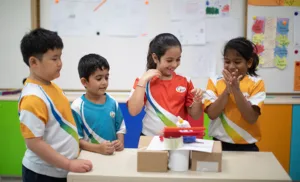
Imagination takes centre stage in play-based learning modalities. It’s where children start creating their own worlds, turning cardboard boxes into spaceships or a pile of cushions into a cave. It helps them look at things differently, come up with new ideas, and express themselves freely.
Benefits of play-based learning
There’s a reason why so many educators and researchers support play-based learning as the most effective way for children to learn in early childhood. That’s important because when children enjoy learning, they want to keep doing it. That mindset carries over as they move into primary school. When you are listing out schools and filling out primary school admission forms, one of the main aspects to check would be, if the school adopts such learning activities. Here are some play-based learning benefits –
- It keeps children engaged. Teachers use this time to notice what interests each child and guide them gently towards new ideas.
- It also allows for different learning styles. One child may enjoy role-play games. Another may prefer quiet storytelling or puzzles. With play-based learning, both can thrive without being pushed into a one-size-fits-all approach.
- Children learn to make decisions, solve problems, and manage their time, even in small ways. They feel ownership over what they’re doing, and that sense of agency boosts confidence.
Role of educators and parents
Teachers play a big role in making play-based learning work. They create the right environment, choose the right materials, and guide children in ways that support learning without interrupting it.
They might watch quietly while a group of children builds a city with blocks. Then, they could ask, “How will cars move through this road?” That question encourages children to think differently without providing them with the answer. It keeps the play going but adds a layer of learning.
At home, parents are also part of the learning process. At GIIS, we encourage parents to understand why play-based learning is important so that they can create similar experiences outside the classroom. It can be as simple as setting aside time each day for pretend play, letting children take the lead during activities, or asking open-ended questions like, “What else could this become?”
The future of play-based learning
In the classrooms, play is no longer seen as extra. In many well-regarded international schools, especially those following the IB Early Years Programme, play is seen as essential. It ties in naturally with inquiry-led learning and student agency, two major pillars of modern teaching.
As digital tools enter early education, the idea of purposeful play is gaining popularity as well. This means play that is fun but also designed with learning outcomes in mind. It still feels free for the child, but the teacher knows exactly what the activity supports, whether that’s literacy, social development, or creative thinking.
Conclusion
Play helps children become confident learners. It teaches them how to think, express, explore, and grow, all in ways that feel natural. When learning feels good, it sticks. We at Global Indian International School (GIIS) believe that play is not a break from learning; it’s where learning begins. Through our inquiry-based, play-driven approach in the IB Early Years Programme, we help young learners build the skills they need for a bright future, starting from their very first classroom.
Play. Learn. Grow.
At GIIS, children learn through play, building curiosity, confidence, and creativity.

Team GIIS
Team GIIS is a group of enthusiastic writers who bring the vibrant world of GIIS in Singapore to life through engaging blog posts. Dedicated to highlighting the school’s teaching methodology, innovative learning environment, and diverse curriculum options like IB, Cambridge and CBSE, they aim to connect with parents, educators and students, sharing insights and stories that inspire and inform the school community.