Global
All Cities
Where would you like to study? Select cities to refine your search.
Any Curriculum
Find a campus based on the curriculum offered.
Global
Global
All Cities
Where would you like to study? Select cities to refine your search.
Any Curriculum
Find a campus based on the curriculum offered.
Search

CBSE vs IGCSE vs IB: Which Curriculum is Right for Your Child in Singapore?

CBSE

Choosing the best curriculum in Singapore is not about finding the “single best” board; it is about finding the right fit for your child’s learning style and your family’s long-term plans. Whether you are considering CBSE vs IGCSE in Singapore schools or looking ahead to the IB Diploma, each pathway offers distinct advantages for different types of learners.

In this guide, we break down the nuances of these three global powerhouses to help you navigate the 2026-27 academic landscape.

Understanding CBSE, IGCSE and IB

Before diving into the whole CBSE vs IGCSE vs IB in Singapore schools, it’s important to understand where these curricula sit in a child’s educational journey:

  • CBSE: A comprehensive K-12 pathway primarily followed by Indian international schools.
  • IGCSE: A mid-secondary qualification (typically Grades 9-10) that often acts as a bridge to pre-university programmes.
  • IB (Diploma Programme): A rigorous two-year pre-university framework (Grades 11-12) focused on holistic development.
  1. CBSE: Alignment and Academic Rigour

For many families in Singapore, the CBSE (Central Board of Secondary Education) is the preferred choice due to its deep alignment with Indian national standards.

  • What it feels like: A structured, content-rich environment where students build a very strong foundation in STEM subjects.
  • Key Strengths: Ideal for students planning to sit for Indian entrance exams (JEE, NEET) or those who may relocate back to India.
  • Assessment: Strong emphasis on standardised board exams in Grades 10 and 12, with a focus on conceptual understanding, application, and disciplined preparation.
  1. Cambridge IGCSE: Flexibility and Subject Choice

The Cambridge IGCSE is often described as the “gold standard” for 14-to-16-year-olds. It is highly flexible, allowing students to mix and match subjects based on their interests.

  • What it feels like: A subject-specific approach where students can dive deep into their passions, whether that is Computer Science, Drama or Additional Mathematics.
  • Key Strengths: It prepares students well for both A-Levels and the IB Diploma by teaching them how to handle a variety of assessment styles.
  • The 2026 Update: With the gradual introduction of digital assessments in some subjects, IGCSE at international schools in Singapore is becoming more interactive, with increasing emphasis on real-world data and application.
  1. The IB Diploma: A Holistic Pre-University Bridge

The International Baccalaureate (IB) is less about “what to learn” and more about “how to think.” In Singapore, IB schools are renowned for producing some of the world’s top scorers.

  • What it feels like: An enriching interdisciplinary two-year journey. Students take six subjects plus the “Core”: Theory of Knowledge (TOK), the Extended Essay (EE), and CAS (Creativity, Activity, Service).
  • Key Strengths: It develops university-level research skills, time management, and a global mindset.
  • Why Parents Choose It: It is one of the most widely recognised qualifications for admission into top-tier global universities in the US, UK, and Australia.
  1. Decision Matrix: CBSE vs IGCSE vs IB

To help you compare and tackle questions like “CBSE or IB which is better?”, use the following table to see how they align with your priorities:

Curriculum Best Suited For Learning Style Assessment Style
CBSE Indian university pathways Structured & content-heavy High-stakes exams
IGCSE Subject exploration & flexibility Clear syllabi & practice Exams + some coursework
IB Global university admissions Inquiry-led & research-based Internal tasks + final exams


  1. Which Pathway Fits Your Child?

Instead of asking which is “better,” ask: “Where will my child stay motivated?” along with the investment of international school fees.

You might lean toward CBSE if:

  • Your child thrives with clear academic boundaries and high-stakes goals.
  • You are targeting professional courses in India.
  • You value a curriculum with a heavy emphasis on core Mathematics and Science content.

You might lean toward IGCSE if:

  • Your child enjoys choosing their own subject combinations.
  • You want a smooth transition into either IB or A-Levels later.
  • Your child prefers having clear, subject-specific frameworks to follow.

You might lean toward the IBDP if:

  • Your child is a curious, independent learner who enjoys writing and reflection.
  • You want a curriculum that doesn’t allow dropping “difficult” subjects like Math or Languages early.
  • You are aiming for a holistic education that values community service and leadership alongside academics.

Frequently Asked Questions

Q: Is IGCSE harder than CBSE?

There is no simple answer. CBSE is often more content-dense, while IGCSE requires more application of knowledge in unfamiliar contexts.

Q: Can a student move from CBSE in Grade 10 to IB in Grade 11?

Yes. While the shift in learning style (from exam-focused to inquiry-focused) can be a jump, many international schools in Singapore offer orientations for smooth transitions to help students adapt.

Q: Which curriculum is most recognised in Singapore?

All three are well recognised. IB and IGCSE are most common in international schools in Singapore, while CBSE is widely followed within the Indian expatriate community.
GIIS Singapore Logo
Team GIIS

Team GIIS is a group of enthusiastic writers who bring the vibrant world of GIIS Singapore to life through engaging blog posts. Dedicated to highlighting the school’s teaching methodology, innovative learning environment, and diverse curriculum options like IB, Cambridge and CBSE, they aim to connect with parents, educators and students, sharing insights and stories that inspire and inform the school community.
Featured Blogs

IGCSE

Where Can You Study Cambridge IGCSE in Singapore? Best Schools, Fees & Admissions

Cambridge IGCSE is offered in Singapore mainly through private international schools, since local MOE schools follow the Singapore-Cambridge GCE syllabus instead. Among the IGCSE schools in Singapore, Global Indian International School (GIIS) Singapore is one of the most established options, offering the Cambridge IGCSE programme for Grades 9 and 10 (ages 14–16) at its SMART Campus in Punggol, with a consistent track record of A* and distinction results.

IGCSE Results

Understanding Your Cambridge IGCSE Results: A Complete Guide to Grades, Grading Scales and What Your Results Mean

Cambridge IGCSE results are graded on a scale from A* (highest) to G (lowest), based on a student's Uniform Mark achieved in each subject. An A* reflects a mark of 90–100%, while a G reflects 20–29%. Grades are issued per subject, not as an overall aggregate and are recognised by universities and employers in more than 160 countries.

GIIS

Mid-Year & Transfer Admissions: Moving Your Child to a Singapore International School (2026)

Relocating to Singapore rarely happens on a school's neat academic calendar. A posting can start in June, a lease can begin in September, a visa can clear in November—and somewhere in between, a child still needs a classroom, a timetable and a group of friends. This is the reality behind expat school admissions mid year in Singapore and it's a far more common situation than most parents expect.

GIIS

Choosing Subjects for IGCSE: A Parent’s Guide to Streams, Options & Future Careers

By age 14, most children have never had to make a decision that shapes their next ten years. Choosing IGCSE subjects is exactly that decision and for parents, it often arrives with more questions than answers. Which subjects matter for university? Does dropping a science close doors? Is a 'safe' combination actually the right one?

Top Scholarships

Dr APJ Abdul Kalam Global Skills Scholarship

Eligibility:

Talent Based - Technology

More from same author
Trending Blogs

IGCSE

Where Can You Study Cambridge IGCSE in Singapore? Best Schools, Fees & Admissions

Cambridge IGCSE is offered in Singapore mainly through private international schools, since local MOE schools follow the Singapore-Cambridge GCE syllabus instead. Among the IGCSE schools in Singapore, Global Indian International School (GIIS) Singapore is one of the most established options, offering the Cambridge IGCSE programme for Grades 9 and 10 (ages 14–16) at its SMART Campus in Punggol, with a consistent track record of A* and distinction results.

IGCSE Results

Understanding Your Cambridge IGCSE Results: A Complete Guide to Grades, Grading Scales and What Your Results Mean

Cambridge IGCSE results are graded on a scale from A* (highest) to G (lowest), based on a student's Uniform Mark achieved in each subject. An A* reflects a mark of 90–100%, while a G reflects 20–29%. Grades are issued per subject, not as an overall aggregate and are recognised by universities and employers in more than 160 countries.

GIIS

Mid-Year & Transfer Admissions: Moving Your Child to a Singapore International School (2026)

Relocating to Singapore rarely happens on a school's neat academic calendar. A posting can start in June, a lease can begin in September, a visa can clear in November—and somewhere in between, a child still needs a classroom, a timetable and a group of friends. This is the reality behind expat school admissions mid year in Singapore and it's a far more common situation than most parents expect.

GIIS

Choosing Subjects for IGCSE: A Parent’s Guide to Streams, Options & Future Careers

By age 14, most children have never had to make a decision that shapes their next ten years. Choosing IGCSE subjects is exactly that decision and for parents, it often arrives with more questions than answers. Which subjects matter for university? Does dropping a science close doors? Is a 'safe' combination actually the right one?

GIIS

Your Child’s Journey to IBDP Success Starts Before Grade 11: A Parent’s Guide

While evaluating the IB Diploma programme in Singapore for their children, parents center the conversation around Grade 11 and 12. It is during these final two high school years that students write their Extended Essays, dive deep into Theory of Knowledge (TOK) and prepare for final examinations.

CBSE Results

IBDP Results 2026: What Parents Should Consider Before Choosing an IB School in Singapore

Choosing the right international school for your child is one of the most critical academic decisions a parent can make. With the release of the May 2026 International Baccalaureate Diploma Programme (IBDP) results, parents across Singapore are evaluating school performance metrics to determine where their child will thrive best.

GIIS

How GIIS Students Achieved Outstanding IBDP Results in 2026: A Look at the Learning Approach

Choosing the right senior secondary curriculum requires more than academic rigour. Students also need an environment that nurtures critical thinking, global perspectives, personal growth, and university readiness. For families evaluating the IB diploma programme in Singapore, the May 2026 International Baccalaureate Diploma Programme (IBDP) examination results offer clear evidence of how structured academic mentoring and personalised pedagogy lead to top-tier university readiness.

GIIS

Moving to Singapore with Children: A Complete School Guide for Expat Families (2026)

Relocating to Singapore is an exciting milestone for any family. Alongside finding a new home, settling into a different culture, and adapting to a new lifestyle, one of the biggest decisions parents face is choosing the right school for their children.

GIIS

Why GIIS SMART Campus Singapore Stands Out as a Future-Ready School

As technology and global careers continue to evolve, parents are looking for future-ready schools that offer more than academics. GIIS SMART Campus Singapore combines academic excellence, global curricula, innovative learning, and holistic development to prepare students for lifelong success.

Search
History Menu Icon

Our vision is to become a global role model for teaching and learning.

History Menu Icon Secondary

Since its inception in 2002, GIIS has spread quality education through 17 campuses across the globe.

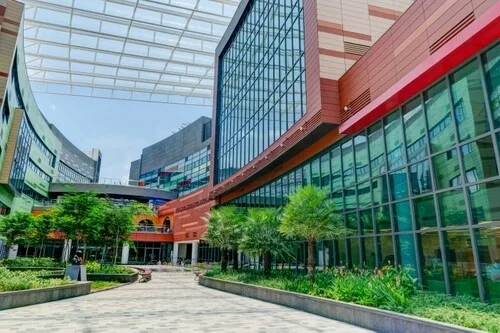
Global Indian International School Singapore smart campus learning environment

SMART Campus

A green, tech-enabled campus with extensive sports facilities that enables a holistic education

  • Kindergarten program at GIIS Singapore smart campus

    Montessori education with a modern touch.

  • Primary school curriculum at GIIS Singapore

    International primary programmes with best holistic learning.

  • Secondary school students learning at GIIS Singapore

    International middle school programmes with best foundation for high school.

  • High school education and curriculum at GIIS Singapore

    International high school programmes with beat launchpads for university.

21st century learning campus at GIIS Singapore

Facilities which are collaborative, creative and adaptable to individual needs.

Holistic education approach with 9 Gems at GIIS Singapore

Award-winning framework for all-round student development

Co-curricular activities at GIIS Singapore

Extra-curricular activities are those activities, often sports-based, that take place outside of the GIIS classroom

Extra curricular activities at GIIS Singapore

Talent shows, performances, competitions, clubs and additional classroom work.

Admission Process Icon

Get an overview of the admissions process

Campus Tour Icon

Register for a tour of the campus to learn more about the school first hand

Book Meeting Icon

You can talk to our Admissions Counsellor online or in-person, as per your convenience.

Admissions Form Icon

Find all forms related to admissions procedure here

Fees Icon

Get information on our fee structure for different grades

Scholarship Icon

Thank you for considering GIIS as a prospective school for your child. Our goal is to make the admissions.