This article highlights that:
- The Montessori method emphasises independence, hands-on materials and self-paced learning—a contrast to traditional teacher-led classrooms.
- The benefits of Montessori education include stronger concentration, intrinsic motivation, enhanced motor and social skills, and a foundation for life-long learning.
- Typical Montessori activities (or “Montessori activity” options) involve practical life work, sensorial materials, language and math manipulatives—all geared to nurture the “whole child”.
- In Malaysia, many schools (including GIIS KL) offer a variant of the Montessori approach via their preschool and early years programmes, helping children transition into primary education with confidence.
- For parents in the Malaysian context, understanding Montessori education means looking at how it works in practice: prepared environment, trained guides, child-centred pace and respectful classrooms.
For families comparing early years options across schools in Kuala Lumpur, Montessori education stands out for its child-centred structure and emphasis on independence. Many parents exploring a kindergarden in KL also look closely at Montessori-inspired programmes when evaluating long-term learning foundations.
The Montessori method is a decades-old educational philosophy developed by Maria Montessori and it centres on the idea that children learn best when free to explore, choose their activities and move at their own pace in a thoughtfully prepared environment. At its heart the method encourages independence, self-discovery and respect for the child as an active learner.
Within the wider landscape of montessori schools, this philosophy continues to attract families seeking a respectful, hands-on approach to early childhood education.

Benefits of Montessori Education
1. Developed Independence and Concentration
Montessori classrooms allow children to select their own work, revisit it and complete it, promoting deeper focus and a sense of achievement. GIIS KL’s GMP programme encourages children to explore materials, play and discover within a flexible yet structured environment.
2. Enhanced Motor, Sensory and Language Skills
Children using Montessori materials work with shapes, sizes, textures and movements—building coordination, fine motor skills and early literacy. GIIS KL emphasises that its Montessori-based early years programme nurtures cognitive, expressive and motor skills alongside environmental awareness.
3. Intrinsic Motivation, Love for Learning
Rather than completing tasks for rewards or grades, children learn because they are curious and engaged. This builds a positive attitude to learning—essential for later success. GIIS KL’s GMP programme aims to build a love for continuous learning.
4. Social and Emotional Growth
Montessori classrooms are mixed-age, where children learn from each other, develop leadership, collaboration and empathy. At GIIS KL, we emphasise community interactions and social responsibility.
5. Smooth Transition into Primary and Beyond
Because the method emphasises order, self-control and independent work, children often adapt well to formal schooling. In Malaysia, where children may move from Montessori into national or international primary systems, this foundation is especially valuable. Our educators facilitate seamless transition from Montessori into the primary years.
Across leading schools in Kuala Lumpur, Montessori-based early years programmes are often chosen for their ability to support smooth transitions into formal schooling, particularly for children beginning their journey in a kindergarden in KL.

What Does a Montessori Activity Look Like?
Here are common examples of Montessori activities, many of which are used in Malaysian Montessori settings including GIIS KL:
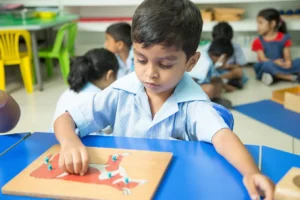
- Practical Life Activities: Pouring water, transferring grains with tongs, tying laces—helping children develop coordination, independence and concentration.
- Sensorial Materials: Blocks with different textures, sound cylinders, colour tablets, stairs of broad to narrow—children refine perception and classification skills.
- Language Exercises: Sand-paper letters, movable alphabets, story-telling corners—children engage in writing, reading and expressive language at their own pace.
- Mathematical Materials: Golden beads, number rods, bead chains—concrete, hands-on tools that lead into abstract mathematical thinking.
- Cultural/Environmental Activities: Nature walks, planting seeds, caring for classroom plants, geography puzzles—these help children connect with their environment and global awareness.
At GIIS KL, the GMP programme rests on pillars such as “iPlay”, “iCare” and “Excelerate” which tie practical, child-centred learning into global education frameworks.
Montessori Education in the Malaysian Context
Malaysia’s international school sector includes many Montessori-influenced programmes. GIIS KL is recognised among the top Montessori schools in Kuala Lumpur and serves the learning needs of expatriates and local families alike.
In Malaysia, choosing a Montessori method education means:
- Considering the montessori method benefits in the local context—where children may transition into different primary systems or move internationally.
- Looking for schools that offer well-trained guides rather than traditional teachers
- Ensuring the environment is properly prepared—Montessori shelves, natural materials, freedom of movement.
As awareness grows, montessori schools in Malaysia continue to evolve, blending traditional Montessori principles with modern educational expectations in urban centres such as Kuala Lumpur.
Is Montessori Right for Your Child?
Here are some questions to help you decide if a Montessori option suits your family:
- Does your child thrive when exploring independently and choosing tasks?
- Are you comfortable with a less rigid, more exploratory early years experience?
- Will the school provide continuity into primary years (so the transition from preschool into formal schooling is smooth)? At GIIS KL, our GMP programme supports a seamless transition into primary education.
- Is the teacher-child ratio low, with children free to move and choose their work?
- Are you seeking a holistic start to schooling—one that values character, independence, curiosity and self-motivation alongside early academic skills?
For parents navigating choices among schools in Kuala Lumpur, understanding how Montessori education functions in real classroom settings helps clarify whether this approach aligns with their child’s learning style and family values.
Also Read: Virtual International School is the Future of Education
Final Words
For parents in Malaysia seeking an education that gives their child not just academic readiness but a country-wide, world-facing foundation of curiosity, independence and joy in learning, the Montessori method offers compelling opportunities. When the Montessori method benefits are well-delivered—through prepared environments, trained guides, thoughtful materials and activities—children gain more than early literacy—they gain a mindset for life.
At GIIS KL, the Global Montessori Plus programme merges Montessori philosophy with 21st-century skills, nurturing children to become confident learners and future-ready citizens in a multicultural Kuala Lumpur environment.
Ready to explore how a Montessori-based start could be the right first step for your child? Book a campus tour and see the Montessori classroom, activity materials and unique learning environment in action. Write to us if you have any queries.
FAQs
1. What is the Montessori method of education?
The Montessori method is an educational approach developed by Maria Montessori that enables children to learn through hands-on materials, independent exploration and a prepared environment that invites them to choose, focus and grow at their own pace.
2. What are the benefits of Montessori education?
Benefits include enhanced concentration, self-motivation, independence, fine motor and sensorial development, stronger language and mathematical foundations, and smooth transitions into further schooling.
3. What is a typical Montessori activity?
A Montessori activity might be transferring grains with tongs (practical life), matching colours or textures (sensorial), using sand-paper letters to trace shapes (language), or golden beads to build numbers (mathematics). In Malaysia, schools including KL incorporate these into their Montessori programme.
4. Is Montessori education available in Malaysia?
Yes. Malaysia hosts several schools offering Montessori-based programmes, especially in Kuala Lumpur. GIIS KL offers its Global Montessori Plus programme for early years, combining the Montessori method with modern learning frameworks.
5. How does a Montessori start to help children in later years?
By developing independence, concentration, self-discipline and a love of learning, Montessori-educated children often adapt well into primary and secondary schooling, perform well academically and carry a strong foundation for lifelong education and personal growth.