When Faiz read a complete guide on the Montessori method and saw how his son Amir thrived in a classroom that valued independence, hands-on learning and respect for every child’s pace and learning style, he understood Montessori’s philosophy behind its enduring impact.
As you explore diverse educational paths for your young child, one approach continues to remain distinct for its holistic and child-centred methodology—the Montessori Method of education. With several families searching for private schools in Kuala Lumpur or evaluating secondary schools in Malaysia, understanding “what is Montessori” and how it works can be a real game-changer.
In this comprehensive guide, we’ll walk you through “what is Montessori education”, its key principles, major benefits that your child will get and whether it’s the right fit for your child. We’ll also touch on how schools such as GIIS Kuala Lumpur (GIIS KL) are offering enhanced Montessori-inspired programmes, such as GMP Plus, to enrich learning experiences.

What is Montessori Education?
The Montessori Method of education is a child-focused approach developed by Italian physician and educator Dr. Maria Montessori in the early 1900s. Rather than traditional, teacher-led instruction, the Montessori philosophy is all about hands-on learning, self-directed activity and collaborative play.
So, “what is Montessori method of education” in its true essence? It’s a dynamic educational model that nurtures a child’s natural curiosity and ability to learn at their own pace, which works wonders to promote autonomy, confidence and a love for lifelong learning.
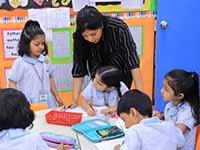
Montessori classrooms are thoughtfully-structured environments where children enjoy the autonomy to choose from a range of activities specifically designed to nurture their intellectual, emotional, social and physical development.

Key Principles of Montessori Education
1. Child-Centred Learning
In a Montessori classroom, the child is at the centre of the learning process. Educators function more like mentors or facilitators, observing and gently directing the child toward activities that align with their interests and developmental stage.
2. Prepared Environment
The classroom is meticulously arranged to promote independence and exploration. Everything—from furniture to learning materials—is designed with the child in mind, enabling a joyful learning experience.
3. Mixed-Age Grouping
Rather than segregating students strictly by age, Montessori education encourages mixed-age classrooms, typically spanning 3-year age bands. This setup nurtures peer learning, leadership and empathy as older students mentor younger ones and learn leadership skills along the way.
4. Freedom with Responsibility
Children are given the freedom to choose their activities and work at their own pace—but within a framework of clearly defined limits. This balance teaches children to manage their time well, make thoughtful choices and take ownership of their learning.
Top 5 Benefits of Montessori Education
1. Encourages Independence
One of the key features of the Montessori method is independence. From tying shoelaces to selecting math tasks, children are constantly empowered to think and act for themselves. This promotes higher confidence and stronger problem-solving skills.
2. Develops Critical Thinking
Montessori materials are intentionally designed to be self-correcting, prompting students to analyse, reflect and revise their approach without needing adult intervention. With this approach, learners develop sharp reasoning and analytical thinking skills from a young age.
3. Promotes a Love of Learning
When children have the independence to explore subjects that genuinely interest them, learning becomes an exciting adventure rather than a chore. Montessori education nurtures this intrinsic motivation, laying the foundation for curiosity and enthusiasm.
4. Fosters Social Skills
In mixed-age settings, children learn collaboration, patience, leadership and compassion. Montessori classrooms emphasise respect for oneself, others and the environment, nurturing well-rounded individuals with strong interpersonal skills.
5. Holistic Development
Montessori is necessarily about educating the whole child. Cognitive, physical, emotional and social development are all woven seamlessly into a child’s learning experience, preparing them not just for school, but for life.
Is Montessori Right for Your Child?
Choosing a school system is a significant decision, and it’s important to consider your child’s personality, learning style and long-term goals. Montessori education works well for:
- Children who like self-directed environments
- Learners who enjoy hands-on activities over rote learning
- Parents seeking a non-competitive, values-based approach
However, some children may initially struggle with the level of autonomy or the less-structured format. If you’re exploring secondary school admissions or considering private schools in Kuala Lumpur, visit the school campuses, speak with the educators and assess if the environment will support your child’s overall development.
Also Read: Benefits of choosing Montessori education for your kid
GIIS KL: Your Child’s Gateway to Global Education
The Montessori Method remains one of the most trusted and holistic educational approaches offered by top international schools in Kuala Lumpur. If you are exploring Montessori schools in Malaysia or considering secondary schools admission, understanding “what is Montessori education” can help you make an informed decision for your child’s future. We, at GIIS Kuala Lumpur, offer modern adaptations of the Montessori model through our acclaimed GMP Plus programme—an enriched curriculum combining the best of the Montessori method with contemporary learning frameworks. Should you wish to learn more about our preschool at Kuala Lumpur, contact our admissions team or book a campus tour.