Global
All Cities
Where would you like to study? Select cities to refine your search.
Any Curriculum
Find a campus based on the curriculum offered.
Global
Global
All Cities
Where would you like to study? Select cities to refine your search.
Any Curriculum
Find a campus based on the curriculum offered.
Search
Exploring distinctions between UK Personal Statements and US College Essays

Exploring distinctions between UK Personal Statements and US College Essays

Secondary School

To grasp the nuances in writing between the two, it’s crucial to delve into the fundamental differences in application processes and academic frameworks of the United Kingdom (UK) and the United States (US).

‍

Distinct evaluators: While applying to universities in the UK and US, students have two very different audience sets to appeal to.

● UK: University academics, experts in their fields, evaluate applications.

● US: Admissions offices assess applications, focusing on creating a diverse university community.

‍

‍

‍

Academic expectations: UK universities prioritise specialised knowledge whereas US universities give more significance to a broad range of knowledge.

● UK: Values depth in a specific subject or discipline, seeks exceptional talent and dedication.

● US: Prefers a well-rounded individual with knowledge across subjects areas.

‍

Emphasis on non-academic aspects: Colleges in the US stress more on beyond the classroom activities and experience as compared to UK universities.

● UK: Prioritises academic achievements and super curriculars, which is extracurriculars directly related to the subject choice.

● US: Prominence on non-academic skills, such as extracurricular activities, leadership roles, talent is sports, music and diversity in background for a vibrant university community. Volunteering, part-time jobs or diverse family backgrounds – all of these give students a better chance of getting admissions.

‍

Application components:

UK Personal Statements: These are part of Universities and Colleges Admissions Service (UCAS) system – a common statement that is submitted to five universities. The idea is to showcase an applicant’s qualification, enthusiasm and suitability.

These statements are structured, formal and importance is given to academic achievements, relevant extracurricular activities and professional aspirations, interests and suitability for a specific course within a 4000-character limit.

‍

‍

‍

US College Essays: These are often a part of the Common Application or college-specific applications. Focuses on showcasing student personality, background and non-academic accomplishments. Allows for creativity, varied topics and personal storytelling, offering a more flexible and conversational tone. The aim is to see a holistic view of the applicants.

The US College essays, being more flexible, can cover a range of topics. The applicants have more freedom to choose their topic of interest and the tone can be personal or conversational.

In essence, UK universities value specialised knowledge, while US universities seek versatility, creativity, and a broader perspective. Understanding these differences is pivotal for crafting effective personal statements or college essays tailored to each educational system’s expectations.

‍

University placements assistance at GIIS

Students at GIIS are encouraged by career counsellors to create three bucket lists for a comprehensive approach: dream universities with high competition, universities where admission is likely, and schools where admission is near guaranteed. They are advised to apply to around 10 universities.

‍

Also Read: Applying for top universities: What GIIS does to support secondary students

‍

GIIS provides support services such as the Education and Career Guidance Programme, one-on-one counselling for college essays and resumes, coaching on interviewing skills, and additional guidance through webinars, podcasts, and education fairs.

Benefitting from alumni connections, many GIIS graduates have successfully attended top global universities, including Oxford, Cambridge, UCLA, NUS and more.

‍

If you are keen to know more about GIIS, please feel free to contact our admissions team.

‍

Seema Kaushik

Ms Kaushik is the Career Counsellor with the GIIS SMART Campus in Singapore. She has mentored and guided hundreds of students over the past decade to connect with Universities of their choice, write essays and choose subjects which will give them a jumpstart in their higher studies.
Featured Blogs

Secondary School

How International Schools Develop Future-Ready Students Through Advanced Presentation Skills

Most international schools build presentation skills by making students speak, perform and defend ideas in front of real audiences, repeatedly and from an early age. At GIIS in Singapore, this happens through the international and Indian curricula, including IB, Cambridge and CBSE and 9GEMS framework. Students also practise these skills through performances, competitions and clubs.

School

How International Schools in Singapore Develop Life Skills Through Different Teaching Approaches

Many international schools in Singapore teach life skills by embedding practical competencies such as problem-solving, emotional regulation and teamwork directly into personalised academic frameworks. Rather than using one-size-fits-all instruction, most top institutions adapt life skill development to match visual, discussion-based and hands-on learning activities.

GIIS

How Do International Schools Prepare Students for University Applications from Grade 9 & 10?

Parents researching Singapore's international schools often ask the same question: when should university planning actually begin? The honest answer is earlier than most families expect. By the time a student reaches Grade 12, the subjects they took, the activities they pursued and the guidance they received years earlier have already shaped what doors are open to them.

GIIS

What Does “Holistic Education” Actually Mean in a Singapore International School?

In a Singapore international school like GIIS, holistic education means academics sit alongside eight other areas of development — sport, arts, leadership, innovation, community service, personality growth, skills, and values — inside one structured framework. It isn't a marketing phrase; it's how the timetable and activities are actually organised. It's natural to wonder what it actually means for your child. Ask ten different parents and you'll probably hear ten different answers — and that's okay. This guide breaks down the meaning of holistic education in plain language, explains what holistic learning looks like day to day and shows how it compares to a traditional, exam-first model.

Top Scholarships

Dr APJ Abdul Kalam Global Skills Scholarship

Eligibility:

Talent Based - Technology

More from same author
Trending Blogs

Secondary School

How International Schools Develop Future-Ready Students Through Advanced Presentation Skills

Most international schools build presentation skills by making students speak, perform and defend ideas in front of real audiences, repeatedly and from an early age. At GIIS in Singapore, this happens through the international and Indian curricula, including IB, Cambridge and CBSE and 9GEMS framework. Students also practise these skills through performances, competitions and clubs.

School

How International Schools in Singapore Develop Life Skills Through Different Teaching Approaches

Many international schools in Singapore teach life skills by embedding practical competencies such as problem-solving, emotional regulation and teamwork directly into personalised academic frameworks. Rather than using one-size-fits-all instruction, most top institutions adapt life skill development to match visual, discussion-based and hands-on learning activities.

GIIS

How Do International Schools Prepare Students for University Applications from Grade 9 & 10?

Parents researching Singapore's international schools often ask the same question: when should university planning actually begin? The honest answer is earlier than most families expect. By the time a student reaches Grade 12, the subjects they took, the activities they pursued and the guidance they received years earlier have already shaped what doors are open to them.

GIIS

What Does “Holistic Education” Actually Mean in a Singapore International School?

In a Singapore international school like GIIS, holistic education means academics sit alongside eight other areas of development — sport, arts, leadership, innovation, community service, personality growth, skills, and values — inside one structured framework. It isn't a marketing phrase; it's how the timetable and activities are actually organised. It's natural to wonder what it actually means for your child. Ask ten different parents and you'll probably hear ten different answers — and that's okay. This guide breaks down the meaning of holistic education in plain language, explains what holistic learning looks like day to day and shows how it compares to a traditional, exam-first model.

Search
History Menu Icon

Our vision is to become a global role model for teaching and learning.

History Menu Icon Secondary

Since its inception in 2002, GIIS has spread quality education through 17 campuses across the globe.

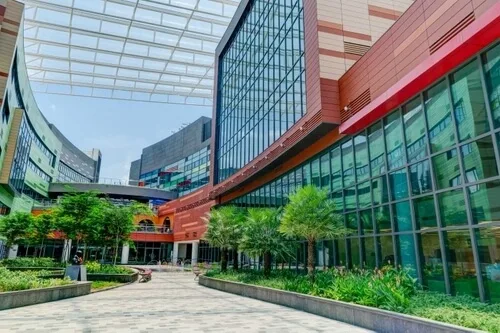
Global Indian International School Singapore smart campus learning environment

SMART Campus

A green, tech-enabled campus with extensive sports facilities that enables a holistic education

  • Kindergarten program at GIIS Singapore smart campus

    Montessori education with a modern touch.

  • Primary school curriculum at GIIS Singapore

    International primary programmes with best holistic learning.

  • Secondary school students learning at GIIS Singapore

    International middle school programmes with best foundation for high school.

  • High school education and curriculum at GIIS Singapore

    International high school programmes with beat launchpads for university.

21st century learning campus at GIIS Singapore

Facilities which are collaborative, creative and adaptable to individual needs.

Holistic education approach with 9 Gems at GIIS Singapore

Award-winning framework for all-round student development

Co-curricular activities at GIIS Singapore

Extra-curricular activities are those activities, often sports-based, that take place outside of the GIIS classroom

Extra curricular activities at GIIS Singapore

Talent shows, performances, competitions, clubs and additional classroom work.

Admission Process Icon

Get an overview of the admissions process

Campus Tour Icon

Register for a tour of the campus to learn more about the school first hand

Book Meeting Icon

You can talk to our Admissions Counsellor online or in-person, as per your convenience.

Admissions Form Icon

Find all forms related to admissions procedure here

Fees Icon

Get information on our fee structure for different grades

Scholarship Icon

Thank you for considering GIIS as a prospective school for your child. Our goal is to make the admissions.