As centuries gradually slipped into each other, the system of education too evolved and gradually the bricks-and-mortar-classroom model has given way to an extremely dynamic and instantaneous model of education. The 21st century saw the advent of online learning.
The internet took teaching and learning out of the confines of schools and universities and put it out there for any and everybody to access at the click of a button. Colloquially, it is called online learning. But for learning to go online things needed to happen and landmarks achieved.
Online learning appears to have made its debut in the international educational arena in the late 1900s. With the advent of the U.S. Postal services department, a need to learn by way of missives from the professors was desired.
And this gave rise to colleges with a ‘ commercial correspondence program. These programs established a penfriend kind of teacher-student relationship. And thus began the distance learning mode of educating oneself.
It was in 1982 that Western Behavioral Sciences Institute in LA Jolla, California opened its School of Management and taught its first course to business executives through video conferencing.
In a first of its kind, a completely online course was offered by the University of Toronto, in 1984. In 1989, the University of Phoenix started a bachelor’s and a master’s program, online. 1996 saw Glen Jones and Bernard Luskin launch Jones international university, the first fully accredited and web-based institution offering collegiate education via online learning.
In 2003, the Blackboard Learning Systems announced to the world that 40,000 instructors were online, teaching 150,000 online courses to 6 million students. And then there was no looking back. Online learning was here to stay.
What is Online Learning
So what is this online learning? To answer this query one has to comprehend the commercial internet and the concept of www, the World Wide Web. With the help of the above mentioned, the teacher and the student transcend the walls of the classroom and establish a virtual link.
The discourse and the learning happen online. Online education comes under the umbrella of distance education. These online classrooms have greatly helped in traversing geographical boundaries and encouraged the dispersal of knowledge and skills through the mode of online learning.
A virtual, relaxed teacher-student relationship is established and the know-how of the desired subject is handed out without much ado. Online learning is all that learning behind closed doors is not. No flying dusters, no chalk scraping on the blackboard, no teacher making you the butt of her/his personal irritation just because he/she got out of the wrong side of the bed. No unnecessary intimidation or bullying.
Online learning has made learning simple, easy, and accessible. One doesn’t have to make tedious and tiring journeys to the mecca-Medina of learning just to enhance oneself. It can be done anytime, from anywhere. So where can this online learning that is such a paragon of virtue, manna from heaven, a panacea of all ills to be found.
Online learning is all about learning at your own convenience – whenever, wherever. This tool has been very actively used by private schools following the international baccalaureate curriculum. IB has greatly used online education to help school-aged children get IB diplomas.
They are taught online and can attend online classes to suit themselves. Since this requires a very robust technical and digital infrastructure and support, it is majorly private schools that are venturing into online education.
During the pandemic, online learning gained more traction and acceptance. They say that necessity is the mother of invention. Online learning, too, fell in the category of a necessity. A facility that helped you, enhanced you, and yet did not disturb your routine or made unreasonable demands of you.
No longer is education confined to four walls, a blackboard and a timetable. Online education shattered the dogma of learning being the preserve of the completely dedicated. With Online learning, one could do myriad things without being wedded to one goal only.
So we can confidently say that online education became a compulsory byword in troubled times. It was the only way to maintain a semblance of normalcy and fulfillment of educational targets. Educational institutions, both schools, and colleges could continue uninterrupted, on the course, online. Pupils and scholars could pursue their IB diploma and university degrees, unhindered. We owe much to online learning.
However, education, since it is a package that facilitates or paves the path of learning is a matter of personal preference. Therefore, online learning or face-to-face learning could be two ends of a spectrum. Now we approach the latter half of the query – face-to-face learning.
What is Face-to-Face Learning?
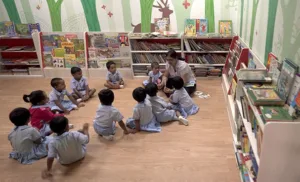
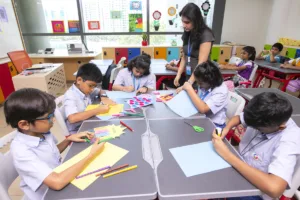
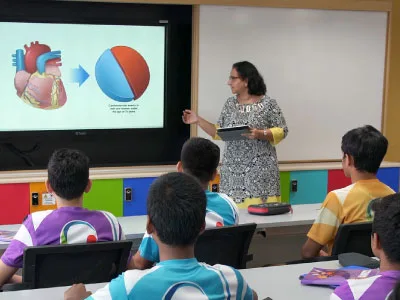
Face-to-face learning is a mode of knowledge transfer done personally, in person. The course content and learning material are handed over to a group of persons sitting in a classroom with a teacher instructing them, and guiding them through it all. There are interpersonal interactions, assignments, and assessments – all done within the confines of the sanctified classroom.
At a given date and time the group of students meets and has their progress checked by their professor/teacher. Face-to-face learning is comparatively a traditional method of learning. This follows a tangible schedule where the entire group has to report to a teacher. Here corporeal tools of learning are used for instruction. It allows for spontaneity of responses and settling of queries here and now.
Amongst the primary and pre-primary students, we have to take cognizance of more qualitative take-aways. These would be real-time interaction, enhanced social skills, group activities, development of team spirit, confidence building, increased organizational skills, motivational exercise, and so on.
One can authoritatively say that the above mentioned is a list of life skills resulting from man being a social animal. A child when left in a classroom full of children will learn things more quickly and comprehensively through interaction than in isolation.
Differences between Face-to-face vs. Online Learning
Face-to-face learning includes physical movement and extracurricular activities thus giving currency to the maxim- a healthy body houses a healthy mind. Classroom learning also contributes to confidence-building and a spirit of cooperation amongst the team members of groups formed in a classroom.
The field trips, group projects et al go into turning a child into a social being. But this face-to-face learning requires proper planning and scheduling. Also, a teacher has to be there to do the hand holding – physically.
Here the child has to follow a predetermined pattern that has been decided by the school in which he has been enrolled. He has to attend hourly classes and has to remain in one place for the assigned number of hours. Some students might look upon it as a breach of freedom. Forced imprisonment does not give them the liberty to choose what they would like to do.
A bricks-and-mortar school has to adhere to all the regulations chalked out by the governing bodies. In turn, it cannot allow children to do as they please. But online learning is only about learning and dispensation of knowledge.
In face-to-face learning the interaction is live and the teacher has the opportunity to observe students and personally nudge and prod children who require it. Online classrooms, since they have a flexible schedule and allow room to decide your own pace of learning, do not have a teacher constantly monitoring the advancement parameters of the student.
Another red flag is that in online learning the assessor can easily be duped by the student into advancing the latter when in actuality he is not fit to be promoted.
Another comparison between online and face-to-face learning is that the former requires a certain amount of faithfulness and sincerity to see the course through. No checks and punishments are there for not having attended classes or missed submission dates of assignments.
On the other hand, online learning gives one the freedom to choose when, where, what and how much. A study revealed that online learning reduces the use of paper, electricity, and carbon emissions, tremendously.
Online courses, thus consume 90% less energy and reduce emissions by 85%. This reason alone is sufficient to encourage online learning when we are leading a threatened existence. Life is hurtling at a break-neck speed where time margins are almost non-existent.
In such a scenario traveling time and traveling expenses saved by online learning adds a gilt edge to turn around time for reskilling and reshuffling roles in business organizations. Digital learning can very effectively future-proof businesses. People are keen to learn and improve but face a lot of roadblocks and speed breakers in the form of time and money constraints.
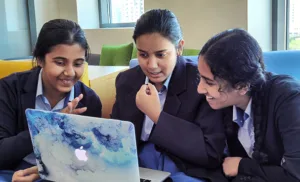
Online learning can sweep all hesitations aside by providing personalized and relevant learning to the desired ones – whenever they want, wherever they want. A laptop, a smartphone, or a tablet is sufficient to upskill and upscale.
How is Online Learning as good as Face-to-face learning
Online learning with its elasticity and flexibility, in the times to come, has the potential to unseat face-to-face learning. Simply because it can cater to all needs, it has asynchronous mode and asynchronous mode.
In the former, all the students in a class engage simultaneously with the help of the internet. It uses web technologies like Google meet, Google hangouts, or zoom. It creates a virtual classroom, wherein immediate responses, feedback, and discussion give the feel of face-to-face learning without the travel and touring.
Also Read: Top 10 Essential Life Skills For High School Students
A lot of time and expense and energy are saved. And then we have an asynchronous mode where the student is self-paced. It is up to the student to decide their own schedules of study, submissions, and interaction with teachers/peers.
Asynchronous online learning uses forums and message boards to keep the communication lines open between the students and teacher and amongst the students themselves. It also uses shared files, self-guided lessons, and workshops. Teachers post pre recorded lessons and quizzes to facilitate students with limited time on their hands.
They can watch and do the assignments at their convenience without the stress of adhering to a strapped schedule.
So it is online learning that has accorded and afforded desirable learners the freedom of choice. They can consider their personality type, the depth of their pockets, and their mental energy to decide the mode of their self evangelization. This is only possible with online learning.

Team GIIS
Team GIIS is a group of enthusiastic writers who bring the vibrant world of GIIS in Singapore to life through engaging blog posts. Dedicated to highlighting the school’s teaching methodology, innovative learning environment, and diverse curriculum options like IB, Cambridge and CBSE, they aim to connect with parents, educators and students, sharing insights and stories that inspire and inform the school community.