Sengkang is a residential estate in Singapore’s northeast region. The estate consists of the Housing Development Board (HDB) that holds high-rise public apartments and private houses. With the availability of resources and all necessary utilities, Sengkang is a hot spot for industrial zones and posh residences. To top it all, Sungei Punggol and Sungei Serangoon are two rivers that provide scenic beauty to the otherwise industrially rich estate of Sengkang. No wonder Sengkang translates to ‘prosperous harbor’ in Chinese.
Sengkang has experienced rapid development and was the first satellite town in which extensive public transportation facilities were constructed simultaneously with the main public housing development. The settlement has now been turned into a 21st-century community, complete with amenities for citizens to work and play. Residents flock from all over the world to inhabit this place. Housing a diverse population, the estate provides for all their needs like work, recreational activities, education, etc.
Education in specific is given utmost importance as it is all over Singapore and there are many international schools in Singapore to choose from. Kindergarten schools have an added advantage with their accessibility and provision to top-notch facilities in and around the area.
Kindergarten Education is the foundation for learning
The educational journey of a child begins at Kindergarten. They learn how to interact and co-habit. Social and cultural values are instilled by the very fact that children from different cultures and backgrounds study under one roof. A school is a place for children to learn and share values without hesitating to state what they feel. This behavior can be shaped only in the early years of education, and teachers are tasked with making children feel comfortable in the environment where they study.
They say education begins at home, but to strengthen that learning, there is a certain pedagogy and strategic methods of teaching that are to be imbibed. Young minds need to be woken and activated for them to grasp and learn from anything and everything around them. Teachers try their best to keep students engaged and that effort leads to children enjoying the school environment. Here are some teaching methods you can adopt for Kindergarten children.
1. Intrinsic Motivation
Motivating youngsters by modeling excitement and interest is one of the most effective teaching approaches. Motivation comes from both the inside (intrinsic) and the outside (extrinsic).
Demonstrating curiosity by asking questions about the things they’ve learnt in class is another way to engage in their endeavors. Apart from praising the child, it is important to reinforce and balance their thinking processes. For example, you can suggest that there are more ways to assemble blocks than the one the child is familiar with.
Praise them for their first effort but then ask them to try another way as well. Telling them that there is another way will strike curiosity and motivation to make something new, and this helps children learn to see things with a fresher perspective.
2. Describe and Share
The description helps little kids put their thoughts into words. Children are natural storytellers, and when they meet with patient adults, who are ready to listen, they freely communicate with them. This exercise of describing and sharing their thoughts with other students and teachers helps to cement concepts and share their knowledge with others.
It can take a long time for children to discover the right words to express their thoughts but patience is key. Students learn from everything they see and hear. Therefore, teachers repeat certain words more often and introduce newer words to build their vocabulary.
To make the describing process easier, you should incorporate descriptive words in your speech when around kids. You will never know when they pick it up and use it when they speak and describe something. It makes their thoughts clearer and precise.
3. Take breaks to break the monotony
If your children have been sitting still for an extended time, they will soon let you know that it is time to move. Children have a very short attention span and wish to jump from one activity to another as soon as possible. If the child requires a break, even the most well-planned and entertaining learning plans will fail. Therefore, it is okay for students to take a break from what they are doing and roam about in class.
When students have been sitting too long, teachers take them on walks around the school, bounce up and down, play out a narrative, or do other things that get them excited. As a result, the break from monotonous teaching helps in better blood circulation and students are more alert.
4. Cooperative Learning
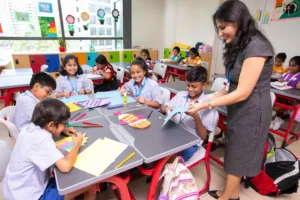
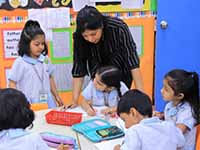
As discussed above, kindergarten schools encourage teaching in groups and here’s why. Cooperative learning is a teaching style in which students are divided into pairs or small groups and given a job to perform. The ability of a team or group to complete a task is determined by how well they work together. This teaching style encourages peer respect and fosters knowledge of one another’s interests, abilities, and needs.
In cooperative learning, group assignments are designed to involve the entire group and cannot be done by a single person. The teacher should keep an eye on the group’s activities and intervene as needed to clarify instructions and help model excellent teamwork.
5. Action-based learning
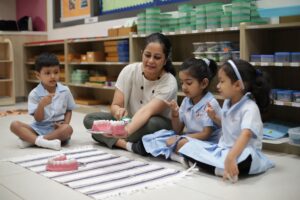
This hands-on approach is a teaching style that encourages students to learn by doing and seeing. Students benefit from using props to grasp abstract concepts, improve critical thinking, and solve issues. For example, board games could be used to teach pupils basic arithmetic concepts such as addition and subtraction.
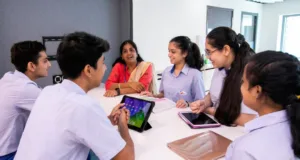
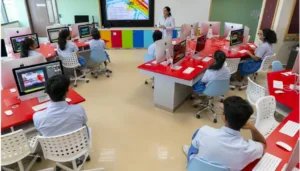
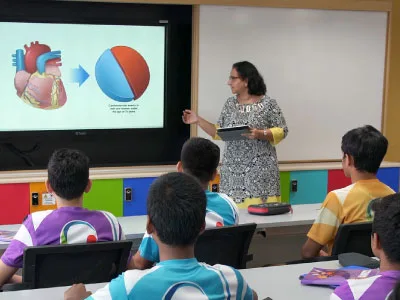
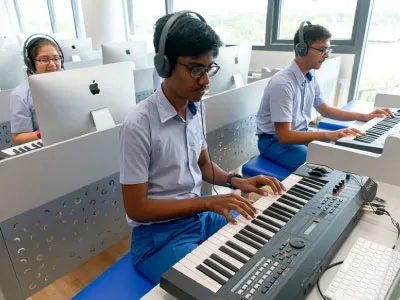
These days with e-classrooms, when students are encouraged to understand a concept through an educational game or an interactive multimedia format, computers play a role in hands-on learning. Students are once again encouraged to take an active role in their education and learn something new through an audio-visual method.
Note to Remember
These methods are not set in stone but teachers may modify them and use them to suit their group of students. But what tops these methods are the need to be sensitive and understanding towards your child. Children are largely driven by instinct and they do what they want to do in that period therefore it is not advisable to penalize them for the same.
For instance, if a child is hungry, it’s easier to let him/her eat part of her lunch early or to provide a snack, than to try to force the child to concentrate on a task until the scheduled break is announced. These little things matter to make the classroom an enjoyable experience for the child.
Conclusion
Sengkang Kindergartens and many other international schools in Sengkang, Singapore follow such practices to enhance their teaching-learning experience. These schools follow well-designed frameworks in an engaging environment to help little children grasp concepts and understand their lessons faster.

Team GIIS
Team GIIS is a group of enthusiastic writers who bring the vibrant world of GIIS in Singapore to life through engaging blog posts. Dedicated to highlighting the school’s teaching methodology, innovative learning environment, and diverse curriculum options like IB, Cambridge and CBSE, they aim to connect with parents, educators and students, sharing insights and stories that inspire and inform the school community.