Early childhood education is crucial for your child as it can have a lasting effect on their physical, cognitive, language, social-emotional and creative development. A quality teaching method along with a high quality teacher-student interaction during early childhood years has a positive impact on their future development.
Language development or the ‘process of learning to use language’ involves speaking and understanding the use of words, phrases, sentences in order to effectively communicate with others. It is an important component of the Montessori method of education.
As per research, the development of language skills in children relies on their inherent cognitive abilities along with external environmental influences. The innate ability for language acquisition and development can therefore be enhanced through exposure to a rich learning environment.
Early childhood language development at GIIS
At Global Indian International School (GIIS), our early childhood learners go through our Montessori-plus curriculum – Global Montessori Plus Programme (GMP). There are five pillars under GMP and language development is part of the first pillar, known as the Excelerate Programme.
As our young learners embark on a journey through the various stages of language development, we ensure students from Nursery to K2 experience a comprehensive language education. At GIIS, this approach is implemented across three levels: Nursery, K1, and K2.
Learning through phonics
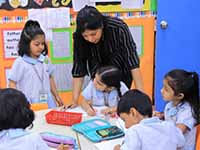
The Montessori curriculum involves the Pink, Blue and Green Schemes, which begin in Nursery and continue till K2. When a young learner, aged 2.5 years or above joins Nursery with varying language abilities, the curriculum begins with the Pink Scheme. Here, the emphasis is on phonics—teaching children to associate sounds with written symbols. Through engaging songs and activities, students learn to recognise and articulate sounds, starting with fundamental phonics like ‘c’, ‘m’ and ‘f’.
Enhancing learning
As part of the Montessori method, we introduce sandpaper letters for each sound. So, when the child is taught to use two fingers to run over letters and trace them, it creates a muscular impression so the child is able to understand better, enhancing the sensory experience.
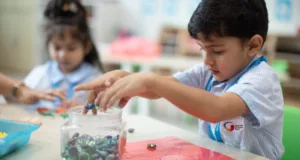
Vocabulary words are associated with these sounds, creating a foundation for language comprehension and acquisition. Nursery students engage in activities such as tracing, coloring, and hands-on tasks related to each letter. All the 26 letters are taught by the end of the year.
Transition to K1: As students progress to K1, a four-month recap reinforces the 26 sounds learned in Nursery. This benefits new joinees as well. The curriculum then advances to introducing two-letter words, three-letter words, sight words (which cannot be read phonetically for example ‘he’, ‘she’), short phrases and sentences.
Picture composition is introduced to aid students to express themselves by attempting to construct grammatically correct sentences. When the students are being introduced to short sentences, they are actually being introduced to grammar. Writing skills are developed through structured activities. This is taken forward in K2.
Advancing to K2: Upon entering K2, students have completed the Pink scheme, and a 1.5-month recap aims at their readiness for the next phase. The Blue Scheme introduces four-letter words, followed by the complex Green Scheme phonograms, including advanced reading skills. Assessments include dictation tests along with observations done by the teachers to strengthen their fluency in reading and writing as compared to assessments in Nursery and K1, which is purely observation based. Also, materials are sent home so that the parents can see and support students. Thereby, actively engaging parents in their child’s learning journey.
Moreover, beyond phonics, at GIIS, writing skills evolve from basic formations to constructing sentences, and students engage in creative writing, picture compositions, oratory skills, including Rebus sentences and logographics. A rebus is a visual representation of a word or syllable using a picture of an object whose name sounds like the word or syllable it represents. It requires them to think and come up with the right words.
Also read: How we embrace Experiential Learning at GIIS preschool
Articulating ideas
Language development extends beyond the classroom with integration to cultural studies. Activities such as ‘insect projects’, not only enhance vocabulary but also encourage students to articulate their ideas and creativity in front of their peers.
GIIS places a strong emphasis on oratory skills through activities like ‘Show and tell’, ‘HiQ quiz’ – a General Knowledge component, Weave-a-Tale (storytelling presentations), tongue twisters, news reading and skits as part of internal annual programmes. All these endeavors aim to boost confidence and overall language competence of our young learners. Our students actively participate in inter-school / campus events and advocacy programmes which boosts their self-esteem and confidence.
The language development journey at GIIS is an engaging process, ensuring that students not only learn to read and write but also develop strong oratory skills, creative expression, and a love for language. As we traverse from Nursery to K2, the structured curriculum and diverse activities contribute to a well-rounded language education for every child.
If you are keen to know more about preschool education at GIIS, please feel free to contact our admissions team.

Rema Rajiv
Ms Rajiv has been an Early Childhood educator and practitioner for the past 15 years at GIIS. She heads the Global Montessori Plus (GMP) Programme, supporting kindergarten students in their learning and holistic development to maximise the potential of every student. She has been instrumental in implementing developmentally age-appropriate curriculum that provides a strong foundation for lifelong learning. She is well-respected due to her rich experience in the field and passion for working with preschoolers, helping establish a good rapport with the parent community.