Global
All Cities
Where would you like to study? Select cities to refine your search.
Any Curriculum
Find a campus based on the curriculum offered.
Global
Global
All Cities
Where would you like to study? Select cities to refine your search.
Any Curriculum
Find a campus based on the curriculum offered.
Search

Developing strong numeracy skills for preschool students

Learning

Competence in numeracy skills in early childhood, as per research, has a significant impact on your child’s mathematical skills in later years. Children learn through various aspects during early years, ranging from their individual abilities such as cognitive skills, language skills, and attention span. However, to maximise learning, preschools must offer high-quality learning environments with engaging curriculum and dedicated teachers.

Some key benefits of numeracy skills during early childhood years are:

● Cognitive skills development: Engaging in numeracy activities supports cognitive development in young learners. Mathematical concepts such as counting backwards and forwards, sorting, recognising patterns or understanding the relationship between numbers stimulate the brain – thereby, enhancing overall cognitive abilities. Moreover, activities to reinforce these concepts lay the groundwork for more complex mathematical thinking in later years.

● Language development: Engaging in conversations on mathematics and activities supports language development. Talking about numbers, comparing sizes, quantities and using mathematical vocabulary contribute to a rich language environment, fostering overall language skills.

● Problem-solving skills: Understanding math involves critical thinking and problem-solving. Research suggests that engaging in mathematical activities or concepts involves reasoning, making decisions and logical thinking. They help them to be better equipped to analyse and solve problems in various contexts.

How GIIS preschool programme develops numeracy skills

As such, laying a strong foundation for numeracy skills is crucial in the early years of a child’s education. At Global Indian International School (GIIS), the approach to fostering numeracy skills among preschool students is comprehensive as well as engaging, ensuring that our students not just learn the basic skills but also develop a deep understanding of mathematical concepts. Let’s take a closer look at the numeracy curriculum for each level, starting from Nursery to Kindergarten 2 (K2).

Numeracy skills form one of the significant components of the five pillars of GIIS’ preschool curriculum, Global Montessori Plus (GMP) programme. Under the first GMP pillar, ‘Excelerate’ programme, focus is laid on developing a strong foundation in various skills, including math skills.

Elevating learning through interactive activities

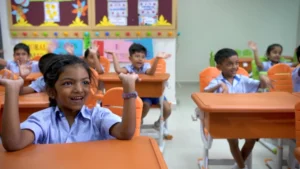
For Nursery students at GIIS, we start with introducing them to the world of numbers through counting, which is taught by memorisation. Using nursery rhymes and interactive activities, our students learn to count from 1 to 10.

A playful approach is adopted, where index fingers become tools for counting, making the learning process fun and enjoyable. It mainly aids children in establishing a physical correspondence with numbers. The emphasis in this stage, along with learning, is on creating a positive and fun association with numbers.

Focus on independent writing

As our young learners transition to K1, numeracy skills become more structured. In the first month, as part of their revisions, students delve into numbers 1 to 10, gradually progressing up to 100 over the following months.

The methodology involves learning to count through memorisation, with 10 additional numbers introduced progressively every month. As students become comfortable with the numbers, the focus shifts to identification and writing. Initially, it involves tracing and eventually they move on to independent writing.

K1 students also explore the concepts of ‘before,’ ‘after,’ and ‘in-between’ numbers, which help in enhancing their understanding of numerical sequencing. Backward counting is introduced, which adds a layer of complexity to their numeracy skills. By the end of  K1, our students are adept at recognising, writing and understanding numbers up to 20.

Establishing a robust foundation for Primary 1

K2 at GIIS takes numeracy education a step further by incorporating a more extensive range of concepts. Each month, students work with five key ideas: before, after, in-between, bigger numbers and smaller numbers. The progression follows a systematic approach, covering numbers 1-10 in the first month, 11-20 in the second month, and so on. By the end of the year, a full range of numbers is covered up to 100.

Alongside these concepts, K2 students learn number names, progressing up to 50 by the end of the academic session. The curriculum introduces single-digit addition and subtraction, starting with concrete objects and fingers and progressing to problem-solving activities. Time concepts, such as an hour and half-hour, are introduced, providing a practical application of math skills. The year concludes with an exploration of basic fractions like whole, half, quarter, and three-quarters.

Also read: Fostering language development at GIIS: From Nursery to K2

In essence, the numeracy skills at GIIS for preschool students is designed not just to impart knowledge but to foster a love for numbers. The structured progression, play-based interactive methods, and incorporation of practical concepts ensure that children not only grasp numerical skills but also develop a solid foundation for more advanced mathematical learning in the years to come as they eventually transition to primary school.

If you are keen to learn more about preschool education at GIIS, please feel free to contact our admissions team.

Rema Rajiv

Ms Rajiv has been an Early Childhood educator and practitioner for the past 15 years at GIIS. She heads the Global Montessori Plus (GMP) Programme, supporting kindergarten students in their learning and holistic development to maximise the potential of every student. She has been instrumental in implementing developmentally age-appropriate curriculum that provides a strong foundation for lifelong learning. She is well-respected due to her rich experience in the field and passion for working with preschoolers, helping establish a good rapport with the parent community.​

Featured Blogs

Admission Tips

How to Apply to an International School in Singapore: Step-by-Step Guide (2026)

Navigating the landscape of international education in the Lion City requires careful planning. Whether you are looking for how to apply for international school in Singapore or managing your budget around international school fees in Singapore, this guide provides a clear, validated roadmap for your family’s transition.

CBSE

CBSE vs IGCSE vs IB: Which Curriculum is Right for Your Child in Singapore?

Choosing the best curriculum in Singapore is not about finding the “single best” board; it is about finding the right fit for your child’s learning style and your family’s long-term plans. Whether you are considering CBSE vs IGCSE in Singapore schools or looking ahead to the IB Diploma, each pathway offers distinct advantages for different types of learners.

IB Program

IB Diploma in Singapore: Schools, Fees, Subjects & University Results (2026-27)

Singapore remains the global powerhouse for the International Baccalaureate (IB) Diploma Programme (DP). As we move into the 2026-2027 academic year, the landscape is evolving with new curriculum updates in the sciences and history, alongside a shift toward digital assessments.

Preschool

Preschool & Nursery School Singapore: Complete Guide for Parents (2026)

Navigating the landscape of preschool Singapore has to offer, looking for nourishing and wholesome preschool can feel like a full-time job. As a parent, you aren’t looking for a ‘babysitter’ but you are looking for a foundational partner.

Top Scholarships

Dr APJ Abdul Kalam Global Skills Scholarship

Eligibility:

Talent Based - Technology

More from same author
Trending Blogs

Admission Tips

How to Apply to an International School in Singapore: Step-by-Step Guide (2026)

Navigating the landscape of international education in the Lion City requires careful planning. Whether you are looking for how to apply for international school in Singapore or managing your budget around international school fees in Singapore, this guide provides a clear, validated roadmap for your family’s transition.

CBSE

CBSE vs IGCSE vs IB: Which Curriculum is Right for Your Child in Singapore?

Choosing the best curriculum in Singapore is not about finding the “single best” board; it is about finding the right fit for your child’s learning style and your family’s long-term plans. Whether you are considering CBSE vs IGCSE in Singapore schools or looking ahead to the IB Diploma, each pathway offers distinct advantages for different types of learners.

IB Program

IB Diploma in Singapore: Schools, Fees, Subjects & University Results (2026-27)

Singapore remains the global powerhouse for the International Baccalaureate (IB) Diploma Programme (DP). As we move into the 2026-2027 academic year, the landscape is evolving with new curriculum updates in the sciences and history, alongside a shift toward digital assessments.

Preschool

Preschool & Nursery School Singapore: Complete Guide for Parents (2026)

Navigating the landscape of preschool Singapore has to offer, looking for nourishing and wholesome preschool can feel like a full-time job. As a parent, you aren’t looking for a ‘babysitter’ but you are looking for a foundational partner.

Primary School

Primary School Fees in Singapore: Everything Parents Need to Know (2026-27)

For expatriate and local families, the primary school fees in Singapore for 2026 and 2027 academic year continues a shift toward “High-Tech, High-Value” education. While premium international schools often command fees, institutions like Global Indian International School (GIIS) have strengthened and continue to offer advanced facilities with emphasis on the wholesome growth of the student.

Admission Tips

Singapore International School Admission Process: Documents, Timelines & Tips

For expatriate and local families alike, securing a place in a best international school in Singapore is a major milestone. The Singapore international school admission landscape is competitive, but also more flexible than many assume, provided you understand the system. This expert guide breaks down timelines, documentation, fees, and proven strategies to strengthen your child’s application.

Search
History Menu Icon

Our vision is to become a global role model for teaching and learning.

History Menu Icon Secondary

Since its inception in 2002, GIIS has spread quality education through 17 campuses across the globe.

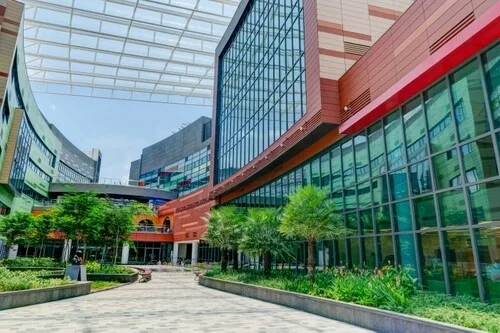
Global Indian International School Singapore smart campus learning environment

SMART Campus

A green, tech-enabled campus with extensive sports facilities that enables a holistic education

  • Kindergarten Menu Image

    Montessori education with a modern touch.

  • Primary School Menu Image

    International primary programmes with best holistic learning.

  • Secondary School Menu Image

    International middle school programmes with best foundation for high school.

  • High School Menu Image

    International high school programmes with beat launchpads for university.

21st Century Learning Campus

Facilities which are collaborative, creative and adaptable to individual needs.

Holistic Education Menu

Award-winning framework for all-round student development

CCA Menu Image

Extra-curricular activities are those activities, often sports-based, that take place outside of the GIIS classroom

ECA Menu Image

Talent shows, performances, competitions, clubs and additional classroom work.

Admission Process Icon

Get an overview of the admissions process

Campus Tour Icon

Register for a tour of the campus to learn more about the school first hand

Book Meeting Icon

You can talk to our Admissions Counsellor online or in-person, as per your convenience.

Admissions Form Icon

Find all forms related to admissions procedure here

Fees Icon

Get information on our fee structure for different grades

Scholarship Icon

Thank you for considering GIIS as a prospective school for your child. Our goal is to make the admissions.