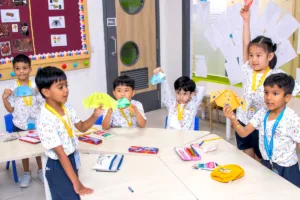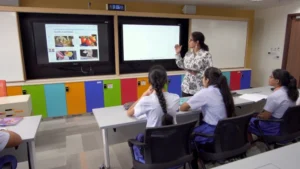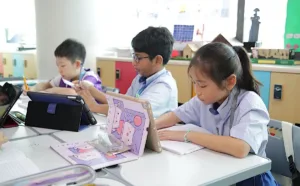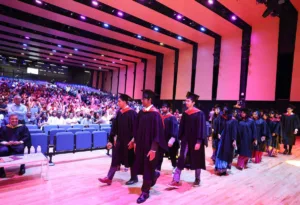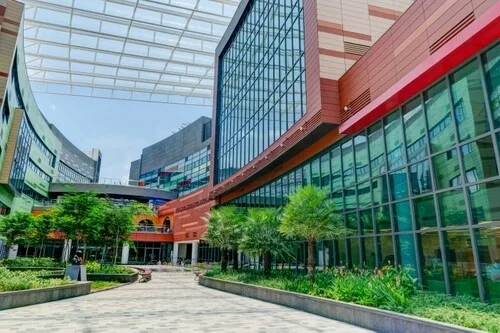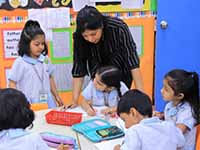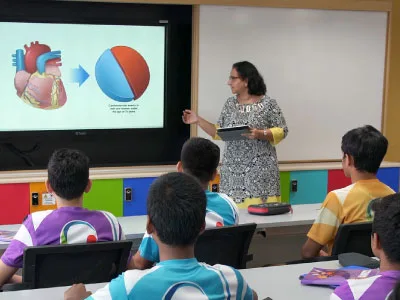
The IB Primary Years Programme (PYP) involves inquiry-based, transdisciplinary learning that helps students master collaborative thinking, hone communication skills, think creatively, and independently. The IB PYP at GIIS is a mature, well-developed curriculum designed to help students develop into life-long learners.
Many parents have questions about PYP, how it works in the classroom and what students will experience when they enroll at GIIS. To answer these questions, we interviewed GIIS SMART Campus IB PYP coordinator, Ms. Manju Nair.
If you’re a parent interested in the PYP for your child, this article will help you understand the programme at GIIS. You’ll learn how the curriculum works, how students learn and are assessed in our IB PYP, and how teachers are supported at GIIS.
Q. How is the IB PYP curriculum designed?
The IB provides a curriculum framework with an emphasis on understanding of the concepts, gaining knowledge about relevant content, and developing the required skills. Whether it is science, social studies, languages or arts, the students need to build their understanding, knowledge and skills.
The framework for the curriculum in all subjects is designed by the IB and shared; these are the IBs subject specific scope and sequence. Schools may use only the IB scope and sequence or combine it with mandated national curricula standards.
However every school has its unique Programme of Inquiry – a matrix consisting of horizontally and vertically articulated units of inquiry for every grade level. Critical knowledge and skills from the scope and sequence are pulled into the units of inquiry. This is the basic framework of the curriculum, which is fleshed out in different schools in different ways.
For example if we take languages, and talk about English – this will include overall learning outcomes that the students must understand. The curriculum doesn’t specify the age or the grade but instead just goes by phase as different schools will use the phases differently. Ultimately, it’s up to the school to answer such questions as:
● How will we teach it?
● How will the skills be inculcated?
● How will we assess it?
Q. How is the PYP curriculum designed at GIIS?
At GIIS, we do not subscribe to any particular national curriculum for PYP. While the programme coordinator takes the lead, we have subject leads with subject matter experts who are passionate about their area of interest.
The teachers act as subject leads, and different subject groups work towards achieving the learning outcomes. The coordinator works towards building the capabilities of the teachers, and together they review the curriculum. This helps them to analyse where students are and determine what is appropriate for the current student body’s abilities.
Also, the IB does evaluations every five years to check on progress of a school. The review process is designed to ensure that every school can do the best it can. Review questions are intended to check that schools are committed to delivering excellence in education.
The IB visits follow an intense self-study process the schools undertake. They review the self study and programme development plans that the school implements to support the school achieve its next level of growth and to ensure the school is taking responsibility for student outcomes.
Q. In terms of providing resources to the teachers, how does the school help? Does IB provide resources for teachers/coordinators?
GIIS helps in providing training to its teachers through workshops and professional development. IB has a suite of workshops and a catalogue that they release every year. There are always new understandings that teachers need to develop. It’s up to the school to see what, of course.
There are a lot of teachers’ support materials to facilitate their learning in the IB websites, and the IB relation managers continually update the coordinators on new initiatives and development within the IB. The IB teachers and coordinators are part of a regional network and they share ideas quite generously. The school also provides many reliable resources like Toddle and so on.
Q. How does learning happen for a PYP student?
The IB PYP is considered a transdisciplinary curriculum. To make teaching and learning transdisciplinary and inquiry-based, we have some broadlook at the big ideas that transcend the boundaries of the subjects.
Say, for example, you’re talking about migration; in mathematics, you may look at data and patterns. In social studies, you may discuss countries and history, asking questions such as, what patterns of migration have occurred? And across what countries? What does geography look like? What did geography look like before? What does it look like post migration? This type of learning is incredibly flexible. Say, for example, a student writes a story. Later, they can use the story to make a movie.
This can be applied to concepts of migration, interdependence, survival, and so on. These concepts transcend, and that’s why we have a programme of inquiry to make learning transdisciplinary.
Then we have the IB Learner Profile, which requires us to ensure that the students develop certain intrinsic values and skills like open-mindedness, risk taking, communication, inquiry and more. So the teachers have to constantly nudge students towards acquiring the big conceptual understanding and developing the required skills.
Q. How are they assessed?
In the assessment, the teacher asks, what are the learning outcomes for a particular unit? What is the big conceptual understanding that students need to develop? What is content knowledge? In social studies? What do they need to know by the end of this unit? Mathematics? What do they need to do? What do they need to know?
Assessment metrics are planned from the beginning. Every year, we look at what was done previously. We may use the same assessment or a different assessment as needed. Either way, students must show an understanding.
To ensure understanding is achieved, there are multiple check-in points throughout the unit. These check-in points become formative assessments, which can happen in various ways, for example in the form of Kahoot quizzes.
Here the teachers are checking if everyone in the class is moving ahead in terms of their learning. There are also graded assessments which happen across the year.
.jpg)
Q. How does GIIS PYP culminate in Grade 5 with PYPx of Exhibition?
We’ve talked about the process, the planning of the end of the unit, and how the teachers tie all these elements together. Students are expected to design an inquiry and present it to the community independently. This is the culmination of the PYP.
The purpose is to show that students can learn independently, that they have curiosity in a particular topic and can come up with a conceptual framework for it. Maybe a student is curious about sleep and sleep patterns — where the student must ask: what do I really want to learn about sleep? Why do human beings need sleep? What is the impact of sleep on your well-being? What other concepts can be explored?
They must ask these questions and answer the questions themselves to create their exhibition, which is also assessed.
Also read: Understanding the IB PYP Approach to Assessment at GIIS
The IB PYP at GIIS is a robust curriculum that helps students of a range of ability levels to become lifelong learners. The transdisciplinary curriculum and inquiry-based learning methods help students learn to explore big concepts while also developing skills and gaining content knowledge that will help them find success not just in secondary school years but at university and beyond. Ultimately, we teach students to become deep thinkers and curious individuals who grow up to become leaders.
If you are keen to know more about IB PYP at GIIS, please feel free to book a campus tour or contact our admissions counsellors today.

Shubhdarshani Mitra
Shubhdarshani has over 10 years of experience in content creation, curation and editing. She has worked for Indian newspapers, school magazines and international news websites where she worked closely with the leadership on the execution and communication of the content strategy. Aside from work, she’s a passionate B&W photographer and storyteller.