Global
All Cities
Where would you like to study? Select cities to refine your search.
Any Curriculum
Find a campus based on the curriculum offered.
Global
Global
All Cities
Where would you like to study? Select cities to refine your search.
Any Curriculum
Find a campus based on the curriculum offered.
Search
7 Classroom team building activities for school students

7 Classroom team building activities for school students

Learning

Team building in school involves activities that help students work together, communicate, and trust each other. It’s about creating a positive classroom environment where students feel connected and supported. It teaches kids essential life skills like cooperation, problem-solving, and leadership.

‍

Team building activities promote a sense of belonging and community among students, reducing conflicts and fostering empathy. They also enhance academic performance by encouraging collaboration and peer learning. It prepares students for success in both school and future endeavours.

‍

‍

What are the benefits of team-building activities for kids?

Team-building activities for kids offer numerous benefits that contribute to their personal and academic growth. Let’s explore some of the key benefits of these activities:

‍

● Promotes Collaboration: Team-building activities encourage children to work together towards a common goal.

● Develops Communication Skills: Kids learn to express their ideas and listen to others effectively.

● Builds Trust and Respect: Collaborative tasks help in establishing trust and respect among peers.

● Enhances Problem-Solving Abilities: Children learn to think critically and creatively to overcome challenges.

● Boosts Self-Confidence: Successfully completing tasks as a team boosts children’s self-esteem.

● Fosters Leadership Skills: Some activities provide opportunities for kids to take on leadership roles.

● Creates a Sense of Belonging: Working together strengthens the sense of belonging and community within the classroom.

● Improves Social Skills: Kids develop better social skills by interacting with their peers in a positive environment.

● Prepares for Real-Life Situations: Skills learned through team-building activities are applicable in real-life situations, preparing kids for future challenges.

‍

‍

Top 7 effective team building activities for students

Incorporating team-building activities into the classroom setting is an excellent way to foster a positive learning environment and develop crucial social and cognitive skills in students. Let’s explore nine engaging and effective team-building activities that can enhance collaboration, communication, and teamwork among students studying.

‍

1. The Name Game

This activity encourages students to learn each other’s names in a fun and interactive way. Students stand in a circle and one person starts by saying their name followed by an action. The next person repeats the first person’s name and action, then adds their own. This continues until everyone has had a turn, reinforcing name recognition and fostering a sense of community.

‍

2. Group Juggle

Group Juggle is a cooperative game where students work together to keep multiple objects in the air simultaneously. Starting with one object, students toss it among themselves. Gradually, more objects are added, challenging students to communicate effectively, coordinate movements, and maintain focus. It promotes teamwork, hand-eye coordination, and quick decision-making skills.

‍

3. Think-Pair-Repair

In Think-Pair-Repair, students initially think about a question or problem individually, then pair up with a partner to discuss their thoughts. After discussing, pairs come together with another pair to share ideas and refine their understanding collectively. This activity promotes active engagement, peer learning, and collaboration while enhancing comprehension and critical thinking skills.
‍

‍

4. Shrinking Classroom

The Shrinking Classroom activity involves gradually reducing the physical space available to students while they work collaboratively on a task. As the space diminishes, students must adapt their communication, cooperation, and problem-solving strategies to accommodate the shrinking area. This activity fosters teamwork, adaptability, and creativity under pressure.

‍

5. Balloon Battle

In Balloon Battle, students are divided into teams and must keep balloons in the air using only their hands or designated tools. The objective is to prevent balloons from touching the ground while also trying to land balloons on the opposing team’s side. This fast-paced game enhances hand-eye coordination, teamwork, and strategic thinking in a lively and engaging way.

‍

6. The Marshmallow Challenge

The Marshmallow Challenge tasks students with building the tallest freestanding structure using spaghetti, tape, string, and a marshmallow. Working in teams, students must collaborate, problem-solve, and innovate to construct a stable tower within a time limit. This hands-on activity fosters creativity, teamwork, and resilience as students experiment with different designs and materials.

‍

7. Team Drawing

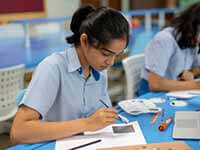
Team Drawing involves groups of students working together to create a single cohesive drawing or artwork. Each student contributes to the drawing, taking turns to add elements or details. This collaborative activity encourages communication, creativity, and compromise as students share ideas and work towards a common artistic goal, fostering a sense of teamwork and camaraderie.

‍

Also Read: Reasons and Benefits of Choosing IB PYP Programme

‍

Conclusion

Team-building activities are invaluable tools for fostering collaboration, communication, and camaraderie among students. By engaging in these activities, students develop essential social, problem-solving, and leadership skills in a fun and interactive environment. Incorporating team-building activities into the classroom promotes a positive school culture and prepares students for success in academics and beyond.

‍

At Global Indian International School (GIIS), we recognise the importance of collaborative activities in nurturing well-rounded students. Just like team-building activities cater to diverse age groups, our classroom initiatives are tailored to suit students’ developmental levels and interests. From interactive group projects in kindergarten to leadership workshops in high school, we provide platforms for social interaction and skill development.

‍

These collaborative endeavours not only enhance communication and teamwork but also foster creativity, problem-solving, and empathy among students. By integrating such activities into our curriculum, we ensure that every student at GIIS is ready to succeed in today’s increasingly interconnected world.

‍

GIIS Singapore Logo
Team GIIS

Team GIIS is a group of enthusiastic writers who bring the vibrant world of GIIS in Singapore to life through engaging blog posts. Dedicated to highlighting the school’s teaching methodology, innovative learning environment, and diverse curriculum options like IB, Cambridge and CBSE, they aim to connect with parents, educators and students, sharing insights and stories that inspire and inform the school community.
Featured Blogs

Secondary School

How International Schools Develop Future-Ready Students Through Advanced Presentation Skills

Most international schools build presentation skills by making students speak, perform and defend ideas in front of real audiences, repeatedly and from an early age. At GIIS in Singapore, this happens through the international and Indian curricula, including IB, Cambridge and CBSE and 9GEMS framework. Students also practise these skills through performances, competitions and clubs.

School

How International Schools in Singapore Develop Life Skills Through Different Teaching Approaches

Many international schools in Singapore teach life skills by embedding practical competencies such as problem-solving, emotional regulation and teamwork directly into personalised academic frameworks. Rather than using one-size-fits-all instruction, most top institutions adapt life skill development to match visual, discussion-based and hands-on learning activities.

GIIS

How Do International Schools Prepare Students for University Applications from Grade 9 & 10?

Parents researching Singapore's international schools often ask the same question: when should university planning actually begin? The honest answer is earlier than most families expect. By the time a student reaches Grade 12, the subjects they took, the activities they pursued and the guidance they received years earlier have already shaped what doors are open to them.

GIIS

What Does “Holistic Education” Actually Mean in a Singapore International School?

In a Singapore international school like GIIS, holistic education means academics sit alongside eight other areas of development — sport, arts, leadership, innovation, community service, personality growth, skills, and values — inside one structured framework. It isn't a marketing phrase; it's how the timetable and activities are actually organised. It's natural to wonder what it actually means for your child. Ask ten different parents and you'll probably hear ten different answers — and that's okay. This guide breaks down the meaning of holistic education in plain language, explains what holistic learning looks like day to day and shows how it compares to a traditional, exam-first model.

Top Scholarships

Dr APJ Abdul Kalam Global Skills Scholarship

Eligibility:

Talent Based - Technology

More from same author
Trending Blogs

Secondary School

How International Schools Develop Future-Ready Students Through Advanced Presentation Skills

Most international schools build presentation skills by making students speak, perform and defend ideas in front of real audiences, repeatedly and from an early age. At GIIS in Singapore, this happens through the international and Indian curricula, including IB, Cambridge and CBSE and 9GEMS framework. Students also practise these skills through performances, competitions and clubs.

School

How International Schools in Singapore Develop Life Skills Through Different Teaching Approaches

Many international schools in Singapore teach life skills by embedding practical competencies such as problem-solving, emotional regulation and teamwork directly into personalised academic frameworks. Rather than using one-size-fits-all instruction, most top institutions adapt life skill development to match visual, discussion-based and hands-on learning activities.

GIIS

How Do International Schools Prepare Students for University Applications from Grade 9 & 10?

Parents researching Singapore's international schools often ask the same question: when should university planning actually begin? The honest answer is earlier than most families expect. By the time a student reaches Grade 12, the subjects they took, the activities they pursued and the guidance they received years earlier have already shaped what doors are open to them.

GIIS

What Does “Holistic Education” Actually Mean in a Singapore International School?

In a Singapore international school like GIIS, holistic education means academics sit alongside eight other areas of development — sport, arts, leadership, innovation, community service, personality growth, skills, and values — inside one structured framework. It isn't a marketing phrase; it's how the timetable and activities are actually organised. It's natural to wonder what it actually means for your child. Ask ten different parents and you'll probably hear ten different answers — and that's okay. This guide breaks down the meaning of holistic education in plain language, explains what holistic learning looks like day to day and shows how it compares to a traditional, exam-first model.

Search
History Menu Icon

Our vision is to become a global role model for teaching and learning.

History Menu Icon Secondary

Since its inception in 2002, GIIS has spread quality education through 17 campuses across the globe.

Global Indian International School Singapore smart campus learning environment

SMART Campus

A green, tech-enabled campus with extensive sports facilities that enables a holistic education

  • Kindergarten program at GIIS Singapore smart campus

    Montessori education with a modern touch.

  • Primary school curriculum at GIIS Singapore

    International primary programmes with best holistic learning.

  • Secondary school students learning at GIIS Singapore

    International middle school programmes with best foundation for high school.

  • High school education and curriculum at GIIS Singapore

    International high school programmes with beat launchpads for university.

21st century learning campus at GIIS Singapore

Facilities which are collaborative, creative and adaptable to individual needs.

Holistic education approach with 9 Gems at GIIS Singapore

Award-winning framework for all-round student development

Co-curricular activities at GIIS Singapore

Extra-curricular activities are those activities, often sports-based, that take place outside of the GIIS classroom

Extra curricular activities at GIIS Singapore

Talent shows, performances, competitions, clubs and additional classroom work.

Admission Process Icon

Get an overview of the admissions process

Campus Tour Icon

Register for a tour of the campus to learn more about the school first hand

Book Meeting Icon

You can talk to our Admissions Counsellor online or in-person, as per your convenience.

Admissions Form Icon

Find all forms related to admissions procedure here

Fees Icon

Get information on our fee structure for different grades

Scholarship Icon

Thank you for considering GIIS as a prospective school for your child. Our goal is to make the admissions.