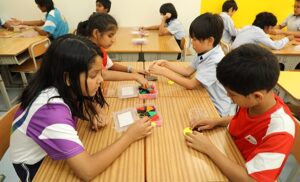
Cognitive skills are mental abilities essential for processing information and learning which include language, understanding, logic, memory, and attention helping us make decisions in daily life. Our cognitive talents shape our intellectual capacities with routine, education, and everyday experiences.
Early childhood growth at nursery school in Tokyo is essential to establish the groundwork for lifetime learning, behaviour, and overall health. Enriching experiences have a positive impact on the development of the brain, emotions and social skills.
This article will discuss the importance of cognitive skill enhancement in early childhood education and why it is necessary to cultivate these abilities in kids from a young age. Also, there are a few engaging cognitive development activities that parents can use to boost their child’s growth journey.
What Is Cognitive Development In Preschoolers?
Cognitive Skills for Early Age are essential for the gradual growth of their mental capacities. Young children actively investigate their surroundings, picking up information via play, interaction, and observation. It offers the framework for more sophisticated thinking later in life by developing fundamental cognitive abilities like memory, attention, and problem-solving.
Significant linguistic progress occurs during this time, facilitating improved comprehension and communication. Good early education programmes and nurturing surroundings promote healthy Cognitive Skills Development. They encourage curiosity, creativity and analytical thinking, which are fundamental for continuous learning and growth.
Why Is Cognitive Development Important For A Child?
A kid’s cognitive growth affects how they think, learn, and resolve problems in the future. The human brain builds a network of neural connections during childhood to serve as the foundation for Cognitive Skills Examples such as thinking, retention, and attention. These abilities are essential for social interaction, emotional control, and academic performance.
Cognitive development also influences language learning, which facilitates efficient communication and comprehension. A child with solid mental skills can better adjust to new circumstances and challenges, which promotes resilience and creativity. Fostering cognitive growth allows kids to confidently and competently negotiate the complexity of the outside world.
9 Reasons Why Cognitive Skills Development Important In Early Childhood
Listed below are the Cognitive Development Important top abilities and advantages kids will gain by developing their cognitive skills in early childhood:
1. Learning Abilities
Learning is improved through abilities like problem-solving, memory and concentration. Cognitive Skills For Students facilitate effective information processing, understanding, and retention, promoting academic performance. Enhanced cognitive skills boost attention and adaptability, enabling better management of complex assignments. Individuals who improve these skills can absorb new information more efficiently and enhance their intellectual and practical abilities.
2. Problem-Solving Skills
Students use primary cognitive processes like critical thinking, retention, and focus to break down complex issues, recognise patterns, and develop solutions. Robust mental skills make it easier to use logical frameworks and think creatively, resulting in more imaginative and efficient problem-solving in academics and everyday life.
3. Promotes Language Development
Memory, awareness, and auditory processing help kids grasp and recall new vocabulary, grammar and sentence structures. Improved brain function allows for better understanding and use of language in varied circumstances, promoting effective communication and vocabulary development along with linguistic fluency.
4. Builds Self-Confidence
Mental capabilities increase self-confidence by allowing students to interpret and manage new tasks and challenges. As mental talents like memory, concentration, and problem-solving increase, learners feel more adept and competent. This sense of proficiency promotes good self-esteem and an active approach to learning and resolving issues. Results acquired via strong cognitive skills boost self-esteem, inspiring more effort and exhibiting perseverance.
5. Enhances Academic Performance
Intellectual skills improve academic achievement by increasing the capacity to absorb, comprehend, and utilise new information. Attention, memory, and analytical thinking are essential qualities taught at the Indian school in Tokyo that allow students to absorb complicated concepts and solve problems efficiently. Strong cognitive talents enable effective study habits, improved organisation, and the capacity to establish connections across subjects.
6. Stimulates Creativity
Cognitive abilities boost creativity by improving the capacity to think differently, establish new connections, and approach issues from multiple perspectives. Memory, attentiveness, and adaptable thinking skills enable students to draw on a wide range of information, recombine ideas, and discover unique solutions.
7. Prepares For Future Success
Mental skills prepare students for future success by providing the necessary tools for learning, solving problems, and adjusting to new settings. They improve academic success, professional capabilities, and personal development. These talents enable successful decision-making, inventiveness, and resilience, all essential for dealing with challenges. Children who develop excellent cognitive skills become better positioned to attain long-term success.
8. Lifelong Learning
Intellectual abilities promote lifelong learning by laying the groundwork for continuous mental growth and flexibility. These skills help students to absorb new knowledge, adapt to changing situations, and face challenges. They enable ongoing learning and personal development, guaranteeing that learners can keep up with advancements and breakthroughs.
9. Decision Making
Supporting Cognitive Development For Early Childhood is essential for reliable decision-making. Students with logical thinking, attentiveness, and problem-solving skills may analyse information, weigh alternatives, and predict possible outcomes. Good memory aids in recalling significant experiences and information, whereas attentiveness assures concentration on crucial details.
What Are Some Cognitive Development Activities For Students?
Students can engage in Cognitive Development Activities like puzzle solving, reading, learning games, science projects, arts and crafts, and music training. These exercises improve mental agility, memory and creativity to ensure intellectual growth and academic achievement.
Cognitive Development Activities For 6-12 Year Olds
Parents can try the following activities for Cognitive Development 6-12 Years to support and make learning enjoyable and engaging.
- Science Experiments: Simple at-home experiments can build student curiosity, comprehension of scientific ideas, and analytical thinking.
- Puzzle Solving: Learners can enhance their troubleshooting and logical abilities with puzzles, crosswords and Sudoku.
- Creative Arts: Activities like drawing, painting, and craft-making encourage creativity, fine motor abilities, and mental flexibility.
- Maths Challenges: Participating in challenges, games, and competitions helps to improve numerical abilities and logical reasoning.
- Memory Games: Engaging in memory-matching exercises or utilising flashcards improves recall and knowledge retention.
- Social Interaction: Group projects and joint tasks promote better communication, empathy and collaborative skills in students.
Cognitive Development Activities For 3-5 Year Olds
The below Cognitive Development 3-5 Years aim to be pleasant while fostering growth and laying a solid basis for future learning:
- Sorting and Categorising: Arranging things by colour or shape can help toddlers improve their pattern recognition and organisation skills.
- Story Time and Reading: Reading and exchanging stories improves language abilities, understanding, and creative thinking.
- Building Blocks: Practicing with blocks or building toys improves fine motor skills, inventiveness, and spatial awareness.
- Counting and Number Games: Counting objects, solving number puzzles, and playing simple math games are all foundational skills for numerical knowledge.
- Outdoor Exploration: Outdoor walks and play can improve observation, curiosity, and comprehension of our planet and ecosystem.
- Pretend Play: Role-playing using costumes and props encourages creativity, language proficiency and social interaction.
Conclusion
Teaching cognitive skills for early age kids is crucial for laying the foundation for success and lifetime learning. Early interactions and experiences help to develop these fundamental mental skills, such as problem-solving, memory retention and focus. Parents who stress cognitive skills in infancy enable their children to grow into competent, confident adults who can navigate an increasingly complicated setting.