Shapes are all around us — in buildings, toys, nature and art. For children, recognising and understanding shapes is one of the first steps in cognitive and mathematical development.
At GIIS Kuala Lumpur (KL) Preschool, part of the renowned Global Indian International School, the award-winning Global Montessori Plus (GMP) Programme introduces children to the fascinating world of 2D and 3D shapes through play-based and experiential learning.
This guide explores the different types of shapes, their features, examples, and how modern preschools in Malaysia integrate them into early childhood education.

Why Learning Shapes Is Essential in Early Childhood
Shapes form the foundation of geometry, spatial reasoning and creativity. When children understand the types of shapes, they develop critical skills that extend beyond the classroom, such as:
- Observation and pattern recognition
- Spatial awareness and visual memory
- Problem-solving and critical thinking
- Early math and geometry understanding
The GMP Programme at GIIS KL Preschool focuses on holistic learning, blending Montessori activities with modern teaching methods that make learning shapes exciting and memorable.
What Are 2D Shapes?
When discussing “what are 2D shapes”, we refer to figures that have two dimensions — length and width — and appear flat.
Common types of 2D shapes include circles, squares, rectangles, triangles and hexagons.
Features of 2D Shapes
- Flat figures with no thickness
- Have sides (edges) and corners (vertices)
- Easy to identify in daily objects: a pizza (circle), a book (rectangle), or a napkin (square)
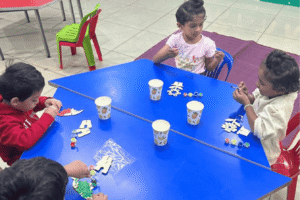
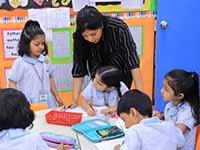
In GIIS KL classrooms, preschoolers learn about different kinds of shapes through art, games and physical exploration, which helps them visualise the connection between real-world objects and 2D figures.

What Are 3D Shapes?
Unlike 2D shapes, 3D shapes have three dimensions — length, width and height. These shapes are solid and exist physically in our environment.
Examples of 3D Shapes
- Cube – Dice, gift box
- Sphere – Ball, globe
- Cylinder – Can, drum
- Cone – Ice cream cone, traffic cone
- Pyramid – Egyptian pyramid, tent
Features of 3D Shapes
- Have faces, edges and vertices
- Can be touched and held
- Found everywhere in the real world
Through the GMP curriculum at GIIS KL, children engage with building blocks and digital learning tools to grasp the concept of “what are 3D shapes” in an interactive way.
Differences Between 2D and 3D Shapes
Understanding the differences between 2D and 3D shapes enhances logical categorisation and helps children make sense of their surroundings.
| Aspect | 2D Shapes | 3D Shapes |
| Dimensions | Length and Width | Length, Width, Height |
| Nature | Flat | Solid |
| Example | Circle, Square | Sphere, Cube |
| Use | Drawing, Painting | Construction, Modeling |
At GIIS KL’s Preschool, teachers integrate visual and tactile learning — letting children match flat 2D cutouts with real 3D models, reinforcing understanding through sensory play.
Comprehensive List of All Shapes for Preschoolers
A strong list of all shapes helps children identify and name both familiar and complex forms.
Common 2D Shapes
- Circle – Round shape with no sides (e.g., coin, clock)
- Square – Four equal sides and corners (e.g., chessboard)
- Rectangle – Two pairs of equal sides (e.g., door)
- Triangle – Three sides and corners (e.g., pizza slice)
- Oval – Like a stretched circle (e.g., egg)
- Pentagon – Five sides (e.g., home plate)
- Hexagon – Six sides (e.g., honeycomb)
- Octagon – Eight sides (e.g., stop sign)
Common 3D Shapes
- Cube: Six square faces (e.g., dice)
- Cuboid: Six rectangular faces (e.g., cereal box)
- Sphere: Round all around (e.g., ball)
- Cylinder: Two circular faces, one curved surface (e.g., can)
- Cone: One circular base, pointed top (e.g., party hat)
- Pyramid: Base with triangular sides (e.g., pyramid structure)
Creative Ways to Teach Shapes to Kids
Shape learning should be playful and immersive. Our GMP Programme emphasises active engagement, allowing children to “learn by doing.”
Here are some fun methods used both at home and in top preschools in Malaysia:
1. Shape Sorting
Give kids objects of various shapes to categorise — cubes, balls and cones — to build differentiation skills.
2. Shape Hunt
Ask children to find real-world shapes — “a round clock” or “a square table.” This builds practical awareness.
3. Drawing and Crafting
Encourage children to draw 2D shapes and build 3D ones using paper or clay.
4. Storytelling with Shapes
Create fun stories using characters like “Sally the Square” or “Tommy the Triangle.”
5. Technology-Enhanced Learning
Interactive smart boards and videos used in GIIS KL classrooms make shape recognition engaging and visual.
Also Read: Virtual International School is the Future of Education
How Learning Shapes Boosts Cognitive Growth
When kids understand different types of shapes, they learn pattern recognition, problem-solving and geometry concepts naturally.
At GIIS KL, shape-based activities are connected with various subjects. For example:
- Art: Identifying geometric shapes in drawings
- Math: Counting sides and vertices
- Science: Observing shapes in nature and structures
Such integration, a hallmark of the GMP Programme, ensures children don’t just memorise shapes — they understand their role in the real world.
Preschools in Malaysia and Their Approach to Shape Learning
Among leading preschools in Malaysia, GIIS Kuala Lumpur stands out for its blend of Montessori methods and modern technology. The GMP curriculum encourages exploration, creativity and practical understanding of everyday concepts like types of shapes with examples.
By focusing on both local and international standards, the preschool also prepares young learners for advanced academic tracks and IGCSE admission requirements in later grades.
How International Schools in Malaysia Enrich Early Learning
International schools in Malaysia, such as GIIS KL, design preschool curricula to balance play with structure. Children are exposed to multicultural environments where they learn to appreciate differences — not just in people, but in forms, sizes and shapes too!
The GMP Programme ensures that every child receives a well-rounded education, covering cognitive, physical and emotional growth — starting with the basics of shapes and progressing to abstract reasoning.
Shaping Bright Minds for a Bright Future
Learning shapes may seem simple, but it lays the groundwork for logical thinking, creativity and mathematical confidence. By understanding the different types of shapes — from 2D and 3D shapes to the differences between them — children develop a deeper understanding of their environment.
GIIS Kuala Lumpur’s preschool transforms this early learning step into a joyful journey through its Global Montessori Plus (GMP) Programme, making it one of the top preschools in Malaysia and a leader among international schools in Malaysia.
Final Words
Ready to give your child a head start in global education?
Explore the Global Montessori Plus (GMP) Programme at GIIS Kuala Lumpur’s Preschool — where curiosity meets creativity and learning shapes the leaders of the future.
Visit GIIS Kuala Lumpur to learn more about the curriculum, early learning admissions and IGCSE admission requirements today!