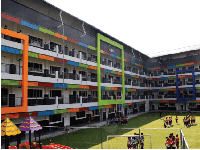
This article narrates that:
- The IGCSE mathematics syllabus is designed to build strong numbers, algebra, geometry and statistics skills and is widely offered by international schools in Malaysia.
- A good IGCSE maths study guide combines clear notes, exam-style practice, topic tracking and regular self-testing rather than last-minute cramming.
- Smart IGCSE tips include using past papers under timed conditions, mastering your calculator and focusing on common “trap” areas like algebraic manipulation and word problems.
- GIIS Kuala Lumpur (GIIS KL) follows the Cambridge IGCSE pathway, with maths as a core subject and a strong track record of excellent IGCSE results.
- Choosing a school with structured support, experienced teachers and a holistic framework like what is offered by schools such as GIIS KL, can make a huge difference to a student’s confidence and performance in IGCSE maths.

The Complete IGCSE Maths Study Guide (Malaysia Edition)
For many teens in Malaysia, IGCSE Mathematics is the subject that feels both important and intimidating. Whether you’re aiming for engineering, business, design or science, a strong maths grade opens doors—so it deserves a clear plan, not guesswork. This guide pulls together everything you need to know about the IGCSE maths syllabus, how to structure revision, practical IGCSE tips and how schools, such as GIIS KL, support students to turn anxiety into achievement.Understanding IGCSE Maths in Malaysia
In Malaysia, Cambridge IGCSE is one of the most popular international qualifications, and many international schools in Kuala Lumpur list it as a key offering. GIIS KL is positioned as a leading Cambridge IGCSE school, offering a well-structured curriculum that emphasises excellence in core subjects, including mathematics. The Cambridge IGCSE mathematics syllabus aims to:- Develop mathematical knowledge as a key life skill
- Build logical thinking and problem-solving skills
- Prepare students for A-Levels or other pre-university maths courses

Breaking Down the IGCSE Maths Syllabus
The exact IGCSE maths syllabus may vary slightly between core and extended tiers, but typically includes:- Number: fractions, percentages, ratio, standard form, bounds
- Algebra: equations, inequalities, graphs, sequences, transformations
- Geometry & Trigonometry: angles, shapes, similarity, Pythagoras, sine/cosine/tangent
- Co-ordinate Geometry: straight line graphs, gradients, midpoints
- Mensuration: perimeter, area, volume, surface area
- Statistics & Probability: data handling, averages, probability rules
Building Your Personal IGCSE Maths Study Guide
A generic guide is helpful, but the best IGCSE maths study guide is personalised. Try this 4-step structure:1. Map the Year
- Divide the IGCSE maths syllabus into monthly or weekly chunks.
- Align your plan with school tests and mock exams.
- Leave at least 4–6 weeks at the end for full revision and past papers.
2. Use Multiple Resources
- Class notes and textbook examples
- School-provided revision sheets
- Online explanations or videos for tricky topics
- Past papers and mark schemes (non-negotiable)
3. Practice with Purpose
Don’t just “do questions”—do them strategically:- Start untimed to learn methods.
- Then move to timed sets (e.g., 30 minutes of mixed questions)
- Review every mistake and rewrite the correct method in your notes.
4. Track Progress
- Keep a simple log of topics and scores.
- Celebrate improvement, not just perfection.
IGCSE Tips for Revision and Exam Day
Here are some focused IGCSE tips that Malaysian students often find useful:During Revision
- Master your calculator. Know how to use fraction, power, memory and statistical functions quickly. Don’t use your calculator “for the first time” in the exam.
- Write your own formula sheet. Even though some formulae may be provided, writing them repeatedly helps retention. Include area/volume formulae, trig identities and common algebra factorisation patterns.
- Mix topics in practice sessions. Real exam papers don’t say “this is the algebra section now.” Mix algebra, geometry and statistics questions so your brain gets used to switching gears.
- Teach someone else. Explain a tricky topic (e.g., completing the square, cumulative frequency graphs) to a friend or even to yourself out loud. Teaching is one of the strongest learning tools.
On Exam Day
- Do an easy sweep first. Answer all the questions you find straightforward to build confidence and secure marks, then circle back to harder ones.
- Show every step. In maths, method marks save you. If your final answer is wrong but your method is correct, you still gain credit.
- Check units and rounding. Many students lose marks through missing units (cm², m³) or incorrect rounding. Underline these in the question to remind yourself.
How GIIS KL Supports IGCSE Maths Success
A strong personal study plan works best when paired with a supportive school environment. GIIS KL offers:- A Cambridge pathway from primary through Lower Secondary into IGCSE, so students build maths skills step by step rather than “cramming” in the last two years.
- Experienced faculty and dedicated maths labs, using active learning and technology to make abstract ideas more accessible.
- Holistic 9GEMS ™ framework, which means exam preparation is balanced with critical thinking, creativity and well-being—crucial for avoiding burnout.
- Proven exam outcomes, with GIIS KL students regularly achieving outstanding IGCSE results and a high proportion of top grades across subjects, including maths.
Also Read: Virtual International School is the Future of Education