“Science is a way of thinking much more than it is a body of knowledge,” Carl Sagan.
From the air, we breathe to the car we drive, every aspect of our mundane lives is directly and indirectly governed by science. While science is essentially a human-driven field of study, it wholly revolves around the natural phenomena prevalent around each of us – plants and animals, cells and atoms, planets and stars, chemicals and elements.
Consequently, limiting the study of science to a thick textbook, some chemical formulae and the four walls of a classroom would negate the whole idea of science as a subject.
Today, elementary and high schools worldwide are recognising the significance of imparting practical scientific knowledge from an early age. Challenging students’ minds with scientific phenomena and pushing them to ponder can open up new possibilities. Therefore, here is a lucrative guide to understanding how one can teach science beyond H2SO4, mitochondria and E=MC2.
1. Preschool Science: Setting the Foundation
Science in preschool? “Yes!”, say experts who go on to suggest that children are programmed to explore their environments right from their formative years. Thus, setting a strong scientific foundation from an early age enables parents and teachers to nurture their scientific predispositions.
Teaching hardcore scientific principles to pre-schoolers can be rather overwhelming and may inhibit them from pursuing the subject. So, here are some simple yet innovative strategies to introduce science to preschoolers:
● Science From the Garden – And the Kitchen: There is science in the fruits children consume and the flowers they collect. Allowing them to explore these kitchen and garden items on their own can help them understand the rudiments of science. Sowing the seed of science in one’s mind literally begins with helping them sow a seed in the soil! Teachers may also conduct other activities such as propagating mint plants through cuttings; sprouting a bowl of fresh beans; preparing compost out of biodegradable waste, etc.
● Shapes, Sizes, Dimensions: The core principles of science and maths are based on an understanding of shapes and sizes. However, shapes and sizes go beyond recognising circles and squares to include a careful study of their patterns. Children may be asked elementary questions like, “How many sides do a square have?” or “Does a circle have lines?” Such questions enable children to ponder over the shapes they witness around them.
● Every Answer has a Question: Asking children questions is just as important as answering the questions they pose. However, instead of being the static and direct one’s asked in exams, teachers may ask interesting, open-ended questions as part of their classroom activities. Some of these include, “Did the apple you ate have seeds? What can you do with it?”, or “What would happen if there were no trees in the school campus?”
2. Primary School Science: Laying the Bricks
While primary school students are still too young for chemical formulae and equations, they are more adept at understanding advanced concepts and theories. Here are some ways to teach science to primary school students:
● What Lives and What Doesn’t: Differentiating between living things and nonliving things is one of the most initial theories that schools in Singapore teach their students. Teaching basic concepts like the characteristics of a living thing (such as breathing, requiring food and water, reproducing and dying) are essential to establish the base for biology and chemistry.
● Solid, Liquid, Gaseous: Understanding the changing states of matter can be extremely interesting and enriching for primary school students. Schools may elucidate the boiling and melting points of water, the restoration of the matter into liquid form at room temperature, etc.
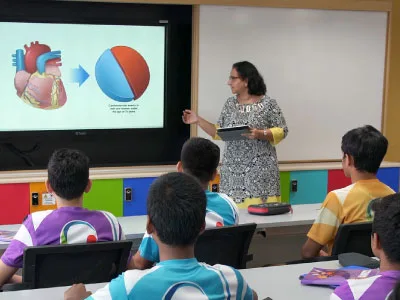
● Seeing is Believing: One of the most effective learning strategies is the visual representation of scientific information. These could range from creative diagrams and charts to tangible globes and real-world objects. One may even conduct engaging sessions of viewing objects under the microscope or observing planets via a telescope.
3. Secondary School Science: Cementing the Structure
At the secondary school level, science eventually transforms from theories and innovative classroom activities to laboratory experiments, formulae and equations. However, does this transformation imply that the subject would become overwhelming? By no means! When students are already familiar with basic scientific experiments conducted as part of their fun classroom activities, they typically find it a breeze to apply their scientific knowledge in a laboratory setting. Here are some ways to smoothen the switch:
● Guided Discovery: Teachers may begin by introducing theoretical scientific concepts in the classroom, such as discussing chemicals’ properties. Then, at the laboratory, students may be asked to identify these chemical compounds based on their classroom discussions. Such a guided discovery strategy enables them to apply theoretical concepts seamlessly at the laboratory.
● Lab-Coats, Beakers, Independent Experiments: Many traditional schools often directly escalate to specific lab experiments after providing a gist of the apparatus and aim. However, modern schools allocate specific predefined time-slots for students to freely explore the apparatus, including beakers, chemical reactions, test-tubes, heaters, etc. However, the teachers are always present to monitor the students, ensuring their safety closely.
● The Back-Story of Equations and Formulae: Any student may by-heart learn physics equations and chemical formulae and pass their practical and theory exams. However, comprehending these formulae’s genesis can crystallise these concepts in their minds, helping them better retain the information. For example, students may experiment with chemical compounds and arrive at the formula through practical exploration at the laboratory. Similarly, in their biology class, they may carry out the mould bread experiment and observe the sporangiophore and other components under the microscope.
4. High School Science: Providing the Final Touch
Finally, students need to be well-versed with Physics, Chemistry and Biology at the high school level, together with their respective subdomains. At this point, understanding the nitty-gritty of practical and theoretical science is exceptionally crucial. Here are some handy tips to teaching science at this level:
● Maths and Science, Hand-in-Hand: Having a strong foundation in maths is a prerequisite for comprehending scientific theories and principles. Thus, it helps to provide students with supplementary maths problems that are mentally stimulating and intriguing.
● Problem-Solving Challenges: Most scientific experiments involve hypotheses (or problem statements) and a systematic approach to resolving these. Thus, problem-solving is one of the essential activities required to master science. Providing advanced-level problem-solving activities can help higher-secondary students to cope better with scientific principles and formulae.
● Continuing to Question: Regardless of one’s age or academic level, the process of questioning must continue. Teachers must encourage high school school students to ask whatever questions pop into their minds while studying the various science subjects. Schools may also conduct brainstorming sessions and quizzes to make the process more interactive and exciting.
Conclusion
Science is a vast and comprehensive field of study involving multiple principles, approaches and formulae, which is propagated from GMP to IBDP in Singapore. Teaching the subject innovatively insides and outside classrooms, and considering individual learning styles can help students befriend the subject effortlessly, losing themselves in the enchanting world of science.

Team GIIS
Team GIIS is a group of enthusiastic writers who bring the vibrant world of GIIS in Singapore to life through engaging blog posts. Dedicated to highlighting the school’s teaching methodology, innovative learning environment, and diverse curriculum options like IB, Cambridge and CBSE, they aim to connect with parents, educators and students, sharing insights and stories that inspire and inform the school community.