Global
All Cities
Where would you like to study? Select cities to refine your search.
Any Curriculum
Find a campus based on the curriculum offered.
Global
Global
All Cities
Where would you like to study? Select cities to refine your search.
Any Curriculum
Find a campus based on the curriculum offered.
Search

Play-based Learning in IB Early Years: Fostering curiosity and lifelong learning

IB Early Years

Play is essential for children’s holistic development, enabling them to express emotions, experiences, and creativity (Landreth, 1993).  Several researchers have come to the conclusion that play in early childhood years teaches children the art of being human, activating their senses and encouraging active engagement with the world. Through play, children learn about the world, and themselves.

In International Baccalaureate (IB) Early years setting, play-based learning is a vital approach that nurtures young learners’ curiosity, creativity, and love for learning.  This pedagogical approach aligns perfectly with the IB’s mission to develop inquiring, knowledgeable, and compassionate individuals. In this article, we will explore the world of play-based learning, understanding its principles, benefits and practical strategies for implementation.


What is Play-based Learning?

Play-based learning is an educational approach that leverages play as a primary vehicle for learning.  It recognises that children’s natural inclination to explore, experiment, and imagine is essential to their cognitive, social, emotional, and physical development.  By providing a supportive environment, teachers facilitate children’s play, guiding them towards discovery, inquiry, and construction of knowledge.


What are the benefits of Play-based Learning in IB Early Years?

The benefits of play-based learning in IB Early Years are numerous. By engaging in play, Early Years learners develop their critical thinking and problem-solving skills. It enhances their creativity and imagination, fosters curiosity and inquiry, improves memory and concentration and develops spatial awareness and mathematical understanding.


Also read: Early childhood education: Reasons to opt for IB PYP Early Years at GIIS

What kinds of play experiences do GIIS EYP students engage in?

At GlIS, our IB Early Years Programme (EYP) students incorporate play-based learning into their daily routine, exploring various opportunities for growth. Their schedule includes free play where they are given uninterrupted blocks of time to explore, experiment, and engage in activities without adult direction for self- directed exploration, experimentation, and interest-led discovery.

It’s unstructured, child-led and driven by their own interests and curiosities.  Students also engage in structured play where they are given specific activities that are intentionally designed and facilitated by teachers to achieve specific learning objectives. Pretend play, also known as imaginative or dramatic play, is also another kind of play that EYP students at GIIS engage into.  It’s a type of play where children use their imagination to create scenarios, roles, and stories, often using props and materials that are found in their learning environment.

What’s new in IB Early Years at GIIS?

At GIIS, the IB Early Years Programme ( IB EYP) students are currently inquiring into their unit on “People explore their environment through relationships.”  As they explored their learning environment – their classroom, the Learning Commons, and even their play areas in school, students noticed that there are things in their environment that have life and there are those that were not alive.

early-years
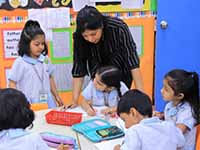
A GIIS IB Early Years student engaging in a classroom activity

This led them to take out their magnetic blocks and LEGOs and create a representation of their observation showing what were the living things that they have seen, and what were the non-living things they encountered around them.  They recreated their learning space and engaged with active discussions with their peers and their teachers.

Play-based learning develops independence and self-directed learning among young learners.  It also develops communication skills, empathy and understanding of others — fostering collaboration and enhancing social skills.

Practising phonetic sounds through play

On another instance, during their language class, EYP students at GIIS independently used beads from their loose-parts corner of their classroom to create a phonics necklace using pipe cleaners.  They used this necklace to practise their phonetic sounds.

By incorporating play-based learning, IB Early Years educators at GIIS provide a solid foundation for children’s cognitive, social-emotional, and personal growth, setting them up for success in the IB Primary Years Programme and beyond.

If you are interested to know more about our IB Early Years Programme at GIIS, please feel free to connect with our admissions counsellors.

Odaia B Ranido

Ms. Ranido is the IB Early Years and PYP coordinator for GIIS Singapore. She has over 20 years of teaching experience in different international and bilingual schools in Southeast Asia. She spent the last 11 years leading the implementation of the IB Primary Years Programme (PYP) as a coordinator and teacher. She completed her Masters of Arts in Education from Sheffield Hallam University, UK in 2015. Ms. Ranido joined the Global Indian International School, EC Campus in July, 2019.
Featured Blogs

GIIS

Extra-Curricular Activities (ECA) at GIIS Singapore: Sports, Arts & Clubs Guide

A child’s growth extends far beyond academics. At Global Indian International School (GIIS) Singapore, Extra-Curricular Activities (ECAs) and Co-Curricular Activities (CCAs) are thoughtfully designed to nurture leadership, creativity, teamwork, confidence, and physical wellbeing alongside academic excellence.

IB Curriculum

IB Schools in Singapore: Top Schools, Fees & How to Choose (2026)

Choosing the right IB school in Singapore is one of the most important decisions for families seeking an internationally recognised education. With Singapore being home to some of Asia’s leading International Baccalaureate (IB) schools, parents today have access to a wide range of institutions offering strong academics, global exposure, and holistic learning environments.

Singapore Education System

PSLE vs International School Singapore: Which Path is Right for Your Child?

Every parent wants to choose the educational pathway that will best support their child’s confidence, happiness, academic growth, and future opportunities.

CBSE

Secondary School Fees in Singapore: CBSE, IGCSE & IB Compared (2026-27)

Choosing the right secondary school in Singapore involves balancing academic quality, curriculum options, future opportunities, and affordability. With multiple international curricula available, including CBSE, IGCSE, and IB, parents often compare tuition fees alongside campus facilities, learning approaches, and long-term value.

Top Scholarships

Dr APJ Abdul Kalam Global Skills Scholarship

Eligibility:

Talent Based - Technology

More from same author
Trending Blogs

GIIS

Extra-Curricular Activities (ECA) at GIIS Singapore: Sports, Arts & Clubs Guide

A child’s growth extends far beyond academics. At Global Indian International School (GIIS) Singapore, Extra-Curricular Activities (ECAs) and Co-Curricular Activities (CCAs) are thoughtfully designed to nurture leadership, creativity, teamwork, confidence, and physical wellbeing alongside academic excellence.

IB Curriculum

IB Schools in Singapore: Top Schools, Fees & How to Choose (2026)

Choosing the right IB school in Singapore is one of the most important decisions for families seeking an internationally recognised education. With Singapore being home to some of Asia’s leading International Baccalaureate (IB) schools, parents today have access to a wide range of institutions offering strong academics, global exposure, and holistic learning environments.

Singapore Education System

PSLE vs International School Singapore: Which Path is Right for Your Child?

Every parent wants to choose the educational pathway that will best support their child’s confidence, happiness, academic growth, and future opportunities.

CBSE

Secondary School Fees in Singapore: CBSE, IGCSE & IB Compared (2026-27)

Choosing the right secondary school in Singapore involves balancing academic quality, curriculum options, future opportunities, and affordability. With multiple international curricula available, including CBSE, IGCSE, and IB, parents often compare tuition fees alongside campus facilities, learning approaches, and long-term value.

IB Curriculum

What is the IB Curriculum? A Parent’s Simple Guide to PYP, MYP & Diploma (2026)

Choosing the right curriculum is one of the biggest decisions parents make for their child’s future. With more families in Singapore exploring international education pathways, the International Baccalaureate (IB) curriculum has become one of the most respected and future-focused learning frameworks globally.

Search
History Menu Icon

Our vision is to become a global role model for teaching and learning.

History Menu Icon Secondary

Since its inception in 2002, GIIS has spread quality education through 17 campuses across the globe.

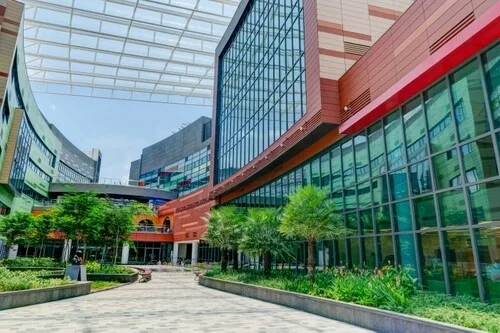
Global Indian International School Singapore smart campus learning environment

SMART Campus

A green, tech-enabled campus with extensive sports facilities that enables a holistic education

  • Kindergarten Menu Image

    Montessori education with a modern touch.

  • Primary School Menu Image

    International primary programmes with best holistic learning.

  • Secondary School Menu Image

    International middle school programmes with best foundation for high school.

  • High School Menu Image

    International high school programmes with beat launchpads for university.

21st Century Learning Campus

Facilities which are collaborative, creative and adaptable to individual needs.

Holistic Education Menu

Award-winning framework for all-round student development

CCA Menu Image

Extra-curricular activities are those activities, often sports-based, that take place outside of the GIIS classroom

ECA Menu Image

Talent shows, performances, competitions, clubs and additional classroom work.

Admission Process Icon

Get an overview of the admissions process

Campus Tour Icon

Register for a tour of the campus to learn more about the school first hand

Book Meeting Icon

You can talk to our Admissions Counsellor online or in-person, as per your convenience.

Admissions Form Icon

Find all forms related to admissions procedure here

Fees Icon

Get information on our fee structure for different grades

Scholarship Icon

Thank you for considering GIIS as a prospective school for your child. Our goal is to make the admissions.