Choosing the right curriculum is one of the biggest decisions parents make for their child’s future. With more families in Singapore exploring international education pathways, the International Baccalaureate (IB) curriculum has become one of the most respected and future-focused learning frameworks globally.
At Global Indian International School (GIIS Singapore), students experience the IB curriculum through inquiry-based learning, innovation, and holistic development designed to prepare them for global success.
As IB admissions experts with over a decade of experience placing students in top-tier global universities, we have seen firsthand how the International Baccalaureate (IB) curriculum transforms young learners into inquisitive, confident, and globally minded individuals.
With 2026 approaching, the IB continues to be regarded as the gold standard for holistic education. This IB Curriculum Guide for Parents in 2026 provides a clear and comprehensive breakdown of the IB framework, helping families make informed decisions about their child’s academic journey and future success.
What is the IB Curriculum? An Overview
The International Baccalaureate (IB) is a non-profit foundation offering four highly respected programs of international education. Unlike national curricula that focus on rote memorisation, the IB is a framework-based system that emphasises critical thinking, intercultural understanding, and exposure to a variety of points of view.
At its core, the IB is governed by the IB Learner Profile- ten attributes that develop students as responsible members of local, national, and global communities.
The IB Learner Profile Explained for Families:
The IB aims to develop learners who are:
- Inquirers: Nurturing curiosity and a love for learning.
- Thinkers: Developing critical and creative problem-solving skills.
- Communicators: Expressing ideas confidently and effectively.
- Principled: Acting with integrity, empathy, and respect for others.
- Balanced & Reflective: Building emotional, intellectual, and personal awareness for lifelong growth.
1. IB Primary Years Programme (PYP): Ages 3–12
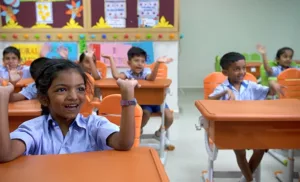
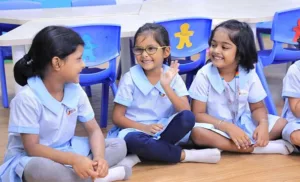
The IB Primary Years Programme is designed for students in preschool and primary school. It focuses on the development of the whole child as an inquirer, both in the classroom and in the world outside.
- Approach: Transdisciplinary learning. Instead of isolated subjects, students explore ‘Units of Inquiry’ that weave together math, language, and science.
- The Culmination: The PYP Exhibition, where students conduct a collaborative inquiry into a real-world issue.
2. IB Middle Years Programme (MYP): Ages 11–16
The MYP provides a challenging framework that encourages students to make practical connections between their studies and the real world.
- Structure: 8 Subject Groups (Language Acquisition, Language and Literature, Individuals and Societies, Sciences, Mathematics, Arts, Physical and Health Education, and Design).
- Assessment: Focuses on conceptual understanding rather than just content.
- The Personal Project: A year-long independent project in the final year of the MYP that demonstrates the student’s ability to manage their own learning.
3. IB Diploma Programme (DP): Ages 16–19
The IB Diploma Programme (DP) is the most recognised of the four IB programmes. It is a rigorous two-year pre-university course that culminates in examinations and is accepted by leading universities worldwide.
What Makes the IB Diploma Unique?
To earn the diploma, students must complete the IB Core, which is central to the DP experience:
- Theory of Knowledge (TOK): Explores how we know what we claim to know.
- Extended Essay (EE): A 4,000-word independent research paper.
- Creativity, Activity, Service (CAS): Activities involving community service, creativity, and physical wellbeing.
Academic Requirements
Alongside the core components, students must:
- Study six academic subjects
- Complete assessments and examinations
- Achieve a minimum overall score (typically 24 points or higher) to receive the diploma
Why the IB Core Matters:
The IB Core is designed to develop critical thinking, research skills, creativity, and global awareness — qualities highly valued by universities around the world.
Why Choose GIIS Singapore for the IB Diploma Programme?
SMART Campus Environment at GIIS Singapore
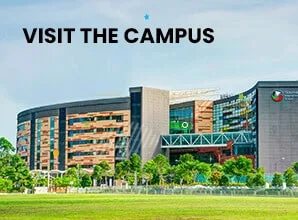
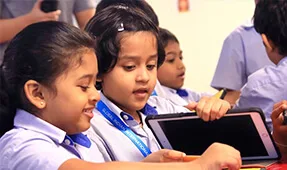
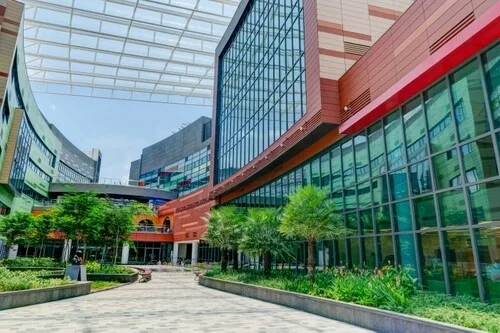
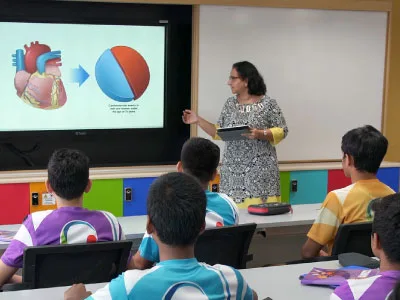
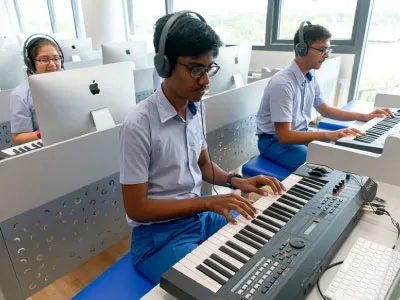
Global Indian International School features a SMART campus designed to enhance learning through technology-enabled classrooms, digital tools, and connected systems that make education more interactive, efficient, and future-ready.
Inquiry-Led Learning in IB Classrooms
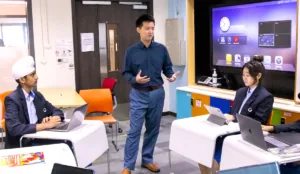
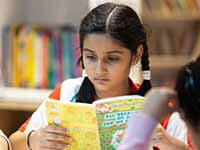
At GIIS Singapore, IB learning is driven by inquiry-led classrooms where students actively explore concepts, ask meaningful questions, and solve real-world problems—building strong analytical and critical thinking skills beyond rote learning.
Experienced IB Educators
Students are taught by experienced IB educators trained in IB pedagogy and assessment standards. This ensures strong academic support while also nurturing independent thinking and balanced development.
Innovation Labs for STEM and Creativity
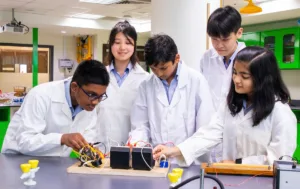
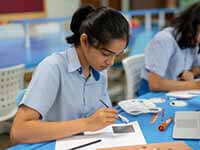
GIIS Singapore provides innovation labs where students engage in hands-on experiments across science, technology, engineering, design, and research, helping them apply theory to practical challenges.
Personalised University Guidance
Dedicated counsellors at GIIS Singapore offer personalised university guidance, supporting students with course selection, application strategy, and admissions planning for top global universities.
Holistic Learning Approach
The IB programme at GIIS Singapore promotes holistic development by balancing academics with sports, arts, and community service, helping students grow into well-rounded individuals.
Leadership Opportunities for Students
Students are encouraged to take on leadership roles through projects, clubs, and service initiatives, developing confidence, teamwork, and responsibility in real-world contexts.
Comparison: IB vs. A-Levels for University Admission
To understand the benefits of the IB Diploma programme, a common question for parents is whether to choose the IB or the British A-Levels.
| Feature | IB Diploma Programme | A-Levels |
| Breadth | Study 6 subjects (3 Higher Level, 3 Standard Level) | Study 3 or 4 subjects in-depth |
| Core Requirements | TOK, EE, and CAS included | No mandatory core/extracurriculars |
| Assessment | Internal assessments + Final exams | Primarily final exams |
| University Prep | Highly regarded for research and time management | Highly regarded for subject-specific depth |
It is observed that while A-Levels allow for early specialisation, the IB is often preferred by top-tier universities (Ivy League, Oxbridge) because it produces well-rounded students who are already accustomed to university-level research.
Is the IB Diploma Worth it for College?
In 2026, university admissions are more competitive than ever. Admissions officers look for more than just high grades; they look for intellectual stamina.
- University Acceptance Rates: Statistics consistently show that IB students have a higher acceptance rate at Ivy League universities compared to the total population of applicants.
- University Readiness: IB graduates tend to skip introductory courses in college due to the depth of their High School Diploma coursework.
- Global Mobility: The IB is a ‘portable’ qualification. If your family moves from Singapore to London or New York, the IB remains a recognised curriculum of education.
Final Take: Is the IB Right for Your Child?
The IB curriculum is ideal for students who are curious, motivated, and want a global perspective. Schools like Global Indian International School (GIIS) provide a nurturing environment where the IB framework is combined with state-of-the-art facilities to ensure students maximise their potential.
Choosing the right path:
- Choose the PYP/MYP if you want your child to develop ‘learning how to learn’ skills early on.
- Choose the IB Diploma if your child aims for top global universities and enjoys a broad, challenging range of subjects.
Frequently Asked Questions
How does the IB Middle Years Programme (MYP) differ from a traditional High School Diploma?
The IB MYP focuses on real-world, interdisciplinary learning and global contexts, while a traditional High School Diploma is usually more textbook and subject-credit based. The MYP also includes a personal project that builds independent research and critical thinking skills.
What are the specific benefits of the IB Diploma Programme for STEM students?
The IB Diploma Programme helps STEM-focused students build strong analytical and research skills. Students study Mathematics alongside sciences and complete the Internal Assessment (IA), a research-based project that develops laboratory, data analysis, and scientific writing skills.
Is the IB curriculum suitable for students who are not ‘all-rounders’?
No. The IB is designed for a wide range of learners and offers flexibility across the PYP, MYP, and DP programmes.
In the Diploma Programme (DP), students choose:
- 3 Higher Level (HL) subjects focused on their strengths
- 3 Standard Level (SL) subjects for balanced learning
This structure allows students to specialise in areas they enjoy — such as Arts, Languages, or Sciences — while still developing well-rounded academic skills.
How do universities in 2026 view the IB Extended Essay during admissions?
While A-Levels allow students to specialise early, many top universities value the IB Diploma because it develops strong research, writing, time management, and critical thinking skills alongside academic depth.
Ready to explore the IB for your child? Visit GIIS Singapore to see how the IB framework is implemented in a world-class setting.

Team GIIS
Team GIIS is a group of enthusiastic writers who bring the vibrant world of GIIS Singapore to life through engaging blog posts. Dedicated to highlighting the school’s teaching methodology, innovative learning environment, and diverse curriculum options like IB, Cambridge and CBSE, they aim to connect with parents, educators and students, sharing insights and stories that inspire and inform the school community.