Global
All Cities
Where would you like to study? Select cities to refine your search.
Any Curriculum
Find a campus based on the curriculum offered.
Global
Global
All Cities
Where would you like to study? Select cities to refine your search.
Any Curriculum
Find a campus based on the curriculum offered.
Search
Top 5 Benefits of the IB Diploma Programme

Top 5 Benefits of the IB Diploma Programme

Secondary School

The IB Diploma Programme (IBDP) is a rigorous pre-university programme, designed to prepare secondary school students for university and beyond. The programme provides students with a well-rounded education, and challenges them both academically and non-academically.

The IBDP features a broad set of subjects in which students exercise their critical thinking skills. It also includes core components such as the Creativity, Activity, Service (CAS) Programme, the Theory of Knowledge and the Extended Essay. When students successfully complete the IBDP, they are often included in the top brackets of students who are vying for university placements around the world. These are a few more benefits of the International Baccalaureate (IB) Diploma that your child may realise if they enrol in the programme at GIIS.

‍

‍

‍

Rigorous academic curriculum

The IBDP is anchored by its broad subject groups, in which students can select specific courses geared towards their personal interests or professional aspirations. By having the ability to choose subjects that suit their unique interests, students can cater their learning experience to their needs.

They feel in control of their own education, which increases their motivation to complete their coursework and succeed in a specific subject.

The subject groups that are included as part of the IBDP are Studies in Language and Literature, Language Acquisition, Individuals and Societies, Sciences, Mathematics and the Arts.

‍

‍

Broad outlook and global perspective

The subject areas and courses the students take in the IBDP are designed with a global perspective in mind. The courses involve group discussions and sharing of personal views and the students are required to participate in the classes actively.

In the IBDP, students are asked to consider the global perspective of a given issue. The student body at GIIS complements this emphasis on a global perspective, as students have lived in various countries around the world and regularly interact with people from a wide variety of backgrounds and cultures.

Given the fact that students will face an increasingly global economy in future, it’s extremely beneficial for them to develop a broad outlook during secondary school.

‍

Critical thinking and collaborative skills

The IBDP sets itself apart from other similar curriculum programmes because its focus extends beyond knowledge acquisition. Students are not simply required to memorise facts and reiterate the information they have learned during routine assessments.

Instead, the structure of the courses allows students to develop the 21st-century skills that they will need to succeed. Students naturally build their critical thinking skills during the innovative assignments and assessments that are provided.

In addition, they often work together with their classmates, which helps them develop their collaborative skills.

‍

Time management skills for university and beyond

Students in the IBDP have the opportunity to follow their syllabus for each individual course and determine how to best complete their assignments.

This real-world practice of time management ensures that they are ready for university, which will require them to pace themselves, set their own deadlines and exercise self-discipline in meeting those deadlines.

Time management is a skill that needs to be learned early and often practised to be perfected over time.

In-demand candidates for top universities globally

The IBDP is the best first step they can take towards accomplishing their personal goals, and it will uniquely prepare them for the university experience and the professional world.

‍

The IBDP is offered at various schools in Singapore, so why should your child opt to enrol in the IBDP at GIIS? Here are a few reasons to consider:

● With over 96 World Toppers and Near Perfect scorers till date, our consistent results are a testimony to our commitment towards academic excellence. ​​In 2022, GIIS IBDP students made their parents and the school proud once again with 10 students emerging as IB World Toppers (45/45) and 16 as Near Perfect (44/45) scorers in 2022. With a school average of 38.6 points, GIIS’ average score surpassed the global average (31.98) and Singapore average (37.49) IBDP score for 2022.

● We are an established international school that has been offering the IBDP since 2005. Our experience with the IBDP ensures that your child has a successful experience. Our staff members are IB certified, experienced DP teachers and 70% of our teachers are IB examiners.

● Our students get selected at top universities globally, including in the US, UK, Singapore, Canada, India and other countries. Some of the universities where our students have been accepted in the last three years include University of Oxford, University of Cambridge, National University of Singapore, UCLA, Cardiff, London School of Economics and Political Science and more.

‍

Also read: ‘IB Learner Profile exposed me to new perspectives’: GIIS IBDP 2022 graduate

‍

We have in-house counsellors, including a dedicated career counsellor who holds one-to-one sessions with our DP students as they apply to get into universities of their choice – whether it is preparing their resume, writing personal statements or the essays, or acing interviews when preparing for university placements.

We welcome you to contact GIIS at any time to learn more about the IBDP programme. To enrol your child in the IBDP, please feel free to contact our admissions counsellors.
‍

Deepa Chandrasekaran

Ms. Deepa Chandrasekaran is a highly-qualified and experienced teacher at GIIS Singapore since 2007. With more than 10 years of experience as the IBDP coordinator at GIIS, Ms. Deepa is well-versed with the IB Diploma curriculum, subject-selection counselling, examinations, teacher orientation and training. She teaches Higher Level and Standard Level Economics in the DP, and is passionate about creating a stimulating learning environment for DP students.

Featured Blogs

Secondary School

How International Schools Develop Future-Ready Students Through Advanced Presentation Skills

Most international schools build presentation skills by making students speak, perform and defend ideas in front of real audiences, repeatedly and from an early age. At GIIS in Singapore, this happens through the international and Indian curricula, including IB, Cambridge and CBSE and 9GEMS framework. Students also practise these skills through performances, competitions and clubs.

School

How International Schools in Singapore Develop Life Skills Through Different Teaching Approaches

Many international schools in Singapore teach life skills by embedding practical competencies such as problem-solving, emotional regulation and teamwork directly into personalised academic frameworks. Rather than using one-size-fits-all instruction, most top institutions adapt life skill development to match visual, discussion-based and hands-on learning activities.

GIIS

How Do International Schools Prepare Students for University Applications from Grade 9 & 10?

Parents researching Singapore's international schools often ask the same question: when should university planning actually begin? The honest answer is earlier than most families expect. By the time a student reaches Grade 12, the subjects they took, the activities they pursued and the guidance they received years earlier have already shaped what doors are open to them.

GIIS

What Does “Holistic Education” Actually Mean in a Singapore International School?

In a Singapore international school like GIIS, holistic education means academics sit alongside eight other areas of development — sport, arts, leadership, innovation, community service, personality growth, skills, and values — inside one structured framework. It isn't a marketing phrase; it's how the timetable and activities are actually organised. It's natural to wonder what it actually means for your child. Ask ten different parents and you'll probably hear ten different answers — and that's okay. This guide breaks down the meaning of holistic education in plain language, explains what holistic learning looks like day to day and shows how it compares to a traditional, exam-first model.

Top Scholarships

Dr APJ Abdul Kalam Global Skills Scholarship

Eligibility:

Talent Based - Technology

More from same author
Trending Blogs

Secondary School

How International Schools Develop Future-Ready Students Through Advanced Presentation Skills

Most international schools build presentation skills by making students speak, perform and defend ideas in front of real audiences, repeatedly and from an early age. At GIIS in Singapore, this happens through the international and Indian curricula, including IB, Cambridge and CBSE and 9GEMS framework. Students also practise these skills through performances, competitions and clubs.

School

How International Schools in Singapore Develop Life Skills Through Different Teaching Approaches

Many international schools in Singapore teach life skills by embedding practical competencies such as problem-solving, emotional regulation and teamwork directly into personalised academic frameworks. Rather than using one-size-fits-all instruction, most top institutions adapt life skill development to match visual, discussion-based and hands-on learning activities.

GIIS

How Do International Schools Prepare Students for University Applications from Grade 9 & 10?

Parents researching Singapore's international schools often ask the same question: when should university planning actually begin? The honest answer is earlier than most families expect. By the time a student reaches Grade 12, the subjects they took, the activities they pursued and the guidance they received years earlier have already shaped what doors are open to them.

GIIS

What Does “Holistic Education” Actually Mean in a Singapore International School?

In a Singapore international school like GIIS, holistic education means academics sit alongside eight other areas of development — sport, arts, leadership, innovation, community service, personality growth, skills, and values — inside one structured framework. It isn't a marketing phrase; it's how the timetable and activities are actually organised. It's natural to wonder what it actually means for your child. Ask ten different parents and you'll probably hear ten different answers — and that's okay. This guide breaks down the meaning of holistic education in plain language, explains what holistic learning looks like day to day and shows how it compares to a traditional, exam-first model.

Search
History Menu Icon

Our vision is to become a global role model for teaching and learning.

History Menu Icon Secondary

Since its inception in 2002, GIIS has spread quality education through 17 campuses across the globe.

Global Indian International School Singapore smart campus learning environment

SMART Campus

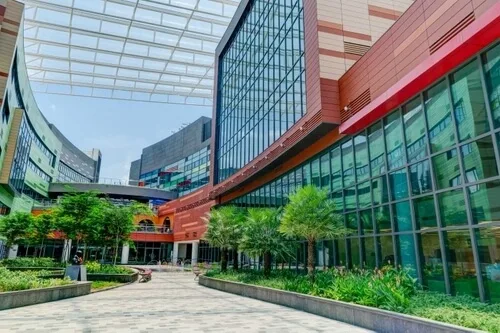
A green, tech-enabled campus with extensive sports facilities that enables a holistic education

  • Kindergarten program at GIIS Singapore smart campus

    Montessori education with a modern touch.

  • Primary school curriculum at GIIS Singapore

    International primary programmes with best holistic learning.

  • Secondary school students learning at GIIS Singapore

    International middle school programmes with best foundation for high school.

  • High school education and curriculum at GIIS Singapore

    International high school programmes with beat launchpads for university.

21st century learning campus at GIIS Singapore

Facilities which are collaborative, creative and adaptable to individual needs.

Holistic education approach with 9 Gems at GIIS Singapore

Award-winning framework for all-round student development

Co-curricular activities at GIIS Singapore

Extra-curricular activities are those activities, often sports-based, that take place outside of the GIIS classroom

Extra curricular activities at GIIS Singapore

Talent shows, performances, competitions, clubs and additional classroom work.

Admission Process Icon

Get an overview of the admissions process

Campus Tour Icon

Register for a tour of the campus to learn more about the school first hand

Book Meeting Icon

You can talk to our Admissions Counsellor online or in-person, as per your convenience.

Admissions Form Icon

Find all forms related to admissions procedure here

Fees Icon

Get information on our fee structure for different grades

Scholarship Icon

Thank you for considering GIIS as a prospective school for your child. Our goal is to make the admissions.