What do GIIS educators mean by “experiential learning”? Experiential learning happens when students are allowed to practise a skill and then apply it to a real-world setting. Learning how to drive involves the experiential learning process because we first learn the rules of the road and are then placed behind the wheel of a car to practise what we’ve learned.
As we drive, we make judgement calls based on reasoning and experience consequences and rewards. As a result, we not only learn what to do behind the wheel but also what not to do. The whole process develops skills such as exploration, observation, reflection, reasoning and conclusion.
But this type of learning is not only helpful for adults but also school-age children; it takes place all through life. Voting is another great example of experiential learning. Adults learn about the candidates and their platforms and then register their vote for the candidate they most agree with. If their candidate is elected, they have the opportunity to see how they perform and decide whether they will vote for this person again.
Children who have the opportunity to use experiential learning in the classroom become adults who have the critical thinking skills needed to succeed in life. For this reason, it’s vital that students have exposure to hands-on learning activities all through school.
What does student-centered learning look like in the classroom?
Let’s take the topic of how a government works and introduce it in a way that involves experiential learning. It may look something like this:
1. Students receive information from the teacher about the Legislative, Executive, and Judicial branches of government.
2. Students then choose which role they would like to play, and groups are formed.
3. The legislative group devises a set of rules by which the classroom will be governed.
4. The executive group ensures the rules are carried out.
5. The judicial group evaluates the rules and develops consequences when they’re breached.
6. Students reflect on what they’ve learned about how a government operates.
7. Students then strategise on how to improve upon the system they’ve developed. For example, they may reword the rules to eliminate loopholes or devise more effective consequences for breaches.
8. Students have the opportunity to test their new model of government to see how well it works.
As students work through each step, they’re practising the four components of experiential learning, as theorised byAmerican psychologist Dr David Kolb:
● Concrete experience where students are exposed to a new learning experience.
● Abstract conceptualisation as they transform the information from their experience to create a hypothesis or model.
● Active experimentation where the students test the model they create. Thereby, developing their research, critical thinking and problem-solving skills students.
● Reflective observation as students must ultimately reflect on these experiences.
Why Experiential Learning is beneficial
This type of learning benefits students for several reasons, but the biggest among them involves student engagement. Because students approach the material in an enjoyable and creative manner, they become more invested. They actually want to find answers and test theories. However, there are other advantages that experiential learning has over more traditional approaches, too. They include:
● A safe, relaxed environment in which it’s okay to make mistakes without being criticised
● The opportunity for deep reflection and introspection
● Real-world relevance
● The opportunity for active engagement and participation
● Experience in collaboration
● Practice in problem-solving
● Increase in retention
Does Experiential Learning boost motivation?
Absolutely, it does. Research has shown that students who take an active interest in their learning paths tend to perform better academically. To this end, researchers have found that motivation for learning requires four basic components:
1. Attention
2. Relevance
3. Confidence
4. Satisfaction
If one or more of these components are missing from the material and the way in which it’s being presented, then students may lack engagement. This, in turn, may lead to disinterest. It’s the difference between teaching a classroom full of excited, enthusiastic students and trying to drill instruction into the bored minds of resentful learners.
Students who are engaged and motivated want to learn the material. They want to find their own answers and draw their own conclusions based on the discoveries they’ve made. They want to try out what they’ve learned to see if it actually works or to see if they can improve upon existing methods.
When students reach this point in their study of a concept or idea, they take a large step toward mastery. They’ve performed the research, drawn conclusions, developed theories, tested those theories, and reflected on what they’ve learned.
Becoming critical thinkers and problem-solvers
Hands-on learning activities like the ones mentioned here are enjoyable and thought-provoking. Since there’s no right or wrong way to arrive at a conclusion, students learn to think outside the box. They’re free to use their own approach to research and explore their own theories.
This is ideal practice for problem-solving in the real world. Once students graduate from GIIS, they’ll become genuinely self-led. Experiential learning hones skills in critical thinking, problem-solving and reasoning.
Integrating into classroom at every grade level
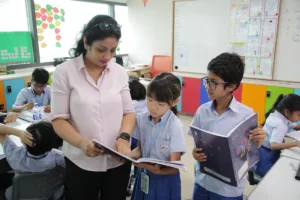
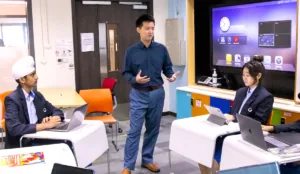
GIIS educators have found that experiential learning can be used to teach nearly any topic at any grade level. By introducing collaborative learning activities and opportunities for hands-on exploration, educators can encourage this type of student-centred learning. Allowing time for students to reflect on their outcomes is also a vital component. At GIIS, it’s the educator’s role to provide information and opportunities for experimentation and act as guides as students take ownership of their learning.
Also read: How we embrace Experiential Learning at GIIS preschool
Is Experiential Learning an effective approach to education?
It is at GIIS. Experiential learners not only learn the material, but they learn how to apply what they’ve learned to real-world scenarios. And learning is not only effective but enjoyable. Levels of engagement are high, and students gain the practical skills they need to succeed well beyond their years at GIIS.
Experiential learners are more creative. They’re more confident in their abilities. They tend to have more original ideas and perform better academically overall.
If you are keen to know more about GIIS, please feel free to book a campus tour.

Melissa Maria
GIIS Singapore SMART Campus principal, Ms Melissa Maria’s journey as an educator started when she was only 16 and continued in the field after she completed her Master’s degree in History and Bachelor’s degree in Education. For over 25 years now, she has been at the forefront of introducing new ideas and methodologies to education. She is also the City Coordinator for Singapore, selected by the CBSE Board for Grade 10 and 12 exams, 2021, managing two other international schools besides GIIS. With numerous achievements sprinkled across her distinguished career, Ms. Maria has been recognised for her efforts as a Mindef volunteer by the Singapore government.