As we advance towards the end of 2023, we find ourselves in a transformative phase with Artificial Intelligence (AI) altering the landscape of work, and compelling educational institutions to rethink learning. Google CEO Sundar Pichai, says that ‘AI is more profound than fire or electricity’, it’s one of the pathbreaking 21st century technological advancements that is predicted to impact the ‘future of mankind’.
Pichai also asserts that AI has the potential to make our lives better in the future in diverse realms. The idea is to embrace technology responsibly. Amid concerns about Generative AI and its applications such as ChatGPT of potentially replacing certain jobs, there’s hope that it holds the promise of enhancing and simplifying certain jobs while reducing the banality of other jobs.
As per Forbes, cutting across industries, companies are increasingly prioritising skills over long-established credentials of degrees in their hiring practices. Furthermore, this means that the current and future job force need to continually upgrade their skills to brace themselves for this technological revolution. One such emerging field is prompt engineering or the skill needed to instruct AI systems effectively, which experts say will play a pivotal role in guiding the new wave of generative AI applications like ChatGPT.
Reimagining education
In the realm of education, learning is no longer confined to classrooms or to the young, as the evolving nature of work demands new models of education. With opportunities being created in previously non-existent industries, it is critical to assess and act towards preparing for these changes.
Geographic boundaries no longer exist, and a child with schooling in Singapore can take instruction from a teacher or even an industry expert who’s located across town or across the world — anytime, anywhere.
For example, if a student is keen to learn about entrepreneurial skills, they can get the learning experience from top entrepreneurs through a short online course. They can gather practical knowledge, rather than just theory, in a shorter time period. The assignments given for such courses are also graded for certification.
In future, this might lead the way for secondary school students to earn credentials in real-world industries, shortening the time needed to reach expert status in their chosen fields.
Distance learning has changed the way the traditional classroom functions. However, it’s only one of many exciting changes taking place in the industry. Others look just as promising, such as personalised learning, gamification, virtual learning, bite-sized learning capsules, and skills acquisition.
‘AI in education’
With AI taking the world by storm, within classrooms a good example would be a teacher grading a student’s work. Every time a child works on a worksheet or does some activity, the AI-triggered system marks the assignment. If the child hasn’t mastered the skills, the system will throw up more worksheets to practise. Thereby, making the learning personalised.
This could mean assistance in grading students’ work, assessing their academic prowess and helping the teachers move them to the next level only after they’ve shown mastery of the subject. The teacher would still be necessary in the classroom but AI could act as her teaching assistant.
While applications like ChatGPT lead to concerns around plagiarism, International Baccalaureate or IB, the international curriculum body has said that it won’t prohibit the use of AI. Rather, it wants educational institutions to focus on aligning the use of the tool with IB’s academic integrity policy. The reason is that banning such a revolutionary tool will be an ineffective approach to managing innovation.
Personalised learning
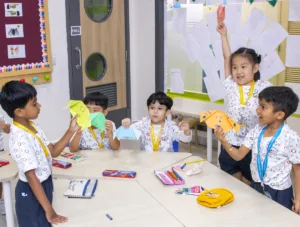
Personalised learning, crafted for individual needs, is where each student has an independent learning journey. For example, a Grade 1 student who’s learning single-digit addition will next move to double-digit addition. However, it could be that one student needs more time on single-digit addition than the other and so their learning journeys will be different.
Here the teacher can personalise instruction for this student so that he/she can master the skill before moving on to the next set of learning. In such a case, the student will have to be given extra assignments, additional classes. While the onus remains with the participant, who is the student in this case, it has to be done with the support and guidance of teachers and parents.
Gamification
Gamification in education is another trending topic. Children have always loved games, whether it’s a rollicking game of hopscotch on the playground or the latest version of Minecraft on their gaming console.
Just as video gamers must replay the same levels over and over until they master them, students in school may have to redo online work, such as science projects, until they induce the right reactions.
Repetition fosters mastery, and students have strong incentives to keep going. With advancing roles of technology in primary and secondary classrooms, gamification has the potential of becoming a norm inside classrooms.

Bite-sized learning capsules
Another way the COVID-19 pandemic has affected education lies in the shortened attention span of students. With the overwhelming influx of information that resulted from the pandemic, many people, not just students, feel bombarded by information. As a result, they’re spending more time engaging in mindless tasks such as watching television as a distraction from information overload.
In reality, though, the average human attention span has been declining for years. Students now prefer scannable online content that’s broken up into shorter segments with lots of images, subheadings and bulleted lists thrown in for easier reading. Moving forward, for this generation, bite-sized learning capsules with 1-2 concepts in each capsule may be more effective than classes that last 45-50 minutes.
Skills acquisition
In a 21st-century world, universities and employers are looking for balanced personalities. Colleges are looking for well-rounded 21st century students who demonstrate excellence in different skills, rather than students who are perfect scholars.
While you still need academic scores to meet the admission requirements, universities and institutes of higher learning are now placing emphasis on skills like communication, collaboration, and creative thinking. And those students who can show a diverse set of skills, both academic and subjective, may be the most well-prepared.
How GIIS is embracing the trends
At GlIS, we’re embracing trends such as data-driven feedback for students, slowly moving towards adaptive learning and encouraging student-led learning, among others. And we have been heavily leveraging the benefits of technology to do so, since our inception.
Our students play important roles in their own learning trajectories from a young age. They’re taught to take responsibility for their own outcomes and are continually rewarded for good progress.
More than just teaching students to be strong scholars, we’re reinforcing leadership skills, empathy, and multicultural awareness. Problem-solving and critical thinking are key, and we help students practise these skills by allowing them to play an active part in their learning.
Also read: How do Smart Schools lead to better learning outcomes?
‘Best of opportunities’
With multiple international curricula to choose from and various events and activities, our students get the best of opportunities. The educators identify learner strengths and weaknesses through data analytics that helps them to enhance the learning outcomes. The performance is tracked — student wise, subject wise, class wise, segment wise — using GIIS’ in-house data analytics tool, 7S.
Overall, GIIS aims to meet every child where they are on the academic ladder and help them build a firm foundation for future learning. We do this through encouragement, high expectations, positive feedback, and our innovative teaching methods.
If you’re interested in learning more about GIIS, please don’t hesitate to contact our admissions team.

Melissa Maria
GIIS Singapore SMART Campus principal, Ms Melissa Maria’s journey as an educator started when she was only 16 and continued in the field after she completed her Master’s degree in History and Bachelor’s degree in Education. For over 25 years now, she has been at the forefront of introducing new ideas and methodologies to education. She is also the City Coordinator for Singapore, selected by the CBSE Board for Grade 10 and 12 exams, 2021, managing two other international schools besides GIIS. With numerous achievements sprinkled across her distinguished career, Ms. Maria has been recognised for her efforts as a Mindef volunteer by the Singapore government.