Parents searching for the best Montessori schools in Singapore often want more than an early introduction to reading and maths. They want a setting where their child can become more independent, develop confidence and enjoy discovering how things work.
However, Montessori programmes can differ in their classroom arrangements, teacher training and use of the method. Understanding these differences helps families look beyond the programme name and assess the learning experience.
This guide explains Montessori teaching, its potential benefits and the questions to ask when comparing schools, including Global Indian International School (GIIS) Singapore’s Global Montessori Plus programme.
What Is Montessori Education?
Developed by Dr Maria Montessori, Montessori education centres on children learning through purposeful activity in a carefully organised environment.
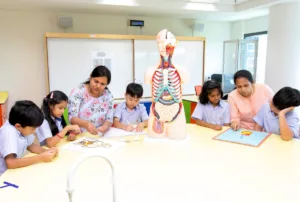
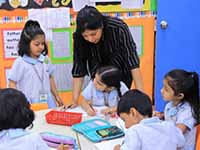
Children work with materials designed to help them explore concepts through direct experience. Teachers introduce activities, observe progress and offer guidance as children develop understanding.
An important principle is independence within clear boundaries. Children have opportunities to make choices while learning to use materials responsibly, respect others and care for their surroundings.
The classroom supports this approach through accessible resources, appropriately sized furniture and spaces for individual and shared activity.
How Does Montessori Teaching Work?
The American Montessori Society identifies five core components: trained Montessori teachers, mixed-age classrooms, Montessori materials, child-directed work and uninterrupted work periods.
These features work together. A classroom containing Montessori materials does not necessarily implement the full method.
Learning Through Hands-On Materials
Children explore ideas through activities they can see, touch and repeat. Materials provide a practical starting point for developing understanding before moving towards more abstract concepts.
During a visit, ask teachers to explain the purpose of an activity and how they decide when a child is ready for the next step.
Choice Within a Structured Environment
Child-directed learning does not mean children are left without guidance. Teachers prepare suitable activities, demonstrate their use and help children make productive choices.
Parents can ask what happens when a child repeatedly avoids an area of learning or needs help getting started.
Time to Concentrate
Uninterrupted work periods give children time to engage with an activity, repeat it and complete it without frequent changes of task.
Ask how the timetable balances these periods with meals, outdoor activity and other experiences.
Learning with Other Children
Mixed-age grouping is a recognised feature of Montessori education. It creates opportunities for children to learn from peers at different stages.
Programmes that adapt Montessori may organise their classes differently. Confirm the actual age grouping rather than assuming it from the programme’s name.
What Are the Potential Benefits of Montessori Education?
Montessori education can support both academic learning and broader development. A 2023 systematic review of 32 studies found modest positive effects across academic and non-academic outcomes, although the strength of evidence varied by outcome.
These findings do not guarantee the same result for every child or every Montessori-labelled programme. The way the approach is implemented matters.
When visiting a school, look for practical opportunities to develop the following:
| Area | What parents can look for |
| Independence | Children choosing suitable activities, managing materials and completing everyday tasks |
| Concentration | Time to remain engaged and revisit an activity |
| Problem-solving | Encouragement to explore, notice difficulties and try again |
| Communication | Opportunities to explain ideas, listen and ask for help |
| Responsibility | Expectations around shared resources, routines and consideration for others |
A useful conversation with teachers focuses on examples of progress rather than promises of faster learning or guaranteed confidence.
Are All Montessori Schools the Same?
No. The term Montessori is not trademarked, and implementation varies.
Some schools closely follow the established model. Others combine Montessori methods with additional approaches, subjects or enrichment activities.
Families should ask what the school means by “Montessori” or “Montessori-based”. Useful questions include:
- What Montessori training do the classroom teachers hold?
- Are children taught in mixed-age groups?
- How much time is available for child-directed activity?
- Which Montessori materials are used?
- What additional approaches are included?
- How do teachers assess progress and plan support?
Clear answers help parents judge whether the programme meets their expectations.
Exploring Global Montessori Plus at GIIS in Singapore
GIIS in Singapore offers Global Montessori Plus (GMP) for children aged three to six, covering Nursery, Kindergarten 1 and Kindergarten 2.
GIIS describes GMP as combining Montessori methods with modern preschool practices. It should therefore be understood as a Montessori-based blended programme.
Its five published learning pillars are:
| GMP pillar | Focus |
| Excelerate | Foundational language and numeracy |
| Multi-faceted Learning | Thematic experiences addressing different areas of development |
| iPlay | Learning through play and exploration |
| iCare | Compassion, kindness and care for the community and environment |
| Future Ready | Hands-on STEAM experiences |
The published programme includes practical life and sensorial exercises, environmental awareness, music and movement, and motor development. GIIS also lists regular and extended programme options.
Parents can discuss how these elements fit into the daily timetable, which option suits their child and how the programme prepares children for the next stage of education. Confirm placement, campus availability and current arrangements with admissions.
How to Choose a Montessori School in Singapore
The best fit depends on your child’s needs, the quality of the programme and your family’s practical circumstances.
1. Understand the Teaching Approach
Ask how Montessori principles are used throughout the day. Request examples of how teachers introduce activities, observe learning and respond when a child needs guidance.
2. Look at Teacher–Child Interactions
Notice how adults listen, explain and offer reassurance. Ask how they support children who are shy, unsettled or unfamiliar with the classroom language.
3. Discuss Your Child’s Needs
Share relevant information about communication, independence, interests and any support needs. Ask what the school can provide and how it works with families.
Avoid assuming that one method will suit every child in the same way.
4. Check the Daily Arrangements
Confirm school hours, meals, rest, outdoor activity, transport and holiday arrangements. A suitable educational approach also needs to work with your family’s routine.
5. Compare the Full Cost
Request tuition, registration charges, deposits and additional expenses separately. Check what is included and review withdrawal and refund terms before accepting a place.
6. Understand the Next Educational Step
Ask how the school supports progression into primary education. Discuss curriculum options, placement requirements and the skills children practise before moving on.
What Should Parents Ask During a School Tour?
A focused set of questions can make a visit more useful:
- Can you describe a typical day for my child’s age group?
- How much choice do children have over activities?
- How do teachers balance independence with guidance?
- How are language and numeracy introduced?
- How do you help children settle in?
- How is progress shared with parents?
- What happens when a child needs additional support?
- Which fees and services are included?
Where classroom observation is available, ask how it is arranged without disrupting children’s learning.
Choosing a Confident Start at GIIS in Singapore
A thoughtful Montessori school search looks at what children experience each day: purposeful activities, responsive teaching, opportunities for independence and clear support.
For families considering GIIS in Singapore, exploring Global Montessori Plus can help clarify how its Montessori-based approach and wider preschool experiences fit their child’s needs.
Book a campus tour at GIIS in Singapore to learn about Global Montessori Plus, discuss programme options and ask about your child’s next steps.

Team GIIS
Team GIIS is a group of enthusiastic writers who bring the vibrant world of GIIS in Singapore to life through engaging blog posts. Dedicated to highlighting the school’s teaching methodology, innovative learning environment, and diverse curriculum options like IB, Cambridge and CBSE, they aim to connect with parents, educators and students, sharing insights and stories that inspire and inform the school community.