Global
All Cities
Where would you like to study? Select cities to refine your search.
Any Curriculum
Find a campus based on the curriculum offered.
Global
Global
All Cities
Where would you like to study? Select cities to refine your search.
Any Curriculum
Find a campus based on the curriculum offered.
Search
Inquiry-based learning: Long-term benefits for IB PYP students

Inquiry-based learning: Long-term benefits for IB PYP students

IBPYP

When students enrol in the IB Primary Years Programme (IB PYP), a model that emphasises inquiry-based learning, their natural curiosity is not only encouraged but essential. This emphasis on curiosity fosters effective learning and empowers students to take on an active role in their education. Thereby, leading to enhanced knowledge retention throughout their academic journey.

‍

With a student-centred approach, inquiry-based learning helps students to develop knowledge, skills and conceptual understanding. Evidence-based reasoning and problem-solving skills underline the idea of asking questions and making observations.

‍

Inquiry-based learning, a key component of the IB Primary Years Programme (IB PYP), is clearly beneficial during your child’s primary years, but many parents do not realise that these benefits extend far beyond the IB PYP years.

‍

‍

Long-term benefits of inquiry-based learning

An inquiry-based programme naturally lends itself to differentiated learning, which is the process of catering to the learning experience to appeal to the student’s individual learning style. As such, an inquiry-led model caters to different learning styles and allows students to explore the material and engage in the discussion in a way that feels comfortable.

‍

After years of learning in an inquiry-based environment, students become naturally confident — regardless of whether they are introverts or extroverts. They know how to connect with the material and participate in the learning process while remaining true to themselves.

‍

Students who are encouraged to ask questions and challenge ideas are more likely to contribute towards classroom discussions with their peers. Thereby boosting a student’s confidence. Confidence is a skill that can last a lifetime, and students who enjoy inquiry-based learning are often more likely to become thoughtful, confident and motivated leaders.

‍

“I like the IB PYP programme and how it works. Since Sophie joined the programme at GIIS East Coast Campus, she’s become more confident. Her IB PYP teacher is quite good, is very skillful and has a lot of patience,” says Elsa Palacois, mother of Sophie Palacois, IB PYP 3A, GIIS East Coast Campus.

‍

‍

Inquiry-based learning encourages independence

In an inquiry-led learning model, students play an active role in their own learning experience. Ultimately, this leads to a sense of independence that encourages students to continue asking questions and seeking answers long after leaving the classroom.

‍

Independent learners know that knowledge acquisition never ends, and they are going to be more motivated to come up with solutions to the most challenging problems faced by an organisation or group.

‍

Inquiry-led learning promotes collaboration

Collaboration is critical in a 21st-century world. Students who have been participating in open-ended discussions for years will find it easy to cooperate and participate in a group setting. They will be comfortable working with people of all backgrounds as they work towards developing solutions to challenges that they face.
‍

‍

Inquiry-led learning enables students to solve real-world problems

One of the hallmarks of inquiry-based learning is that it helps students connect the material they are learning in the classroom with the experiences they will enjoy in the real world. These connections will last longer than simple knowledge acquisition, which prioritises fact memorisation and reiteration over comprehension and understanding.

‍

Inquiry-led learning builds student engagement

In traditional classrooms, some students can get away with passively learning the material while the extroverts participate more often. In an inquiry-based classroom, all students have opportunities to interact and engage with the content, which shows them the importance of staying involved. They are more likely to be active participants in any role that they take on in the future.

‍

“IB is an international curriculum, so whether we are in Europe or America, we would find an IB school, and the transition will be easier for our kids due to the curriculum. In the PYP, children are working towards their own learning along with the teacher. It is an engaging learning experience, where the child gets to be expressive,” says Daniele Mari, parent of Victoria, IB PYP 3A.

‍

At GIIS Singapore, the inquiry-based IB PYP curriculum is implemented by offering content in a variety of forms to students including video, audio and text. In addition to providing students with the resources that they need within the classroom and adopting an inquiry-based approach that prioritises discussion, GIIS believes in the power of experiential learning. Our students have the opportunity to experience first-hand the topics they are learning about, which helps them understand the material better and make lasting connections.

‍

Also read: Top reasons for choosing IB PYP curriculum for your child

‍

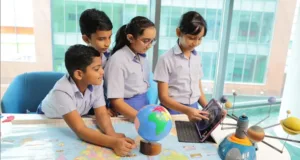
Through experiential learning, we give our primary school students opportunities to ask questions, form their theories and test their ideas.

For more information about inquiry-based learning in our IB PYP, please don’t hesitate to contact our friendly admissions team.

Odaia B Ranido

Ms. Ranido is the IB Early Years and PYP coordinator for GIIS Singapore. She has over 20 years of teaching experience in different international and bilingual schools in Southeast Asia. She spent the last 11 years leading the implementation of the IB Primary Years Programme (PYP) as a coordinator and teacher. She completed her Masters of Arts in Education from Sheffield Hallam University, UK in 2015. Ms. Ranido joined the Global Indian International School, EC Campus in July, 2019.
Featured Blogs

Cambridge IGCSE

What Is the Cambridge IGCSE? A Guide for Parents and Students

A secondary school curriculum plays an important role in shaping a child's academic journey. It influences how a teenager learns, thinks and is assessed, while also affecting the pathways available for senior high school and university. For parents in Singapore exploring different curriculum options, the Cambridge IGCSE is often part of the conversation. As one of the world's most widely recognised secondary qualifications, it offers an internationally oriented approach to education.

Cambridge IGCSE

Cambridge IGCSE Results 2026: Everything Students and Parents Need to Know

If your child is preparing to enter Grade 9 or Grade 10, you have likely already encountered the term ‘IGCSE results’ in parent meetings, school communications, and open days. For those currently comparing IGCSE schools in Singapore, one practical question often stands out: how can a school's results be verified as genuinely reliable, rather than simply a marketing claim

IGCSE

Where Can You Study Cambridge IGCSE in Singapore? Best Schools, Fees & Admissions

Cambridge IGCSE is offered in Singapore mainly through private international schools, since local MOE schools follow the Singapore-Cambridge GCE syllabus instead. Among the IGCSE schools in Singapore, Global Indian International School (GIIS) Singapore is one of the most established options, offering the Cambridge IGCSE programme for Grades 9 and 10 (ages 14–16) at its SMART Campus in Punggol, with a consistent track record of A* and distinction results.

GIIS

Understanding Your Cambridge IGCSE Results: A Complete Guide to Grades, Grading Scales and What Your Results Mean

Cambridge IGCSE results are graded on a scale from A* (highest) to G (lowest), based on a student's Uniform Mark achieved in each subject. An A* reflects a mark of 90–100%, while a G reflects 20–29%. Grades are issued per subject, not as an overall aggregate and are recognised by universities and employers in more than 160 countries.

Top Scholarships

Dr APJ Abdul Kalam Global Skills Scholarship

Eligibility:

Talent Based - Technology

More from same author
Trending Blogs

Cambridge IGCSE

What Is the Cambridge IGCSE? A Guide for Parents and Students

A secondary school curriculum plays an important role in shaping a child's academic journey. It influences how a teenager learns, thinks and is assessed, while also affecting the pathways available for senior high school and university. For parents in Singapore exploring different curriculum options, the Cambridge IGCSE is often part of the conversation. As one of the world's most widely recognised secondary qualifications, it offers an internationally oriented approach to education.

Cambridge IGCSE

Cambridge IGCSE Results 2026: Everything Students and Parents Need to Know

If your child is preparing to enter Grade 9 or Grade 10, you have likely already encountered the term ‘IGCSE results’ in parent meetings, school communications, and open days. For those currently comparing IGCSE schools in Singapore, one practical question often stands out: how can a school's results be verified as genuinely reliable, rather than simply a marketing claim

IGCSE

Where Can You Study Cambridge IGCSE in Singapore? Best Schools, Fees & Admissions

Cambridge IGCSE is offered in Singapore mainly through private international schools, since local MOE schools follow the Singapore-Cambridge GCE syllabus instead. Among the IGCSE schools in Singapore, Global Indian International School (GIIS) Singapore is one of the most established options, offering the Cambridge IGCSE programme for Grades 9 and 10 (ages 14–16) at its SMART Campus in Punggol, with a consistent track record of A* and distinction results.

GIIS

Understanding Your Cambridge IGCSE Results: A Complete Guide to Grades, Grading Scales and What Your Results Mean

Cambridge IGCSE results are graded on a scale from A* (highest) to G (lowest), based on a student's Uniform Mark achieved in each subject. An A* reflects a mark of 90–100%, while a G reflects 20–29%. Grades are issued per subject, not as an overall aggregate and are recognised by universities and employers in more than 160 countries.

Search
History Menu Icon

Our vision is to become a global role model for teaching and learning.

History Menu Icon Secondary

Since its inception in 2002, GIIS has spread quality education through 17 campuses across the globe.

Global Indian International School Singapore smart campus learning environment

SMART Campus

A green, tech-enabled campus with extensive sports facilities that enables a holistic education

  • Kindergarten program at GIIS Singapore smart campus

    Montessori education with a modern touch.

  • Primary school curriculum at GIIS Singapore

    International primary programmes with best holistic learning.

  • Secondary school students learning at GIIS Singapore

    International middle school programmes with best foundation for high school.

  • High school education and curriculum at GIIS Singapore

    International high school programmes with beat launchpads for university.

21st century learning campus at GIIS Singapore

Facilities which are collaborative, creative and adaptable to individual needs.

Holistic education approach with 9 Gems at GIIS Singapore

Award-winning framework for all-round student development

Co-curricular activities at GIIS Singapore

Extra-curricular activities are those activities, often sports-based, that take place outside of the GIIS classroom

Extra curricular activities at GIIS Singapore

Talent shows, performances, competitions, clubs and additional classroom work.

Admission Process Icon

Get an overview of the admissions process

Campus Tour Icon

Register for a tour of the campus to learn more about the school first hand

Book Meeting Icon

You can talk to our Admissions Counsellor online or in-person, as per your convenience.

Admissions Form Icon

Find all forms related to admissions procedure here

Fees Icon

Get information on our fee structure for different grades

Scholarship Icon

Thank you for considering GIIS as a prospective school for your child. Our goal is to make the admissions.