Global
All Cities
Where would you like to study? Select cities to refine your search.
Any Curriculum
Find a campus based on the curriculum offered.
Global
Global
All Cities
Where would you like to study? Select cities to refine your search.
Any Curriculum
Find a campus based on the curriculum offered.
Search
How we embrace Experiential Learning at GIIS preschool

How we embrace Experiential Learning at GIIS preschool

GMP

Experiential learning is at the heart of the education philosophy at GIIS’ preschool. Experiential learning can be a valuable approach for preschool age students as it encourages them to actively engage with their environment, develop new skills and make connections between their learnings and surroundings.

At GIIS, we take this into account as we carefully craft various aspects of learning for our preschool programme, a customised Montessori programme – the Global Montessori Plus (GMP) programme.

Based on Howard Gardner’s theory of multiple intelligences, our GMP programme supports each of our students’ varied strengths, needs and learning styles. A wide range of activities and opportunities are provided to allow each of our learners to discover their passions, interests and personal strengths.

‍

‍

Exposure to outdoor play areas

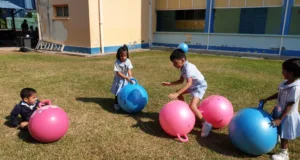
While learning through play is important for students at this age, it is equally important that they play outdoors along with indoors. Playing outdoors offers numerous physical, social, emotional, and cognitive benefits. It helps them to develop spatial awareness, ability to navigate their surroundings, learn about nature, science and develop problem-solving skills. GIIS offers green space for our young students to learn and explore. There are open-air areas such as our Mist and Nest play zones that allow our students to explore hands-on learning.

‍

Montessori Lab

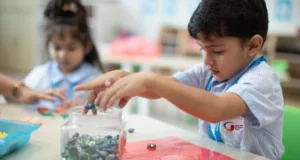
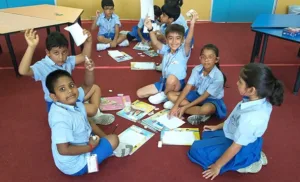
Manipulatives (objects that allow children to explore an idea through a hands-on approach) and customised, child-centred learning are at the heart of our preschool environment. Our customised Montessori Lab provides our students with amazing opportunities for hands-on learning in both numeracy and literacy.

Our students thrive with the experiential learning that our Montessori Lab allows them to experience. This engaging lab experience ensures that our students gain knowledge and skills in a motivating, child-centred environment.

‍

‍

Skill-development

Developing communication and collaboration skills are of critical importance for preschool children. Mastering these skills at a young age sets children up for success as they learn to communicate well and collaborate with their peers and teachers and advance in their education and beyond. At GIIS, we ensure that our classrooms are designed to maximise our students’ opportunities to develop their interaction skills. This helps our learners become adept at communication skills.

‍

Preschool students playing at the Mist area at GIIS SMART Campus

STEAM learning

Our emphasis on experiential learning extends to STEAM (Science, Technology, Engineering, Arts and Mathematics) learning. Our teachers plan activities for our students that enable them to gain valuable skills in science, English, mathematics and problem-solving through a hands-on approach. This allows our students to use their different senses to explore and learn about the world around them.

For example, in a lesson on colour mixing, our teachers provide paint and water to enable students to create a rainbow effect. By allowing students to experience these activities by themselves, they learn quickly and retain what they learn. It also makes learning fun and helps to build curiosity about the world around them. Students learn scientific truths through several such hands-on activities, such as the fact that ‘every action has an equal and opposite reaction’.
‍

‍

Exposure to age-appropriate technology

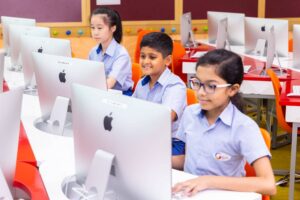
Our students are given sufficient opportunities to work with technology to ensure that they develop age-appropriate technological skills. Using iPads to play drag and drop games, complete puzzles and navigate mazes provides motivating, age-appropriate technology skills for our learners.

‍

Also read: 3 key reasons why GIIS nurtures confident preschool students

‍

Child-centred, free playtime

An important aspect of experiential learning is allowing free playtime, providing our students with learning materials such as building blocks, jigsaw puzzles and other toys for free playtime.

At GIIS, our teachers provide plenty of stimulating learning materials and guidance but also ensure that children are given sufficient time and space for self-directed play. Free play is scientifically proven to help children develop their critical thinking, innovation, collaborative problem-solving and communication skills.

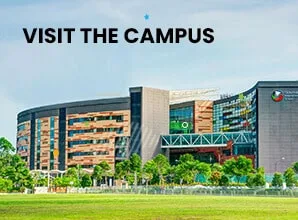
To explore the possibilities for your preschool age child at GIIS, please don’t hesitate to book a campus tour.

‍

Rema Rajiv

Ms Rajiv has been an Early Childhood educator and practitioner for the past 15 years at GIIS. She heads the Global Montessori Plus (GMP) Programme, supporting kindergarten students in their learning and holistic development to maximise the potential of every student. She has been instrumental in implementing developmentally age-appropriate curriculum that provides a strong foundation for lifelong learning. She is well-respected due to her rich experience in the field and passion for working with preschoolers, helping establish a good rapport with the parent community.​

Featured Blogs

Secondary School

How International Schools Develop Future-Ready Students Through Advanced Presentation Skills

Most international schools build presentation skills by making students speak, perform and defend ideas in front of real audiences, repeatedly and from an early age. At GIIS in Singapore, this happens through the international and Indian curricula, including IB, Cambridge and CBSE and 9GEMS framework. Students also practise these skills through performances, competitions and clubs.

School

How International Schools in Singapore Develop Life Skills Through Different Teaching Approaches

Many international schools in Singapore teach life skills by embedding practical competencies such as problem-solving, emotional regulation and teamwork directly into personalised academic frameworks. Rather than using one-size-fits-all instruction, most top institutions adapt life skill development to match visual, discussion-based and hands-on learning activities.

GIIS

How Do International Schools Prepare Students for University Applications from Grade 9 & 10?

Parents researching Singapore's international schools often ask the same question: when should university planning actually begin? The honest answer is earlier than most families expect. By the time a student reaches Grade 12, the subjects they took, the activities they pursued and the guidance they received years earlier have already shaped what doors are open to them.

GIIS

What Does “Holistic Education” Actually Mean in a Singapore International School?

In a Singapore international school like GIIS, holistic education means academics sit alongside eight other areas of development — sport, arts, leadership, innovation, community service, personality growth, skills, and values — inside one structured framework. It isn't a marketing phrase; it's how the timetable and activities are actually organised. It's natural to wonder what it actually means for your child. Ask ten different parents and you'll probably hear ten different answers — and that's okay. This guide breaks down the meaning of holistic education in plain language, explains what holistic learning looks like day to day and shows how it compares to a traditional, exam-first model.

Top Scholarships

Dr APJ Abdul Kalam Global Skills Scholarship

Eligibility:

Talent Based - Technology

More from same author
Trending Blogs

Secondary School

How International Schools Develop Future-Ready Students Through Advanced Presentation Skills

Most international schools build presentation skills by making students speak, perform and defend ideas in front of real audiences, repeatedly and from an early age. At GIIS in Singapore, this happens through the international and Indian curricula, including IB, Cambridge and CBSE and 9GEMS framework. Students also practise these skills through performances, competitions and clubs.

School

How International Schools in Singapore Develop Life Skills Through Different Teaching Approaches

Many international schools in Singapore teach life skills by embedding practical competencies such as problem-solving, emotional regulation and teamwork directly into personalised academic frameworks. Rather than using one-size-fits-all instruction, most top institutions adapt life skill development to match visual, discussion-based and hands-on learning activities.

GIIS

How Do International Schools Prepare Students for University Applications from Grade 9 & 10?

Parents researching Singapore's international schools often ask the same question: when should university planning actually begin? The honest answer is earlier than most families expect. By the time a student reaches Grade 12, the subjects they took, the activities they pursued and the guidance they received years earlier have already shaped what doors are open to them.

GIIS

What Does “Holistic Education” Actually Mean in a Singapore International School?

In a Singapore international school like GIIS, holistic education means academics sit alongside eight other areas of development — sport, arts, leadership, innovation, community service, personality growth, skills, and values — inside one structured framework. It isn't a marketing phrase; it's how the timetable and activities are actually organised. It's natural to wonder what it actually means for your child. Ask ten different parents and you'll probably hear ten different answers — and that's okay. This guide breaks down the meaning of holistic education in plain language, explains what holistic learning looks like day to day and shows how it compares to a traditional, exam-first model.

Search
History Menu Icon

Our vision is to become a global role model for teaching and learning.

History Menu Icon Secondary

Since its inception in 2002, GIIS has spread quality education through 17 campuses across the globe.

Global Indian International School Singapore smart campus learning environment

SMART Campus

A green, tech-enabled campus with extensive sports facilities that enables a holistic education

  • Kindergarten program at GIIS Singapore smart campus

    Montessori education with a modern touch.

  • Primary school curriculum at GIIS Singapore

    International primary programmes with best holistic learning.

  • Secondary school students learning at GIIS Singapore

    International middle school programmes with best foundation for high school.

  • High school education and curriculum at GIIS Singapore

    International high school programmes with beat launchpads for university.

21st century learning campus at GIIS Singapore

Facilities which are collaborative, creative and adaptable to individual needs.

Holistic education approach with 9 Gems at GIIS Singapore

Award-winning framework for all-round student development

Co-curricular activities at GIIS Singapore

Extra-curricular activities are those activities, often sports-based, that take place outside of the GIIS classroom

Extra curricular activities at GIIS Singapore

Talent shows, performances, competitions, clubs and additional classroom work.

Admission Process Icon

Get an overview of the admissions process

Campus Tour Icon

Register for a tour of the campus to learn more about the school first hand

Book Meeting Icon

You can talk to our Admissions Counsellor online or in-person, as per your convenience.

Admissions Form Icon

Find all forms related to admissions procedure here

Fees Icon

Get information on our fee structure for different grades

Scholarship Icon

Thank you for considering GIIS as a prospective school for your child. Our goal is to make the admissions.