Global
All Cities
Where would you like to study? Select cities to refine your search.
Any Curriculum
Find a campus based on the curriculum offered.
Global
Global
All Cities
Where would you like to study? Select cities to refine your search.
Any Curriculum
Find a campus based on the curriculum offered.
Search

The Future of Work: Is your child prepared?

Future-ready Education

The Fourth Industrial Revolution is upon us, and the world is changing faster than we realise. Automation of existing processes continues at an exponential rate, and nearly half of the jobs that humans perform today are expected to be done by robots or artificial intelligence in the near future. Therefore, schools and parents need to work together to prepare children to be flexible and creative in their thinking and become future-ready.

The Fourth Industrial Revolution and the age of automation

Over the last few centuries, there have been several technological advances and industrial revolutions.

● The First Industrial Revolution began in 1760 and lasted until the 19th century. During this industrial revolution, mechanisation took centre stage.

● Beginning in 1870 and lasting into the 20th century, the Second Industrial Revolution is considered by most to be the most significant and important industrial revolution because, during this period, the world began to rely on new types of energy while simultaneously developing new technologies. Methods of transportation and communication significantly improved during this time.

● The Third Industrial Revolution, or the Digital Revolution, which began in 1969 and lasted into the millennium, was defined by emerging technology and the development of nuclear energy.

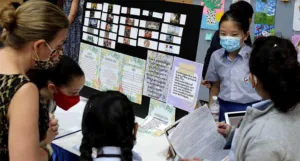
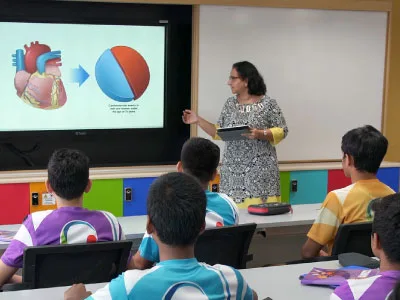
At GIIS, students are encouraged to work together as a team

Changes expected over the next 20 years

The Fourth Industrial Revolution is expected to take shape over the next few years, and 20 years from now, significant changes are expected in the way people do their jobs, the amount of work that is automated and the types of jobs people do.

These are just a few of the changes that are already under way and are expected to accelerate in the coming years:

● Robots will perform many tasks, including tasks that need logical thinking like coding, that are done by humans today.

● Health care professionals will rely more heavily on technology when evaluating and diagnosing patients.

● Cars will no longer need to be driven by humans, as driverless technology will improve significantly.

How schools can prepare students for the future

It can be a difficult task to prepare students for a future that has yet to be written, but there are enough clues about what the years ahead may hold, and educators can start making changes now.

This is what schools can do now to prepare students for the future of work:

● Educators must first ditch the age-old model of teaching students to memorise and reiterate facts. Rather than focusing on teaching for a test, teachers and administrators must find ways for students to collaborate, communicate, and develop their critical thinking skills. Creative thinking will be vital in the future.

● Students must be encouraged to be creative and innovative in all of their lessons. At times, this means that they will be taking risks — and likely failing. This is okay as it helps them learn resilience in the face of failure. Students who are unafraid to take risks are more likely to innovate in the future.
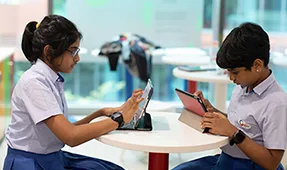
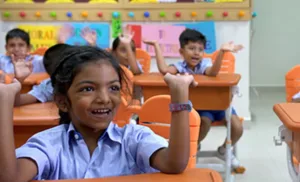
● Children should work together in pairs or teams, as this requires them to communicate and collaborate with their peers. In a multicultural environment, they learn to work with students of all beliefs and backgrounds, which will prepare them for the global economy.

● Students must be provided with the freedom to learn in ways that work best for them. This helps them become confident learners and gives them the ability to be creative in their endeavours.

● Students should be given open-ended assignments in which there is no specific approach or correct answer. This helps to foster new ways of thinking and ideas naturally.

Future-Ready learning at GIIS

At GIIS, we have long relied on a future-ready approach to education. With our 9Gems holistic framework providing the foundation for students’ learning, our students participate in a wide variety of activities, hands-on learning assignments and STEM-based initiatives. They are prepared to think critically, ask questions, engage in discussions and collaborate with their peers as part of their day-to-day school life.

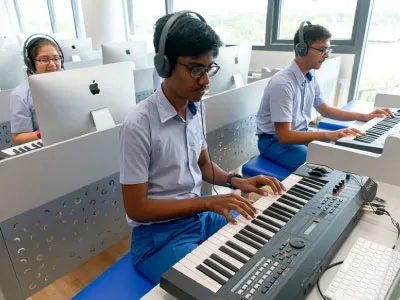
In addition, our campus provides the facilities and resources — such as skills-based studios, student innovation rooms, design thinking labs and collaborative learning spaces — that students need to develop 21st-century skills. Beyond that, all of our students are encouraged to participate in extracurricular and co-curricular activities that help them combine their passions and interests with future-ready learning.

These are the early days of the Fourth Industrial Revolution, but it is the best time to prepare your children for the future of work. You can do this by enrolling them in an international school that encourages creativity and innovation in a child’s daily life — one that provides an environment where children can develop the 21st-century skills they need while collaborating with peers and taking risks.

If you’d like to know more about how GIIS Singapore prepares our students to become future-ready learners, contact us to schedule a school tour or book an appointment with our admissions team.

Selina D Souza

Selina D'souza is a Senior Communications specialist with 10+ years of marketing communications experience in the B2B and B2C IT and Education sector. She is a passionate curator of good content, believes that schools can be a place of creativity and innovation if the right mindset and practices are adopted, and is always looking for more sustainable lifestyle choices.
Featured Blogs

Cambridge IGCSE

Cambridge IGCSE Results 2026: Everything Students and Parents Need to Know

If your child is preparing to enter Grade 9 or Grade 10, you have likely already encountered the term ‘IGCSE results’ in parent meetings, school communications, and open days. For those currently comparing IGCSE schools in Singapore, one practical question often stands out: how can a school's results be verified as genuinely reliable, rather than simply a marketing claim

IGCSE

Where Can You Study Cambridge IGCSE in Singapore? Best Schools, Fees & Admissions

Cambridge IGCSE is offered in Singapore mainly through private international schools, since local MOE schools follow the Singapore-Cambridge GCE syllabus instead. Among the IGCSE schools in Singapore, Global Indian International School (GIIS) Singapore is one of the most established options, offering the Cambridge IGCSE programme for Grades 9 and 10 (ages 14–16) at its SMART Campus in Punggol, with a consistent track record of A* and distinction results.

IGCSE Results

Understanding Your Cambridge IGCSE Results: A Complete Guide to Grades, Grading Scales and What Your Results Mean

Cambridge IGCSE results are graded on a scale from A* (highest) to G (lowest), based on a student's Uniform Mark achieved in each subject. An A* reflects a mark of 90–100%, while a G reflects 20–29%. Grades are issued per subject, not as an overall aggregate and are recognised by universities and employers in more than 160 countries.

GIIS

Mid-Year & Transfer Admissions: Moving Your Child to a Singapore International School (2026)

Relocating to Singapore rarely happens on a school's neat academic calendar. A posting can start in June, a lease can begin in September, a visa can clear in November—and somewhere in between, a child still needs a classroom, a timetable and a group of friends. This is the reality behind expat school admissions mid year in Singapore and it's a far more common situation than most parents expect.

Top Scholarships

Dr APJ Abdul Kalam Global Skills Scholarship

Eligibility:

Talent Based - Technology

More from same author
Trending Blogs

Cambridge IGCSE

Cambridge IGCSE Results 2026: Everything Students and Parents Need to Know

If your child is preparing to enter Grade 9 or Grade 10, you have likely already encountered the term ‘IGCSE results’ in parent meetings, school communications, and open days. For those currently comparing IGCSE schools in Singapore, one practical question often stands out: how can a school's results be verified as genuinely reliable, rather than simply a marketing claim

IGCSE

Where Can You Study Cambridge IGCSE in Singapore? Best Schools, Fees & Admissions

Cambridge IGCSE is offered in Singapore mainly through private international schools, since local MOE schools follow the Singapore-Cambridge GCE syllabus instead. Among the IGCSE schools in Singapore, Global Indian International School (GIIS) Singapore is one of the most established options, offering the Cambridge IGCSE programme for Grades 9 and 10 (ages 14–16) at its SMART Campus in Punggol, with a consistent track record of A* and distinction results.

IGCSE Results

Understanding Your Cambridge IGCSE Results: A Complete Guide to Grades, Grading Scales and What Your Results Mean

Cambridge IGCSE results are graded on a scale from A* (highest) to G (lowest), based on a student's Uniform Mark achieved in each subject. An A* reflects a mark of 90–100%, while a G reflects 20–29%. Grades are issued per subject, not as an overall aggregate and are recognised by universities and employers in more than 160 countries.

GIIS

Mid-Year & Transfer Admissions: Moving Your Child to a Singapore International School (2026)

Relocating to Singapore rarely happens on a school's neat academic calendar. A posting can start in June, a lease can begin in September, a visa can clear in November—and somewhere in between, a child still needs a classroom, a timetable and a group of friends. This is the reality behind expat school admissions mid year in Singapore and it's a far more common situation than most parents expect.

GIIS

Choosing Subjects for IGCSE: A Parent’s Guide to Streams, Options & Future Careers

By age 14, most children have never had to make a decision that shapes their next ten years. Choosing IGCSE subjects is exactly that decision and for parents, it often arrives with more questions than answers. Which subjects matter for university? Does dropping a science close doors? Is a 'safe' combination actually the right one?

GIIS

Your Child’s Journey to IBDP Success Starts Before Grade 11: A Parent’s Guide

While evaluating the IB Diploma programme in Singapore for their children, parents center the conversation around Grade 11 and 12. It is during these final two high school years that students write their Extended Essays, dive deep into Theory of Knowledge (TOK) and prepare for final examinations.

CBSE Results

IBDP Results 2026: What Parents Should Consider Before Choosing an IB School in Singapore

Choosing the right international school for your child is one of the most critical academic decisions a parent can make. With the release of the May 2026 International Baccalaureate Diploma Programme (IBDP) results, parents across Singapore are evaluating school performance metrics to determine where their child will thrive best.

GIIS

How GIIS Students Achieved Outstanding IBDP Results in 2026: A Look at the Learning Approach

Choosing the right senior secondary curriculum requires more than academic rigour. Students also need an environment that nurtures critical thinking, global perspectives, personal growth, and university readiness. For families evaluating the IB diploma programme in Singapore, the May 2026 International Baccalaureate Diploma Programme (IBDP) examination results offer clear evidence of how structured academic mentoring and personalised pedagogy lead to top-tier university readiness.

GIIS

Moving to Singapore with Children: A Complete School Guide for Expat Families (2026)

Relocating to Singapore is an exciting milestone for any family. Alongside finding a new home, settling into a different culture, and adapting to a new lifestyle, one of the biggest decisions parents face is choosing the right school for their children.

Search
History Menu Icon

Our vision is to become a global role model for teaching and learning.

History Menu Icon Secondary

Since its inception in 2002, GIIS has spread quality education through 17 campuses across the globe.

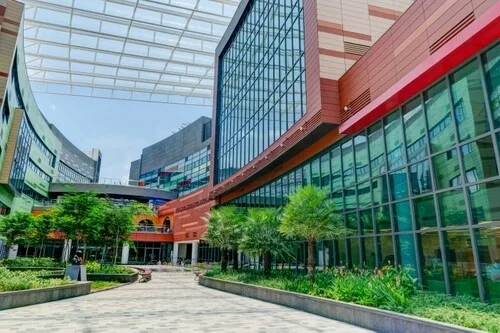
Global Indian International School Singapore smart campus learning environment

SMART Campus

A green, tech-enabled campus with extensive sports facilities that enables a holistic education

  • Kindergarten program at GIIS Singapore smart campus

    Montessori education with a modern touch.

  • Primary school curriculum at GIIS Singapore

    International primary programmes with best holistic learning.

  • Secondary school students learning at GIIS Singapore

    International middle school programmes with best foundation for high school.

  • High school education and curriculum at GIIS Singapore

    International high school programmes with beat launchpads for university.

21st century learning campus at GIIS Singapore

Facilities which are collaborative, creative and adaptable to individual needs.

Holistic education approach with 9 Gems at GIIS Singapore

Award-winning framework for all-round student development

Co-curricular activities at GIIS Singapore

Extra-curricular activities are those activities, often sports-based, that take place outside of the GIIS classroom

Extra curricular activities at GIIS Singapore

Talent shows, performances, competitions, clubs and additional classroom work.

Admission Process Icon

Get an overview of the admissions process

Campus Tour Icon

Register for a tour of the campus to learn more about the school first hand

Book Meeting Icon

You can talk to our Admissions Counsellor online or in-person, as per your convenience.

Admissions Form Icon

Find all forms related to admissions procedure here

Fees Icon

Get information on our fee structure for different grades

Scholarship Icon

Thank you for considering GIIS as a prospective school for your child. Our goal is to make the admissions.