When you’re raising children in Singapore or planning a move here, schooling becomes one of the most important decisions you’ll make. The country is known all over the world for having very high standards for education, but there’s much more to the system than just rankings and results.
From early childhood through to university education, every step in the journey has a purpose that’s rooted in improving learning outcomes for children. Let’s break down the stages, how they connect, and what they actually mean for your child.
Structure of Singapore’s Education System
The Singapore education system is structured, yes, but that doesn’t mean it’s rigid. It has many pathways that vary based on different learning patterns, since no two children have the same patterns.
Personalisation at every level of the learning journey is what makes Singapore’s education system such a global success.
Early Childhood Education
This is, of course, the first step in the framework. Early Childhood Education begins between the ages of three and six. While there’s no compulsion for your child to go through this phase, most families consider it essential anyway. This age group is one of the most important ones in child motor and cognitive development stages, where social habits, early language skills, and classroom behaviour start taking shape.
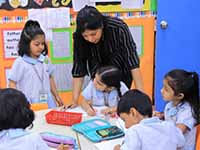
Preschool classrooms in Singapore are often vibrant and busy, filled with stories, blocks, phonics stations, and outdoor play. Some follow local frameworks, while others, like ours at Global Indian International School (GIIS), use international models like the IB Primary Years Programme (PYP). The focus is on social habits, early language, motor skills and classroom readiness. At this stage, learning doesn’t look like learning, but the foundations are being laid.
Primary Education
Primary Education starts at age six and continues for six years. The first four years are more about building fluency in language and numbers, while the last two help prepare children for the Primary School Leaving Examination (PSLE). That’s the first formal checkpoint in a student’s academic journey. Subjects include English, Mother Tongue, Mathematics, Science, and Character and Citizenship Education (CCEs) and co-curricular activities (CCAs). At GIIS, we encourage our students studying at this level, to problem-solve, write with clarity, and build resilience through co-curricular activities.
Secondary Education
Once the PSLE results are out, students are posted to a secondary school based on their Achievement Level (AL) scores. Singapore’s education system is merit-based, but also has several other factors put in. Students enter one of three main streams: Express, Normal (Academic), or Normal (Technical), and appeal for their preferred school or shift streams later if they show progress.
- Express students typically sit for their GCE O-Levels after four years.
- Normal (Academic) students follow a five-year route with O-Level subjects in the final year.
- Normal (Technical) students focus more on practical learning and applied skills.
Outside the mainstream, there are private and international schools that offer programmes like IGCSE, Cambridge Lower Secondary, or the IB MYP (Middle Years Programme). These are often chosen by families who want their children to be in less exam-driven environments or who travel frequently with them.
Tertiary Education
This stage opens after secondary school and includes three key options: Junior Colleges (JCs), Polytechnics, and the Institute of Technical Education (ITE).
- JCs offer a two-year A-Level track, which is ideal for those looking for admission to traditional universities.
- Polytechnics offer three-year diplomas in specialised areas like engineering, media, design, or business.
- ITE provides hands-on vocational training with industry alignment, often including apprenticeships or internships.
Each path leads to further studies or direct entry into the workforce, depending on the student’s goals and performance.
What Students Learn At Every Stage and Why It Matters
Each stage of education isn’t just about what subjects are taught. It’s about how they are taught and why.
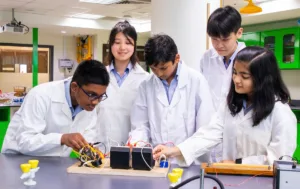
At the primary level, the emphasis is on literacy, numeracy, and critical thinking. Schools create space for creativity through music, dance, and visual arts, while also introducing basic science concepts and IT skills. In classrooms that adopt the primary years programme, learning feels more exploratory. Students ask questions, carry out small investigations, and present their own findings. It’s not just about memorising answers, it’s about understanding how learning connects to the world.
By the time they enter secondary level, students start making their own choices. They select subject combinations, Sciences or Humanities, Pure or Combined, and they begin to discover their academic strengths. Schools support this with career guidance, applied learning modules, and co-curricular involvement.
At the tertiary level, specialisation becomes key. Junior Colleges focus on academic depth, while Polytechnics offer practical training in specific fields like engineering, business, design or media. Some diploma courses come with work attachments. Others include overseas exchanges.
Pros and Cons of Studying in Singapore
There’s a reason so many families across the globe look to Singapore for schooling. Singapore’s education system is robust, outcomes are measurable, and teachers are highly trained. And the curriculum evolves to match modern needs, including digital skills, environmental awareness, and global issues. Exposure to technology, language support programmes, and co-curricular diversity also play a big part in well-rounded development.
That said, it’s a fast-moving system. The competitive culture begins early. Exams like the PSLE and O-Levels are high-stakes moments, and many families turn to tuition or enrichment programmes for extra support. Sometimes, even children who are doing well feel the need to keep up with peers who are pushing harder.
Future of Education in Singapore
Education in Singapore isn’t standing still but moving with the times. In recent years, the Ministry of Education (MoE) has rolled out changes aimed at reducing stress and creating more holistic experiences. PSLE scoring has been revised to lessen the comparison. More schools are removing mid-year exams and focusing instead on project work and formative assessments.
We’re also seeing new emphasis on flexible pathways. Not all learners need to take the traditional JC-university route. The growth of applied learning in Polytechnics and ITE has opened doors to meaningful careers that start earlier and lead just as far.
In this evolving space, international schools like the Global Indian International School (GIIS), offer globally accepted learning programmes, like the IB Diploma Programme, which prepare them to excel, both academically and with emotional readiness. Our aim is not just to make them skilled, but also to make them fit to take on whatever comes their way in life.
The Big Picture
The education system that Singapore follows is not only about structured learning. It offers choice, direction, and opportunity for every kind of learner, be it their emphasis on play-based learning or focus on skill development for senior learners. From early years to tertiary, every stage adds a layer of growth that prepares students to think beyond the classroom.
At Global Indian International School (GIIS), we understand that every child’s journey is unique. Through our international curriculum pathways and personalised attention, we support learners from their very first step to wherever their path leads next.
Start Your Child’s Learning in Singapore
GIIS helps your child explore, learn, and grow from early years to IB Diploma.
Team GIIS
Team GIIS is a group of enthusiastic writers who bring the vibrant world of GIIS in Singapore to life through engaging blog posts. Dedicated to highlighting the school’s teaching methodology, innovative learning environment, and diverse curriculum options like IB, Cambridge and CBSE, they aim to connect with parents, educators and students, sharing insights and stories that inspire and inform the school community.