
After weeks of guided practice, Arif was surprised to see his son Aamir’s once-messy scrawl transform into neat, confident handwriting. This was a case that demonstrated that small, consistent efforts really pay off.
In today’s digital world, good handwriting is gradually becoming a forgotten skill, but it still plays a major role in education and everyday communication. Whether you’re a student preparing for exams, an adult wishing to improve your script or a parent guiding your child’s early writing journey, knowing how to improve your handwriting can make a real difference.
For students aspiring to meet IGCSE admission requirements or follow the IGCSE syllabus in leading institutions such as GIIS Kuala Lumpur (GIIS KL), legible and confident handwriting remains a powerful tool. This article offers a practical guide on how to improve your handwriting, increase writing speed and develop a personal writing style.
How to Improve Your Handwriting?
The first step in improving your handwriting is knowing the fact that it is a skill that can be learned and refined with practice. Understanding how to improve handwriting involves identifying issues including illegibility, inconsistent spacing or awkward slants and then applying proper techniques to overcome them.
Regardless of age or level, handwriting improvement requires time, the right tools and practices and mindful habits. At GIIS KL, students take part in structured handwriting exercises as part of the early curriculum, which helps build both speed and legibility over time.

How to Increase Your Writing Speed

Being able to write clearly and quickly is especially important in timed assessments such as GCSEs or IGCSE exams, where speed has an impact on performance. If you’re trying to find out how to increase handwriting speed, here are a few strategies:
- Focus on letter joins: Learn cursive or semi-cursive writing to make transitions between letters smoother.
- Relax your grip: A tense grip slows you down and tires your hand.
- Limit unnecessary flourishes: Stick to simple, streamlined letters that are easy to replicate.
Pro Tip: Use a stopwatch during practice to time yourself. Track how many words you can write neatly in 5 minutes—and aim to improve your count with time.
How to Improve Your Handwriting
Improving your handwriting isn’t just about making it look nice or artistic; it’s also about readability, speed and consistency. Knowing how to perfect your handwriting requires dedication, but the right approach can make it an enjoyable habit. Start by choosing the right writing tools and developing your muscle memory through regular practice.
Let’s dive into some practical tips.

8 Effective Tips to Improve Handwriting
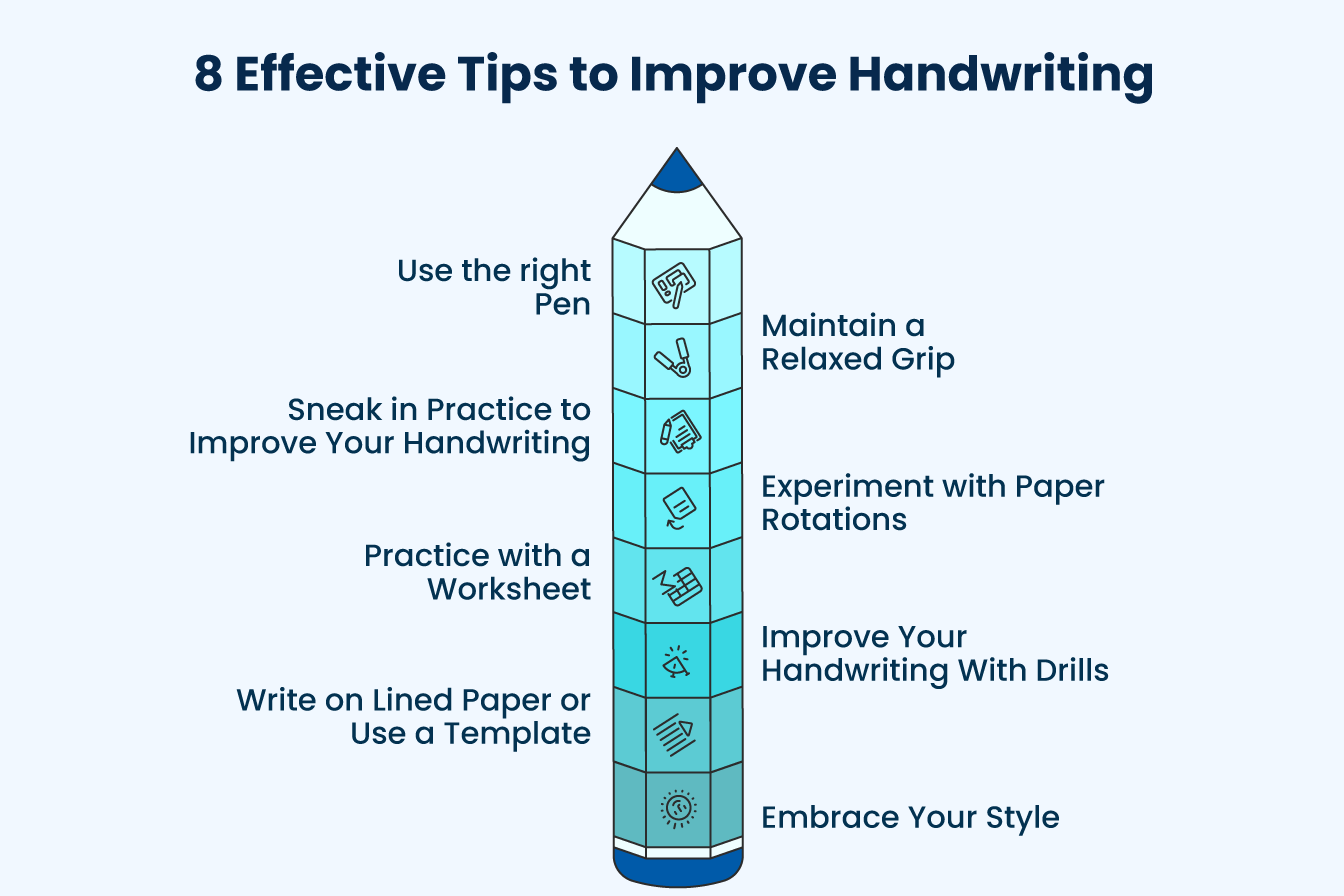
1. Use the right Pen
A pen with smooth ink-flow can make a huge difference. Try gel pens or fountain pens to see what feels most comfortable in your hand.
Pro Tip: Avoid cheap pens with uneven ink flow as they may make your writing messy.
2. Maintain a Relaxed Grip
Hold the pen lightly as a tight grip will cause hand fatigue and affect stroke fluidity.
Pro Tip: Hold the pen about 1.5–2 cm above the nib while resting it on your middle finger for support.
3. Improve Your Handwriting With Drills
Repeating shapes such as loops, waves and zig-zags helps improve control and precision. These drills build muscle memory.
Pro Tip: Spend 5–10 minutes daily practising figure-eight loops to warm up your fingers.
4. Experiment with Paper Rotations
Everyone’s natural writing slant is different. Rotate your paper to find an angle that matches your writing flow.
Pro Tip: Right-handers usually benefit from tilting the page clockwise, while left-handers often prefer an anti-clockwise tilt.
5. Practice with a Worksheet
Printable handwriting worksheets help reinforce stroke patterns and spacing consistency.
Pro Tip: Use lined worksheets with pre-traced letters to mimic correct form and spacing.
6. Sneak in Practice to Improve Your Handwriting
Maintaining journals daily, copying passages from a book or writing thank-you notes are easy ways to integrate handwriting practice in your everyday routine.
Pro Tip: Set aside at least 10 minutes each day to write instead of typing.
7. Write on Lined Paper or Use a Template
Guidelines help maintain uniformity in letter height and alignment. If you are a beginner or a young learner, ruled notebooks are essential.
Pro Tip: Try using dot grid notebooks so that you can write subtle structures.
8. Embrace Your Style
While copying others’ writing styles can be helpful in the beginning, ultimately, you should aim to identify and refine your unique writing style. Keep making small changes until your handwriting feels natural yet tidy.
Pro Tip: It is a good idea to stick to one or two letter styles consistently (e.g., rounded vs. angular) to avoid clutter.
Also Read: Why Do Writing Skills Matter To The Student?
Final Words
Improving your handwriting is an achievable target that brings long-lasting benefits. Whether you’re preparing for exams under the IGCSE syllabus, fulfilling IGCSE admission requirements or simply aiming for clearer notes, consistent practice can transform your writing.
At GIIS Kuala Lumpur, handwriting is integrated into a holistic learning approach that helps develop students’ confidence, communication and academic readiness. As one of the best international schools in Malaysia, GIIS KL fosters skills that go beyond academics and this includes personal presentation, of which good handwriting is an essential part. Discover the world-class early years and primary programmes at GIIS Kuala Lumpur. Drop us a comment or send an Enquiry! We will be happy to give you more details.