From intricate geometric patterns in ancient mosaics to the precise proportions in modern architecture, the relationship between math and art has captivated thinkers, creators and educators for centuries. At first glance, these subjects may appear to inhabit opposite sides of the intellectual spectrum — logic versus creativity — but the truth is far more fascinating. They are deeply connected, with each discipline enhancing the other in surprising ways.
This blog explores the compelling link between mathematics and art, offering historical context, art in mathematics examples, practical examples of math in art, and commentary on their relevance in contemporary education. We’ll also highlight how schools — including Global Indian International School Kuala Lumpur (GIIS KL) — encourage this interdisciplinary appreciation among students.
What Is the Connection Between Math and Art?
The phrase math and art might conjure chalkboards and paintbrushes side by side, but the connection runs much deeper. Mathematics can explain artistic compositions and inspire new forms of creative expression. Conversely, art can provide intuitive and aesthetic ways to understand mathematical ideas.
This interplay has been observed throughout history, from ancient geometric motifs to the Renaissance use of perspective — where artists applied mathematical rules to depict three-dimensional space on a flat surface.
Historical Roots: Math in Art
Long before digital tools and computer graphics, artists used mathematical principles to create harmonious works:
- Geometric Patterns: Many traditional art forms, including Islamic tiles and classical mosaics, rely on symmetry and tessellation.
- The Golden Ratio: Renaissance masters like Leonardo da Vinci used the golden ratio — a mathematical proportion — to craft balanced compositions.
- Linear Perspective: During the Renaissance, figures such as Brunelleschi and Alberti developed mathematical approaches to perspective drawing, enabling artists to create depth with precision.
These historical examples show that art mathematics in the modern world is simply the continuation of a long tradition.
Art in Mathematics Example: Geometry and Symmetry
One of the clearest art in mathematics examples is geometry. Shapes, symmetry and patterns are central to both fields:
- Mandalas: Creating mandalas involves drawing intricate circular patterns based on geometric symmetry. This reflects key mathematical concepts such as rotation and reflection.
- Fractal Art: Fractals — endlessly repeating patterns at different scales — are mathematical constructs that produce striking visual art.
- Tessellation Patterns: Repeating shapes that fit together without gaps illustrate both mathematical precision and artistic design.
In classroom settings, these examples make abstract math concepts more engaging and accessible to learners.
Examples of Math in Art: Beyond the Canvas
Mathematics extends into many visual and creative domains:
Architecture and Design
The Parthenon, Gothic cathedrals and modern skyscrapers all rely on geometric principles. Mathematics determines structural integrity, while art defines aesthetic appeal.
Music and Rhythm
Mathematical ratios underpin musical harmony. Patterns of beats and rhythms can be understood through mathematical sequences.
Digital Graphics
Computer art, animation and video game design use mathematical algorithms to generate lifelike visuals and effects.
These examples of math in art reveal that mathematics often operates behind the scenes to shape creative outcomes.
Why the Math–Art Connection Matters in Education
The intersection of math and art isn’t just intellectually intriguing — it has educational value too.
Enhancing Creativity and Logic
Studies show that integrating art into math lessons can help students grasp concepts more intuitively. Art invites creative exploration, while math reinforces logical thinking.
Boosting Engagement
Students who struggle with formulas might better understand patterns through artistic activities like drawing or constructing shapes.
Developing 21st-Century Skills
Combining analytical and creative skills prepares learners for careers in STEAM (Science, Technology, Engineering, Art and Mathematics) fields — a focus shared by many modern curricula.
Bringing Math and Art Together in Schools
Forward-thinking educators strive to blend these disciplines in their teaching. Elements of art for maths have proven successful in engaging young minds and making abstract ideas tangible.
Activities that bridge both subjects
- Symmetry Art Projects: Students use symmetry to create drawings that mirror across axes.
- Mosaic Math: Designing mosaic tiles reinforces geometry and proportional reasoning.
- Math-Art Exhibitions: Showcases where students explain mathematical concepts through creative works.
These approaches make learning dynamic and memorable — especially in primary years when curiosity and creativity are at their peak.
Math and Art in Modern Education Contexts
Today’s educational frameworks increasingly recognise the value of interdisciplinary learning. For example:
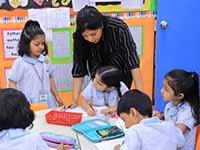
- At GIIS KL, one of the best schools in Kuala Lumpur, students benefit from a holistic curriculum that integrates academic, creative and critical thinking skills.
- GIIS KL offers international programmes including Cambridge International Primary Programme and CBSE, both of which encourage exploration across subjects including arts and sciences.
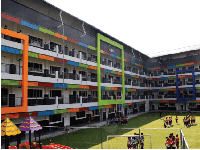
- Facilities and extra-curricular opportunities at GIIS KL allow students to explore creative expression alongside analytical studies such as mathematics.
These environments exemplify how student learning can flourish when math and art are woven together.
Practical Tips for Students: Enjoying Math Through Art
Whether you’re a learner or a parent, here are friendly ways to experience the beauty of the math–art relationship:
- Start with Patterns: Notice repeating shapes in nature, architecture or textiles.
- Try Symmetry Drawing: Fold paper and cut shapes to create mirrored art.
- Explore Fractals Online: Use digital tools to create fractal patterns.
- Measure and Create: Use rulers and compasses to construct precise art pieces.
These simple activities show that art mathematics in the modern world isn’t confined to textbooks — it’s everywhere around you.
Final Thoughts
The connection between math and art is not a coincidence — it’s a powerful testament to how creativity and logic enrich each other. From historical masterpieces to modern multidisciplinary classrooms, this relationship invites us to appreciate both subjects more deeply.
For families exploring educational options that nurture both analytical and creative abilities, GIIS KL, one of the top international schools in Kuala Lumpur, offers environments where students can thrive. With a holistic curriculum, strong academic support and diverse opportunities, GIIS KL exemplifies how learners benefit when mathematical thinking and artistic expression are given equal value.
Ready to see how your child can explore math and art together?
Schedule a campus tour or admissions consultation with us today — and watch your child’s creativity and logical thinking flourish!
FAQs
1. What are some examples of art in mathematics used in schools?
Projects like drawing symmetrical designs, creating fractals, and analysing geometric patterns in famous artworks help students see math through art.
2. How does learning math through art help students?
Combining art with math enhances engagement, makes abstract concepts tangible and supports both creative and logical thinking.
3. Why is the math and art connection important in modern education?
It encourages STEAM learning, where science, technology, engineering, art and mathematics are integrated to build critical 21st-century skills.